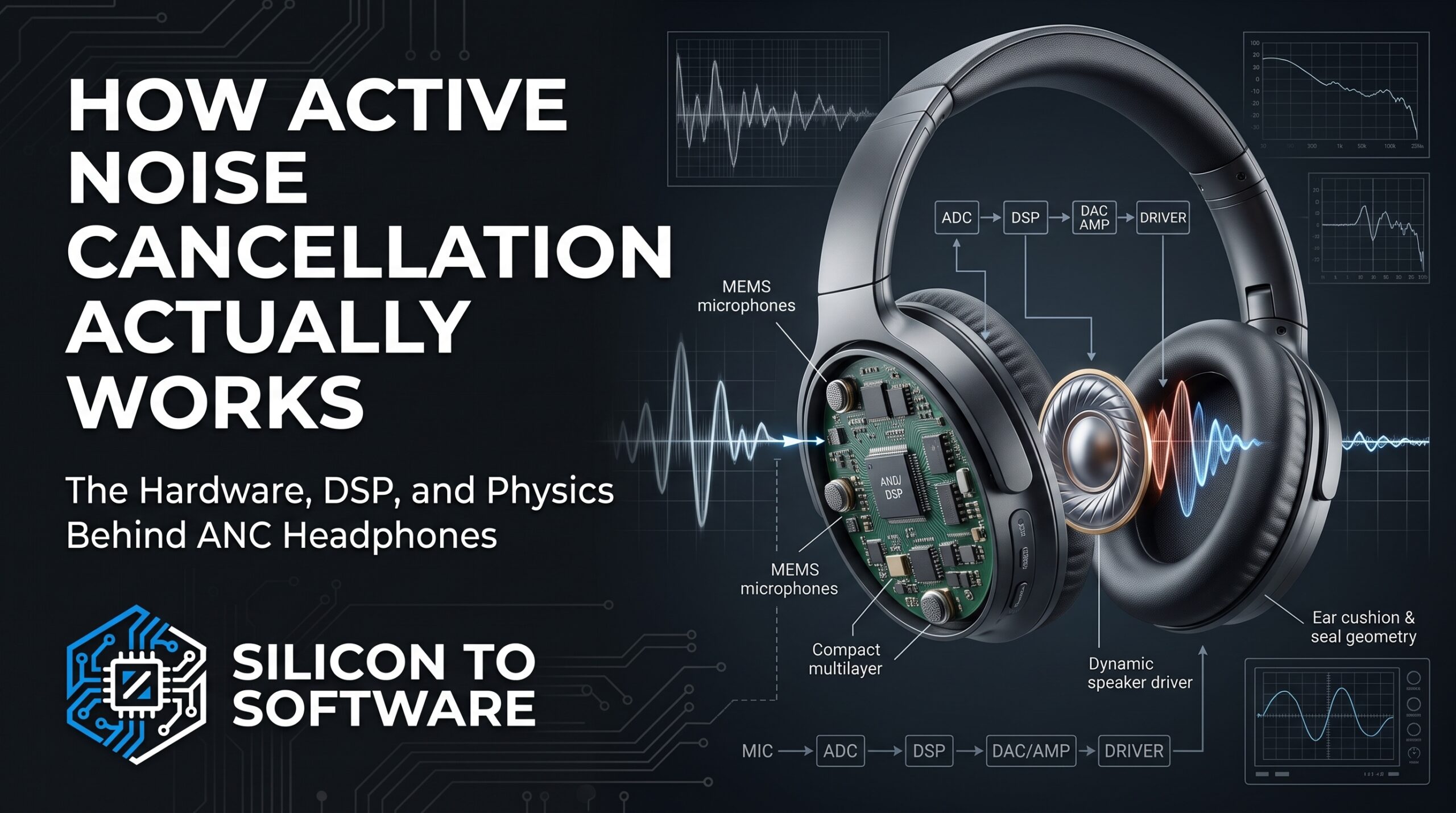
How Active Noise Cancellation Actually Works: The Hardware, DSP, and Physics Behind ANC Headphones
Inside the microphone-to-driver signal path, the destructive-interference mechanism, and the latency wall that keeps active noise cancellation from ever reaching perfect silence.
Table of Contents
Turn on active noise cancellation and your headphones don’t get quieter. They get louder — the driver adds a whole second waveform to the air in your ear canal, on top of whatever you’re already listening to.
That’s not a marketing footnote — it’s the entire operating principle, and it’s the piece most consumer coverage of ANC skips. To cancel a sound wave, the driver in your ear cup has to generate a second sound wave — inverted, and fast enough to arrive at your eardrum within a hair’s width of the noise it’s fighting. ANC headphones don’t block sound. They manufacture an opposing signal and race it against noise already in flight. Get the timing and amplitude right and the residual drops sharply. Miss them and cancellation weakens — or, at some frequencies, the two signals reinforce each other and you end up with more noise, not less.
That race is decided entirely by hardware: microphone placement, converter speed, filter compute time, driver response. This piece walks through the full signal path — from microphone to eardrum — the three primary ANC architectures manufacturers actually ship, the physical reason ANC crushes a jet engine but barely touches a nearby conversation, and the hard physical limits that mean no amount of silicon progress will get ANC to true silence under current transducer and control-loop physics.
Passive Isolation vs. Active Noise Cancellation: Two Different Engineering Problems
Passive isolation and active noise cancellation solve two different problems, and most consumer coverage collapses them into one spec.
Passive isolation is simple physics: foam, silicone, and the mass of the ear cup attenuate sound energy before it reaches your ear canal. A 100 Hz tone has a wavelength of roughly 3.4 meters, and conventional porous absorption at that frequency requires material thickness on that same order of magnitude — which is why the thin foam and silicone practical in a wearable device isolate high frequencies far better than low ones (U.S. Patent 10,692,483, “Active noise cancellation device and earphone having acoustic filter”). Denser passive approaches — mass-loaded barriers, tuned resonators, engineered acoustic structures — can do better at low frequency without matching wavelength scale, but they don’t fit in an ear cup’s size and weight budget, which is exactly the gap ANC is built to fill.
Active noise cancellation works by an entirely different mechanism: a control system. A microphone captures incoming noise, a signal chain inverts it, and the driver re-emits that inverted waveform alongside the audio you actually want to hear. Match the inverted wave to the original in amplitude and phase, and the two waves cancel at your eardrum. That’s destructive interference — an acoustics and control-systems problem wearing an audio-consumer costume.
Most ANC headphones still ship with passive isolation as a first line of defense — the ear tip seal, the cup padding — because active cancellation alone can’t cover the spectrum. (Open-ear and other non-occluding ANC designs, covered further down in the Latency Wall section, are a deliberate exception that trade passive isolation away entirely.) Rtings’ bench measurements illustrate why (Rtings.com, “Our Headphone Tests: Noise Isolation”): headphones consistently struggle with passive isolation in the bass range where engine and traffic noise live, and that’s precisely where the best ANC implementations pick up the slack, attenuating over 15 dB in that same range. In sealed designs, the two techniques aren’t redundant. They’re covering for each other’s blind spot.
This same complementary-systems logic shows up throughout hardware engineering — the same way passive heat sinking and active cooling divide labor in thermal management design. (Cross-link to our PCB thermal management coverage when that piece is live.)
The ANC Signal Path: Microphone to Driver in Under a Millisecond
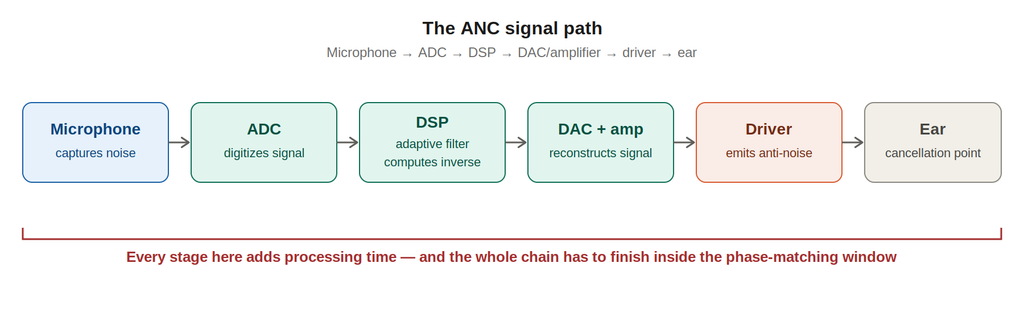
The ANC signal chain is a real-time embedded system fit into a space smaller than a matchbox:
Microphone → ADC → DSP/ANC algorithm → DAC/amplifier → driver → ear
- MEMS microphone. Captures ambient noise. Its self-noise floor and frequency response set the ceiling on how clean a cancellation signal the rest of the chain can ever produce.
- ADC (analog-to-digital converter). Digitizes the captured signal. Converter speed matters more than it looks like it should: U.S. Patent 9,412,356 (“Apparatus and method for non-occluded active noise shaping,” assigned to Doppler Labs, Inc.) notes that conventional sigma-delta ADCs and DACs “introduce hundreds of microseconds of delay,” which is why purpose-built low-latency ANC designs instead specify converters capable of sub-2-microsecond conversion times. Like the latency figures cited later in this piece, this is a patent-disclosed design target, not an independently verified measurement from a shipping product — worth flagging here since the assignee, Doppler Labs, ceased operations in December 2017 after its Here One earbuds underperformed commercially. The earbuds did ship, but whether this specific converter-latency design ever reached mass production at scale isn’t established by the patent alone.
- DSP / adaptive filter. Runs an adaptive filtering algorithm — commonly an LMS (least mean squares) variant or a derivative such as filtered-x LMS in the published research literature on ANC; commercial products from major headphone manufacturers generally use proprietary variants that aren’t publicly documented in this level of detail — to compute the inverted waveform in real time.
- DAC and amplifier. Reconstruct the inverted signal as an analog waveform.
- Driver. Reproduces the waveform physically, summing it acoustically with the incoming noise at your eardrum. The driver isn’t instantaneous either: the same patent shows measured phase shift between a speaker’s electrical input and its acoustic output growing from small at low frequencies to nearly 180 degrees above the driver’s natural resonant frequency.
Every stage in that chain adds processing time — and every microsecond added there is a microsecond stolen from the phase-matching window the whole system depends on. It’s less like matching trace lengths for signal skew and more like meeting a timing-closure budget on a single critical path: the whole chain has to finish inside its window, not just stay in sync with a parallel one.
Three ANC Architectures: Feedforward, Feedback, and Hybrid
There isn’t one ANC architecture. There are three, and each makes a different bet about where to place the microphone and how fast it needs to react.
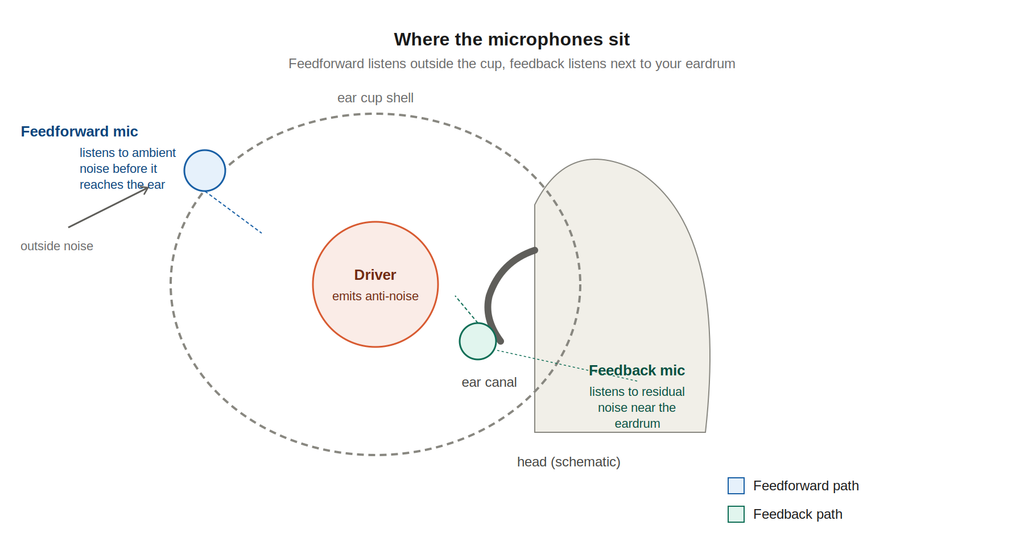
Feedforward ANC
Puts the microphone outside the ear cup, listening to ambient noise before it reaches your ear. Published research on ANC-equipped hearing devices documents that feedforward ANC “proves effective primarily for stationary, low-frequency sounds below 1 kHz,” precisely because it reacts to the reference noise early, before the signal path to the ear does anything unpredictable to it (arXiv preprint — not yet independently confirmed as peer-reviewed — “Advances in Intelligent Hearing Aids: Deep Learning Approaches to Selective Noise Cancellation”).
Feedback ANC
Puts the microphone inside the ear cup, next to your eardrum, listening to what’s actually left after passive isolation and the driver have already done their work. It corrects residual noise more accurately, but it’s a closed loop reacting to a signal that already includes the driver’s own output — which makes it far more sensitive to instability.
That’s not a hypothetical risk. U.S. Patent 8,792,670 B2 (“Loudspeaker and system for active noise cancellation,” originally assigned to ams AG) states that “in the case of a phase shift of greater than 180°, the negative feedback transforms into feed forward and the feedback loop begins to oscillate,” and that a larger physical distance between the loudspeaker and microphone directly causes a larger phase shift. The fuller picture, per standard feedback-control theory: sustained oscillation requires both that phase condition and loop gain at or above unity at the same frequency — when phase crosses 180 degrees at a frequency where gain hasn’t dropped below that threshold, negative feedback effectively becomes positive feedback, and the loop oscillates. Engineers coming from analog or power-supply design will recognize the underlying logic as the same gain-and-phase-margin discipline that governs op-amp and switching-regulator loop compensation, even though the specific Nyquist-style stability analysis differs in its particulars from an oscillator’s Barkhausen condition.
Hybrid ANC
Combines both. Calling it a premium feature misses the point — it’s the industry’s practical concession that neither approach alone works well enough. Peer-reviewed research on hybrid feedforward-feedback active noise reduction — tested in 2006 on a circumaural earcup and a communication earplug built for hearing protection, not modern consumer headphones — found the combined architecture improved gain stability margins over either component acting alone, and separately found improved low-frequency (below 100 Hz) noise-reduction performance of up to 15 dB over either single approach (peer-reviewed study, Dartmouth Thayer School of Engineering, via PubMed). Those are two distinct findings, not one number describing both — the study reports a stability-margin improvement and a separate, quantified attenuation improvement. Extrapolating either finding to today’s consumer hybrid ANC designs is a reasonable engineering inference, not a direct measurement of any shipping headphone. The cost of going hybrid is real regardless: additional external and internal microphone channels to sense both sides of the loop, more DSP load, more power draw, more bill-of-materials expense.
Destructive Interference: Why Amplitude and Phase Determine Cancellation
Cancellation isn’t just about generating an opposite sound. Its amplitude and phase both have to be right — get either wrong and you don’t get silence; you get a partial result at best.
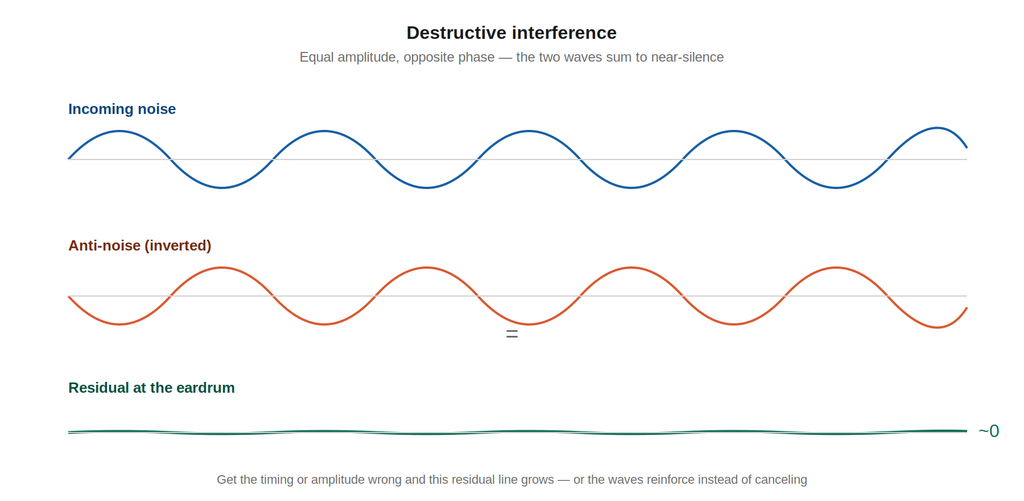
Two sound waves of equal amplitude and opposite phase sum to silence at the point they meet. Real ANC systems have to create that relationship after accounting for the frequency-dependent transfer functions of the microphone, electronics, driver, enclosure, and acoustic path. None of those elements behaves like an ideal zero-delay component, and their combined magnitude and phase response changes with frequency. The controller therefore works against measured or modeled transfer functions for the actual hardware rather than assuming the transducers naturally provide the required phase relationship.
Phase error is a major limitation in ANC — not the only one; reference-signal coherence, primary/secondary path modeling accuracy, adaptation speed, and acoustic leakage all matter too — and it scales with frequency for a fixed processing delay, because a fixed time delay represents a larger fraction of a shorter wavelength. This relationship — fixed delay, frequency-dependent phase error — is a major reason the same hardware that comfortably silences a jet engine struggles badly against a raised voice.
Frequency Dependence: Why ANC Beats a Jet Engine but Loses to a Conversation
Low-frequency, steady-state noise — jet engine drone, HVAC hum, road rumble — is the easiest target for ANC’s own contribution, even though it’s rarely the loudest number on a spec sheet. Independent bench testing illustrates the gap concretely: for the Logitech Zone Wireless headset, Allion Labs measured active noise control alone contributing more than 2 dB of attenuation below 600 Hz. Allion’s published data also shows the active system’s own contribution around 230 Hz as roughly “-10 dB attenuation” — their own wording, which the page doesn’t define precisely enough to convert into a confident directional claim on its own. The useful takeaway is the shape of the response rather than that single ambiguous number: active electronics contribute unevenly across the low-frequency band, and at some points that contribution is small enough that passive isolation and system-level tuning are doing most of the real work. Passive isolation did the bulk of the work at high frequency in that same test, reaching over 30 dB by 7 kHz on its own — worth separating out, since the strong high-frequency numbers headphone marketing likes to cite are usually passive isolation’s doing, not the active electronics’ (Allion Labs, “Measuring the Efficiency of Noise Cancellation of Active Noise Canceling Headphones”). SoundGuys puts the marketing-spec problem plainly: a headline “30dB noise reduction” figure “doesn’t tell the whole story,” because headphones “don’t attenuate all noise frequencies equally” (SoundGuys, “How to read audio charts”).
Speech and other transient, higher-frequency sound sit on the harder end of this same curve. It’s non-stationary — words start and stop, and consonant energy carries well up into the kHz range where a fixed loop delay produces much larger phase error. Speech is a structurally harder control target for every ANC system built this way — that’s a physical constraint, not a euphemism for bad engineering — but microphone placement, path modeling, and controller design still determine how much of that gap a given product closes, which is exactly why some implementations handle a nearby conversation better than others.
The ANC “Pressure” Sensation: What’s Physical, What’s Perceptual
Users routinely describe ANC as creating a “pressure” sensation in the ears — something being pushed or sucked. Patent documentation acknowledges this as a real, recognized phenomenon, though the scale isn’t independently measured: U.S. Patent 9,978,357 B2 (“Headphones with active noise cancellation adverse effect reduction,” assigned to Plantronics, Inc.) states, in its own unquantified characterization of the problem it aims to solve, that “a large portion of users of active noise canceling (ANC) headphones… experience an unpleasant ‘vacuum’ or ‘suction’ sensation when the ANC is activated,” and that for some users it produces headache and dizziness. That’s the patent applicant’s own framing of the problem it’s solving — useful as confirmation the phenomenon is real and recognized in the industry, not as a measured prevalence statistic; no percentage or study methodology backs “a large portion.”
A genuinely adjacent, peer-reviewed body of research exists on the occlusion effect — the well-documented change in an occluded ear canal’s sound pressure that makes a wearer’s own voice sound “boomy,” with measured sound-pressure-level boosts of roughly 15–32 dB at low frequencies (IEEE/ACM Transactions on Audio, Speech, and Language Processing, “Occlusion Effect Cancellation in Headphones and Hearing Devices — The Sister of Active Noise Cancellation”). That’s an oscillating acoustic sound-pressure-level effect, measured in dB — a fundamentally different physical quantity from the static or quasi-static pressure differential people associate with ear-popping on an airplane. It confirms sealing an ear canal changes acoustic sound pressure at low frequency, but it’s a physically distinct phenomenon from the “vacuum” sensation specific to ANC switching on, and shouldn’t be conflated with either that sensation or with a static pressure change.
For the ANC-specific sensation itself, the best available account remains independent reporting rather than a clinical study: a physical test rig built to measure in-ear pressure with ANC on and off found no detectable pressure change, and an audio engineer consulted for that reporting described the sensation as psychosomatic (SoundStageSolo, “Eardrum Suck: The Mystery Solved!”). No peer-reviewed source addressing this specific ANC-toggle sensation turned up in our research — a gap worth disclosing rather than papering over.
The Latency Wall: The Physical Constraint Behind ANC’s Ceiling
The entire loop — capture, convert, filter, reconstruct, re-emit — has to complete fast enough for the anti-noise signal to matter by the time it reaches the eardrum. That constraint takes a different shape depending on architecture: feedforward ANC has a strict causality requirement — peer-reviewed research on feedforward ANC headsets frames it precisely as the primary acoustic path delay (reference microphone to ear) needing to exceed the secondary path delay (controller processing plus driver-to-ear acoustic delay), or the controller can’t generate a causal response in time (Zhang & Qiu, “Causality study on a feedforward active noise control headset with different noise coming directions in free field,” Applied Acoustics, 2014). Feedback ANC, discussed above, faces a related but distinct constraint: processing and acoustic delay eat into loop phase margin rather than breaking causality outright, which is why it fails via oscillation rather than simply arriving late. Sound travels through air at roughly 343 meters per second; peer-reviewed work on an open-ear feedforward-style wearable device puts real acoustic-path delays in the range of a few hundred microseconds for that specific geometry, which illustrates the scale of the budget involved even though the exact number shifts with architecture and form factor.
Research on open-ear wearable ANC puts a number on that budget directly: the acoustic propagation delay between an ear-worn microphone and the ear canal is “typically less than a few hundred microseconds,” and any additional processing delay beyond that window “introduces phase errors that degrade cancellation” (arXiv preprint — not yet independently confirmed as peer-reviewed — “Active noise cancellation on open-ear smart glasses”). This is the specific acoustic engineering challenge sitting underneath a broader hardware story: audio-first AI glasses are the smart-glasses subcategory that’s actually reached commercial maturity, precisely because they sidestep the harder optical and thermal constraints — but they still have to solve ANC without the sealed ear cup a traditional headphone relies on.
U.S. Patent 8,848,935 B1 (“Low latency active noise cancellation system”) states the design target explicitly: total latency “can be less than or equal to 100 microseconds,” and “in some embodiments, this latency can be less than or equal to 50 microseconds.” That figure is a patent-disclosed design target, not a verified measurement of any shipping product — evidence of the scale of the problem, not a spec you can shop by.
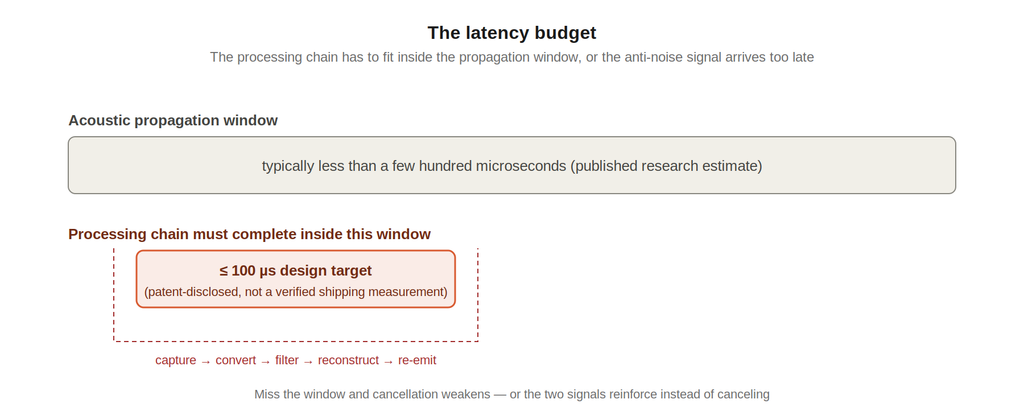
The same patent is direct about what happens when the budget is missed: excessive latency in a feedforward system “makes the anti-noise signal arrive too late to effectively cancel the noise signal, resulting in unsatisfactory cancellation at higher frequencies,” while excessive latency in a feedback system “can cause the closed-loop system to become unstable when the feedback gain is increased” — forcing designers to cap gain and accept weaker attenuation instead.
Newer silicon is putting more compute against related constraints. Apple states that machine learning on its H2 chip actively reduces louder, more intermittent environmental noise 48,000 times per second — specifically as part of Hearing Protection, a feature aimed at loud transient sounds like concerts, sirens, and power tools, distinct from the everyday ANC loop this piece has been describing (Apple, AirPods Pro Hearing Health documentation). It’s a company-stated architectural claim, not an independently measured latency or attenuation figure, and not, on its own, confirmation of a specifically predictive (look-ahead) architecture rather than a fast adaptive one. Worth noting: 48,000 Hz is also the standard consumer digital-audio sample rate, so the figure alone doesn’t establish anything beyond processing at ordinary audio sampling speed — it says nothing on its own about the loop’s actual end-to-end latency against the microsecond budget described above. It’s the same kind of spec-sheet caution that applies to edge AI processing claims generally: Apple’s M4 Neural Engine “38 TOPS” figure turns out to be a doubled FP16 number presented as an INT8-equivalent rate, not an independently measured benchmark — a different chip, the same pattern of a real number that doesn’t establish what the marketing implies it does. More sophisticated real-time processing plausibly helps within that budget, whichever specific feature it’s applied to. It doesn’t repeal the underlying propagation-delay physics. It works inside it.
Why Perfect Silence Isn’t Coming: Four Converging Hardware Limits
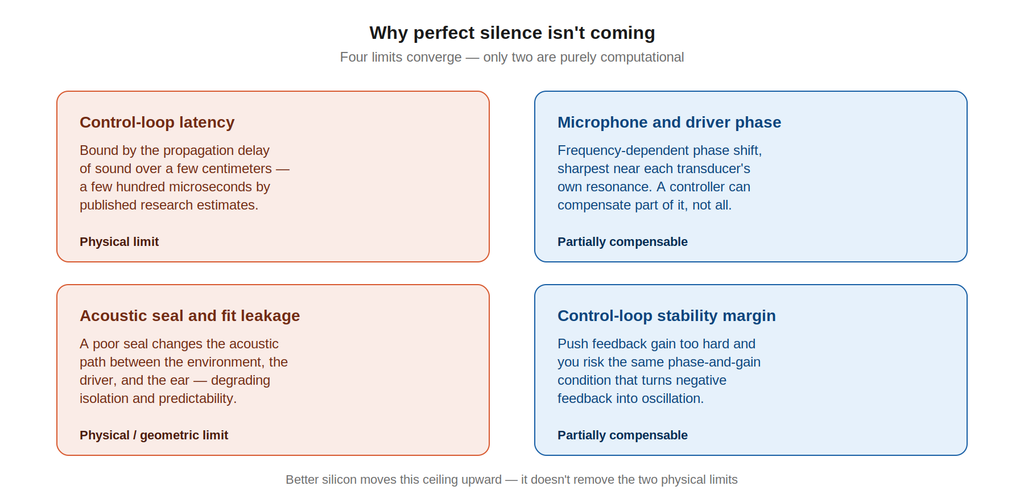
- Control-loop latency — bound by the propagation delay of sound over a few centimeters, on the order of a few hundred microseconds, by published research estimates. Faster silicon and more sophisticated real-time processing shrink the effective impact, but don’t remove the underlying delay.
- Microphone and driver phase behavior — both introduce phase shift that’s frequency-dependent, growing sharpest near each transducer’s own mechanical resonance — a property of the physical parts themselves. A controller can compensate part of that behavior through modeling, but only within its own causality, bandwidth, and stability limits, not by eliminating it outright.
- Acoustic seal and fit leakage — a physical, geometric problem. A poor seal changes the acoustic path between the environment, the driver, and the ear canal, degrading passive isolation and making the acoustic environment the ANC controller was tuned for less predictable — noise that leaks around the seal isn’t reliably captured or compensated by either microphone position.
- Control-loop stability margin — push feedback gain too aggressively chasing better cancellation and you risk the same phase-and-gain condition documented in ANC loudspeaker patent filings, where a large enough phase shift at sufficient loop gain turns negative feedback into oscillation.
Better silicon and more capable real-time processing will keep moving this ceiling upward, and Apple’s own generational claims suggest real, if company-reported, progress. They will not remove the ceiling entirely, because two of these four limits — propagation delay and seal leakage — are physical and geometric, not purely algorithmic. The next generation of ANC chips will not fix a headphone that doesn’t seal properly against your ear, and no amount of machine learning changes how fast sound travels through air.
ANC doesn’t fail because the software isn’t good enough yet. It fails at the edges because physics sets a ceiling that computation can approach, but never fully clear.
A note on perspective: this breakdown draws on two decades of PCB manufacturing and technical sales experience across Bay Area hardware programs. The relevant discipline isn’t just signal-integrity theory — it’s the practical DFM reality that every one of the ANC constraints described above has to survive contact with mass production. A control-loop stability margin that looks fine on a reference design still has to hold up across manufacturing tolerance on mic sensitivity, driver resonance, and ear-tip seal geometry, unit to unit. Published ANC calibration patents describe exactly this kind of correction — measuring each unit’s actual acoustic response against a reference and computing a gain correction factor to compensate for it — which is why ANC manufacturing can lean on per-unit end-of-line acoustic calibration to compensate for driver, microphone, and assembly variation rather than relying entirely on a one-size-fits-all filter, not because every product on the market necessarily does. It’s the same category of tolerance-stack problem that shows up in board-level DFM review, just measured in ear cups instead of layers.
About the Author
Imran Valiani | Sales Director, PCB Electronics Manufacturing
20+ years working with major Bay Area and global tech clients. Founder of Silicon to Software, where I write about the hardware layer — PCB fab, AI gear, autonomous systems, and cyber — the stuff most tech writers have never touched. Literally.
Follow: X @SiToSoftware | LinkedIn
For more analysis of embedded hardware, electronics, and system-level engineering constraints, explore the Embedded Systems & Electronics Engineering Resource Hub.
This article was developed with AI assistance and edited, fact-checked, and reviewed by the author. See my full AI disclosure.
Sources
- U.S. Patent 10,692,483 — “Active noise cancellation device and earphone having acoustic filter” Google Patents / USPTO https://patents.google.com/patent/US10692483
- RTINGS.com — “Our Headphone Tests: Noise Isolation” RTINGS.com https://www.rtings.com/headphones/tests/noise-isolation-cancellation-passive-active
- U.S. Patent 9,412,356 — “Apparatus and method for non-occluded active noise shaping” (assigned to Doppler Labs, Inc.) Google Patents / USPTO https://patents.google.com/patent/US9412356
- “Advances in Intelligent Hearing Aids: Deep Learning Approaches to Selective Noise Cancellation” arXiv preprint, 2025 (not independently confirmed as peer-reviewed) https://arxiv.org/abs/2507.07043
- U.S. Patent 8,792,670 B2 — “Loudspeaker and system for active noise cancellation” (originally assigned to ams AG) Google Patents / USPTO https://patents.google.com/patent/US8792670B2/en
- Ray, L.R., Solbeck, J.A., Streeter, A.D., Collier, R.D. — “Hybrid feedforward-feedback active noise reduction for hearing protection and communication” Journal of the Acoustical Society of America, Vol. 120, Issue 4, 2006. DOI: 10.1121/1.2259790 https://pubmed.ncbi.nlm.nih.gov/17069300/
- Zhang, M., Qiu, X. — “Causality study on a feedforward active noise control headset with different noise coming directions in free field” Applied Acoustics, Vol. 80, 2014 https://www.sciencedirect.com/science/article/pii/S0003682X1400005X
- Allion Labs — “Measuring the Efficiency of Noise Cancellation of Active Noise Canceling Headphones” Allion Labs (measurements of the Logitech Zone Wireless headset) https://www.allion.com/anc-headphone/
- SoundGuys — “How to read audio charts: Everything you need to know” SoundGuys https://www.soundguys.com/how-to-read-charts-23129/
- “Occlusion Effect Cancellation in Headphones and Hearing Devices — The Sister of Active Noise Cancellation” IEEE/ACM Transactions on Audio, Speech, and Language Processing, 2022 https://signalprocessingsociety.org/publications-resources/ieee-transactions-audio-speech-and-language-processing/2022/01/occlusion
- SoundStageSolo — “Eardrum Suck: The Mystery Solved!” Independent reporting (not peer-reviewed research): https://soundstagesolo.com/index.php/features/178-eardrum-suck-the
- “Active noise cancellation on open-ear smart glasses” arXiv preprint, 2026 (not independently confirmed as peer-reviewed) https://arxiv.org/abs/2604.05519
- U.S. Patent 8,848,935 B1 — “Low latency active noise cancellation system” Google Patents / USPTO https://patents.google.com/patent/US8848935B1/en
- Apple — “AirPods Pro 3 — Hearing Health” Apple (source for the 48,000-times-per-second Hearing Protection / Loud Sound Reduction claim; not a specification for the standard ANC loop) https://www.apple.com/airpods-pro/hearing-health/
- U.S. Patent 9,978,357 B2 — “Headphones with active noise cancellation adverse effect reduction” (assigned to Plantronics, Inc.) Google Patents / USPTO https://patents.google.com/patent/US9978357B2/en
- TechCrunch — “Smart earbuds startup Doppler Labs shuts down after raising $50M+” TechCrunch, Nov. 1, 2017 https://techcrunch.com/2017/11/01/smart-earbuds-startup-doppler-labs-shuts-down-after-raising-50m/