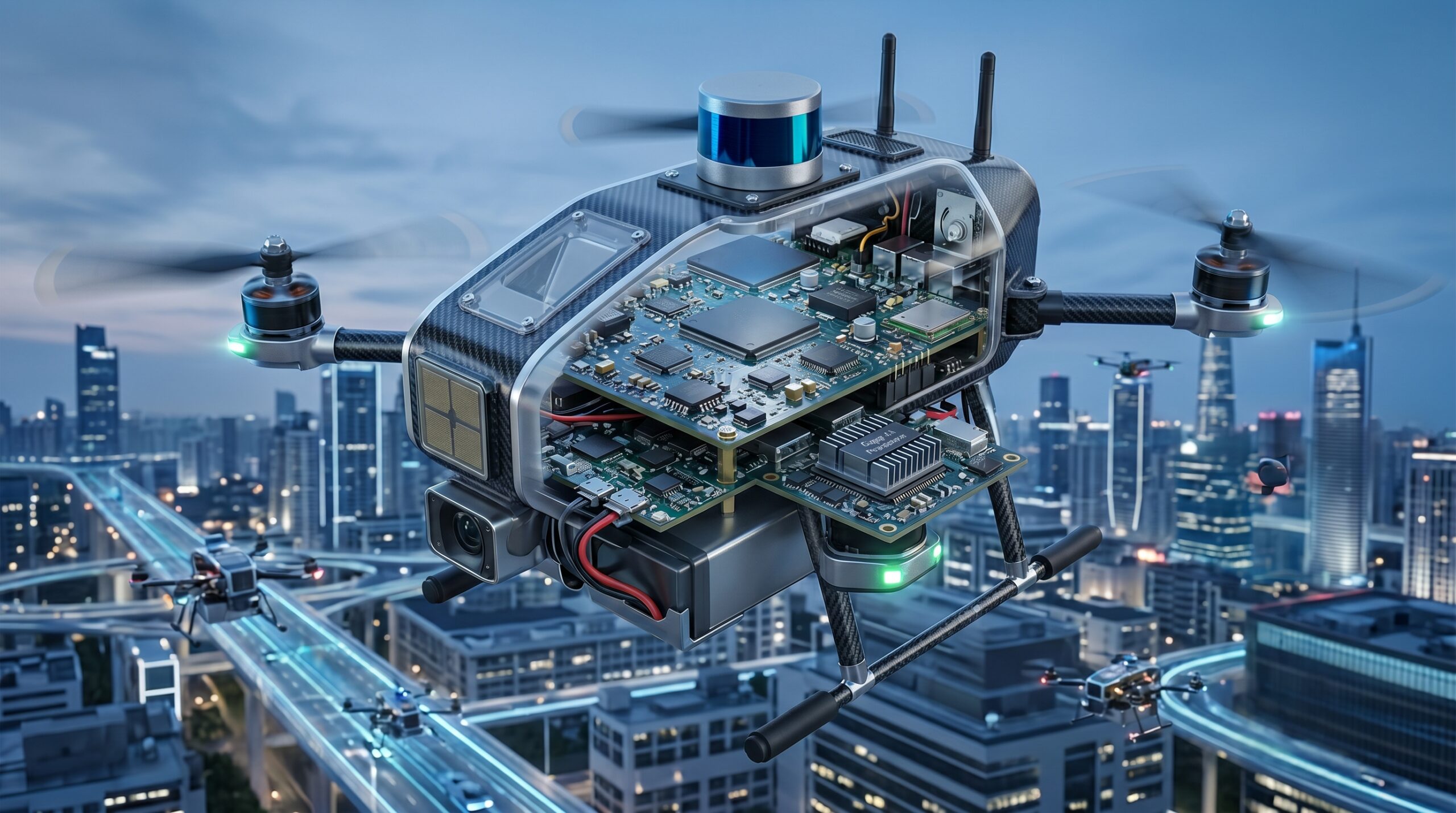
Delivery Drone Safety Hardware: 6 Critical Systems Preventing Mid-Air Failures, Crashes, and Injuries
Delivery drone safety hardware is the only thing standing between a 10-pound autonomous aircraft and your neighborhood. From redundant flight controllers and AI-powered obstacle detection to aviation-grade sensors and battery safety systems — here’s the engineering keeping delivery drones safe in crowded skies.
Table of Contents
Let me start with a crash — because delivery drone safety hardware is only as good as the worst failure it couldn’t prevent.
October 1, 2025. Two Amazon Prime Air MK30 drones hit a crane in Tolleson, Arizona — around 10 a.m. local time, per the FAA’s own statement to local authorities. Both drones took what the FAA’s preliminary report called “substantial” damage. The FAA and the NTSB opened formal probes. Amazon pulled deliveries. And an old, uncomfortable question came back: are we actually ready for this?
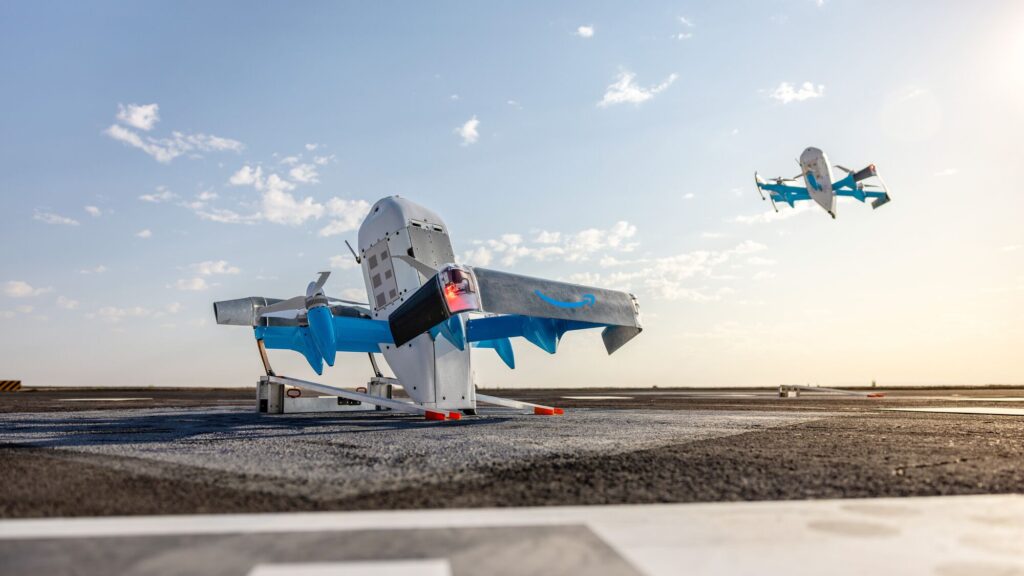
I think most people read that headline and moved on. They shouldn’t have.
This wasn’t a one-off. Not even close. Amazon’s drone fleet had already logged at least eight crashes across a 13-month stretch around 2021 — one burned acres of land (Bloomberg, via TechCrunch, January 2025). Two more MK30s went down in December 2024 at the Pendleton, Oregon test site after bad rain messed with their LiDAR sensors. Then in early 2026, a Prime Air drone plowed into an apartment building in Richardson, Texas. Props still spinning on impact. A resident called it in after smelling smoke.
Here’s the thing, though. None of this means the tech is dead. It means the safety gear inside these machines is getting stress-tested by the real world — hard — and the people who build them are scrambling to keep up.
So let me walk you through what’s actually in these drones — specifically the delivery drone safety hardware that stands between a malfunction and a serious injury — what breaks, and what the hardware teams are doing about it.
Why Hardware Failures Happen at All
Actually, before I explain the general problem — let me start with the specific one. The crane.
The FAA and NTSB investigation into Tolleson was still open as of this writing, so the official root cause hasn’t been established. But the type of collision — two drones hitting a piece of equipment that wasn’t there when the flight was planned — points at a well-known engineering problem: dynamic obstacle detection. Cranes move. Sites change. A map built last week doesn’t know that a 150-foot boom swung into the flight path this morning. Amazon’s own post-incident response leaned the same direction, promising “enhanced visual landscape inspections to better monitor for moving obstructions such as cranes.” That’s a process patch, not a fix.
The fix lives in delivery drone safety hardware.
Now, for the bigger picture: delivery drones aren’t hobby quads with a GoPro. They’re real aircraft — operating Beyond Visual Line of Sight (BVLOS), typically under 400 feet AGL, in shared airspace under the FAA’s UAS Traffic Management (UTM) framework. A Remote Pilot in Command (RPIC) and a Ground Control Station (GCS) stay in the loop, as required by FAA BVLOS approval rules. But the drone itself is making most of the moment-to-moment calls — millisecond to millisecond, deciding whether to go, reroute, or land. Not a human, in the routine case. How much autonomy the aircraft actually holds varies by operator and by the specific waiver it’s flying under.
I’ve noticed that this surprises people more than it should.
Delivery Drone Safety Hardware Layer 1: The Flight Controller That Can’t Fail
Start here: the flight controller is the onboard computer that reads sensor data, runs the flight math, and fires commands to the motors. Not the only one — many safety-focused UAV architectures use redundant flight-control paths and degraded operating modes, but the exact implementation varies by aircraft. But every layer of backup has a limit. Run out of layers, and the drone falls.
I’ve found that most people hear “redundant systems” and think that means they don’t have to worry. It doesn’t. Redundancy isn’t “plug in a spare.” Two or three flight controllers have to run in sync, cross-check each other’s outputs in real time, and hand off fast enough to hold stable flight — because even a small jerk in control output during a switchover can put the drone into a spin recovery logic can’t catch. That needs synced clocks, rock-solid firmware, and careful handling of what engineers call IMU (Inertial Measurement Unit) disagreement — when two sensors give you slightly different numbers on speed or angle.
Reference and open-source flight-controller architectures — the Pixhawk/PX4/ArduPilot ecosystem — typically carry three IMU modules, running a sensor fusion algorithm — usually an Extended Kalman Filter (EKF) or Unscented Kalman Filter (UKF) — that weighs all three inputs and spots drift.
Now here’s the part that makes your head hurt a little. Per Embedded.com’s deep-dive on UAV IMU design, flight control loops run at 100 Hz to 1,000 Hz. The system corrects its flight path every 1 to 10 milliseconds. IMUs run above 1,000 Hz to stay ahead of that. Peer-reviewed security research on ArduPilot’s EKF (USENIX VehicleSec 2025, ConfuSenSe; arXiv:2410.11131) shows the Kalman Filter defaults to 400 Hz — a 2.5 ms cycle — and if sensor input falls below that, the whole task queue stalls. Attitude control. Crash detection. Everything. One bad sensor drags the whole loop to a stop.
That’s the failure mode. That’s what triple-IMU redundancy — documented in reference flight-controller architectures — exists to prevent. Proprietary commercial fleets don’t publicly disclose their IMU counts, so this shouldn’t be read as a universal commercial-drone spec — but the underlying failure mode it protects against is real regardless of which fleet you’re looking at.
On the other hand, maybe I’m wrong to frame this as purely a software problem. I think the chip beneath it matters just as much. The Cortex-M7 class chips running most Pixhawk-based gear today are starting to show limits at scale — which is why higher-end platforms are moving toward dual-core Asymmetric Multiprocessing (AMP) silicon (think TI Sitara AM6x or STM32MP1/MP2 lines). AMP splits the hard real-time flight loop from communications I/O onto separate cores, so they don’t fight for time. The open-source and reference-design ecosystem today still runs mostly on STM32H7-class chips. But AMP-class silicon is where next-gen delivery drone safety hardware platforms are going. (Amazon’s and Zipline’s actual production silicon isn’t public — this is the documented open-source baseline, not a claim about proprietary commercial fleets.)
Delivery Drone Safety Hardware Layer 2: LiDAR, Radar, and Vision Working Together
I know what you’re thinking about delivery drone safety hardware — just use better sensors, right? Not that simple.
Here’s the core issue with delivery drone safety hardware sensors: no single sensor works well in all conditions. Period.
- LiDAR is great in dry air. Crisp, centimeter-level range data. Rain? Snow? Fog? Water drops scatter the laser — you get attenuation, backscatter, multipath effects, and bad readings. That’s consistent with what happened at Amazon’s Pendleton, Oregon site in December 2024, where Amazon attributed the failure to LiDAR performance in rain.
- Millimeter-wave radar cuts through rain just fine. Lower detail than LiDAR, though. And whether it catches a moving object depends on signal processing, the radar cross-section (RCS) of the target, and how much clutter is in the scene. Good against big, moving things like crane booms. Not great. It’s a toss-up versus LiDAR in many clear-sky cases.
- Computer vision / stereo cameras give you semantic smarts — a CNN (convolutional neural network) can tell a crane from a bird. But it chokes in low light, glare, or — as the Richardson crash suggested — low-contrast surfaces like stucco walls or glass that don’t stand out to the sensor even in decent light.
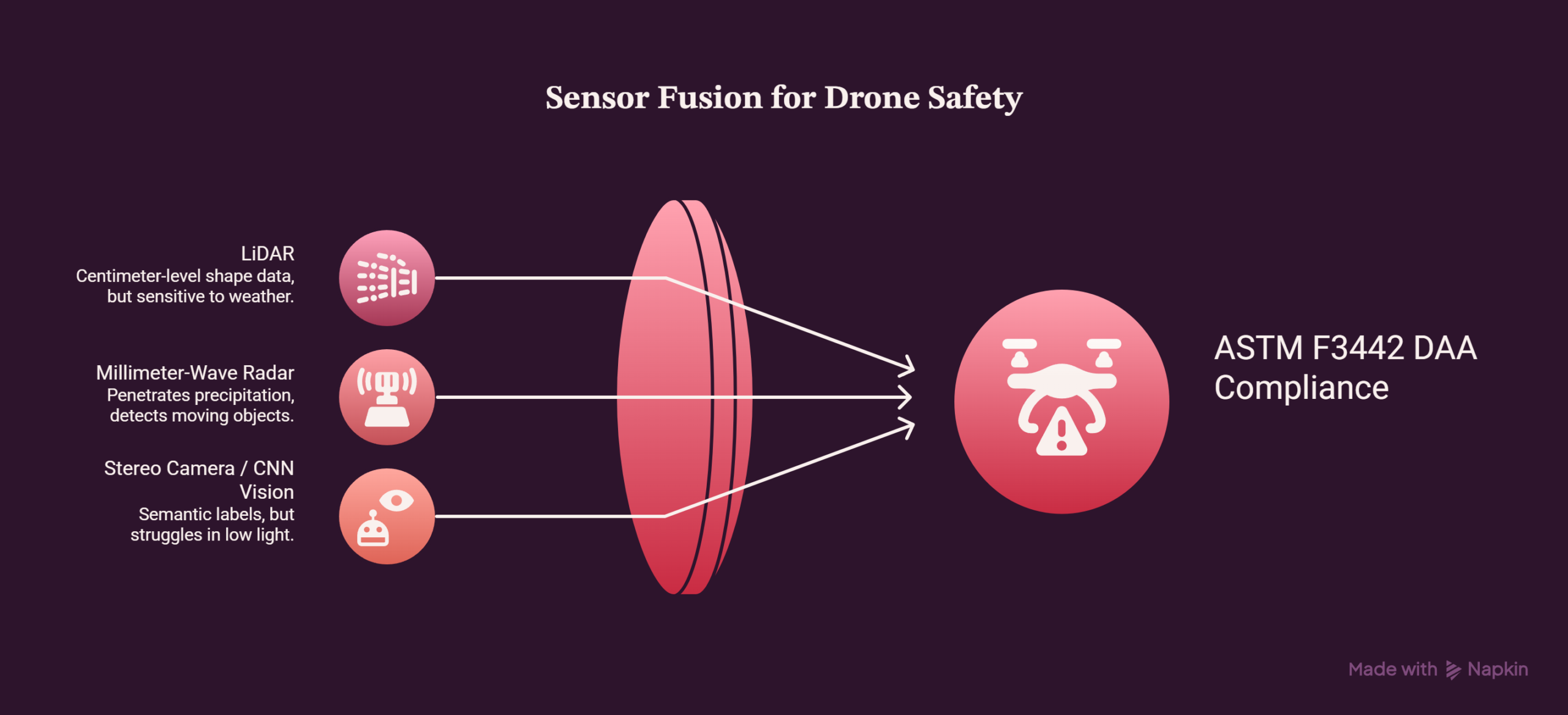
None of them is the answer on its own. You fuse all three.
Per published research on multi-sensor fusion for drone navigation (GreyB/xray.greyb.com, Autonomous Navigation of Drones, September 2025), a layered map pools radar, LiDAR, cameras, and an IMU — radar gives rough density, LiDAR gives shape, vision gives meaning. Together the drone knows: “that’s a crane, it moved, go around.” Alone, no single sensor can tell you that reliably.
This all feeds into what the FAA and ASTM International call Detect and Avoid (DAA) — a system-level capability that’s become central to how delivery drone safety hardware gets evaluated. ASTM F3442 is the reference performance standard the FAA increasingly points to in BVLOS waiver and rulemaking discussions. It’s not a blanket legal requirement for every current operator, but it’s the bar sensor hardware gets measured against as the regulatory framework matures. The same sensor fusion challenge — LiDAR, radar, and vision working together under real-world conditions — is something we covered in depth in our piece on autonomous driving PCB engineering and AI safety systems.
I’ve spent 20 years in PCB manufacturing and I’ll be honest — the part of this most tech writers skip entirely is the board under all these sensors. The boards running these pipelines operate under vibration, heat cycles, and altitude swings that consumer electronics will never see. Many high-reliability UAV platforms target IPC-6012 Class 3 — a high-reliability printed-board performance classification. Class 3 sets tighter board-level performance requirements than consumer-grade classifications, including minimum copper plating in via barrels — typically around 25 µm depending on board type and spec revision — to stop via-barrel cracks from vibration and heat. Not every drone operator has published their PCB qualification level. The FAA doesn’t make it mandatory. But the physics don’t care about the paperwork. A 400 Hz EKF running on data corrupted by a cracked via under the IMU is just doing math on noise. The board is not separable from the sensor. For a deeper look at how laminate selection affects signal integrity at this level, see our breakdown of high-speed laminates for AI hardware.
The compute load behind all this needs two separate tiers — both documented in the open-source UAV world, not speculation. Worth saying upfront: this is the reference architecture from the PX4/Dronecode ecosystem, not a confirmed description of what’s actually flying inside Amazon’s or Zipline’s aircraft — their production silicon is proprietary and undisclosed. What follows is the documented pattern, not a claim about any specific commercial fleet.
Tier 1 — Flight Controller MCU: Your STM32H7-series chip (STM32H743 or H753, up to 480 MHz) in a Pixhawk-standard controller, or the NXP i.MX RT1176 in the newer FMUv6X-RT. Runs PX4 or ArduPilot. Handles attitude control, EKF, motor output. Built for real-time determinism. Not brute-force compute.
Tier 2 — Companion Compute SoC: Separate, higher-power board handles vision, edge AI inference, SLAM, and obstacle logic. The PX4/Dronecode community, Seeed Studio, and ARK Electronics all document NVIDIA Jetson modules connected to PX4 via MAVLink over UART as the standard setup for this. Jetson sees the world. STM32 flies the drone. This two-tier structure itself is verifiable, even where the specific silicon inside any one commercial product isn’t.
Delivery Drone Safety Hardware Layer 3: Battery Management Nobody Talks About
I think batteries are the most under-discussed delivery drone safety hardware issue in this whole space. Not glamorous. But important.
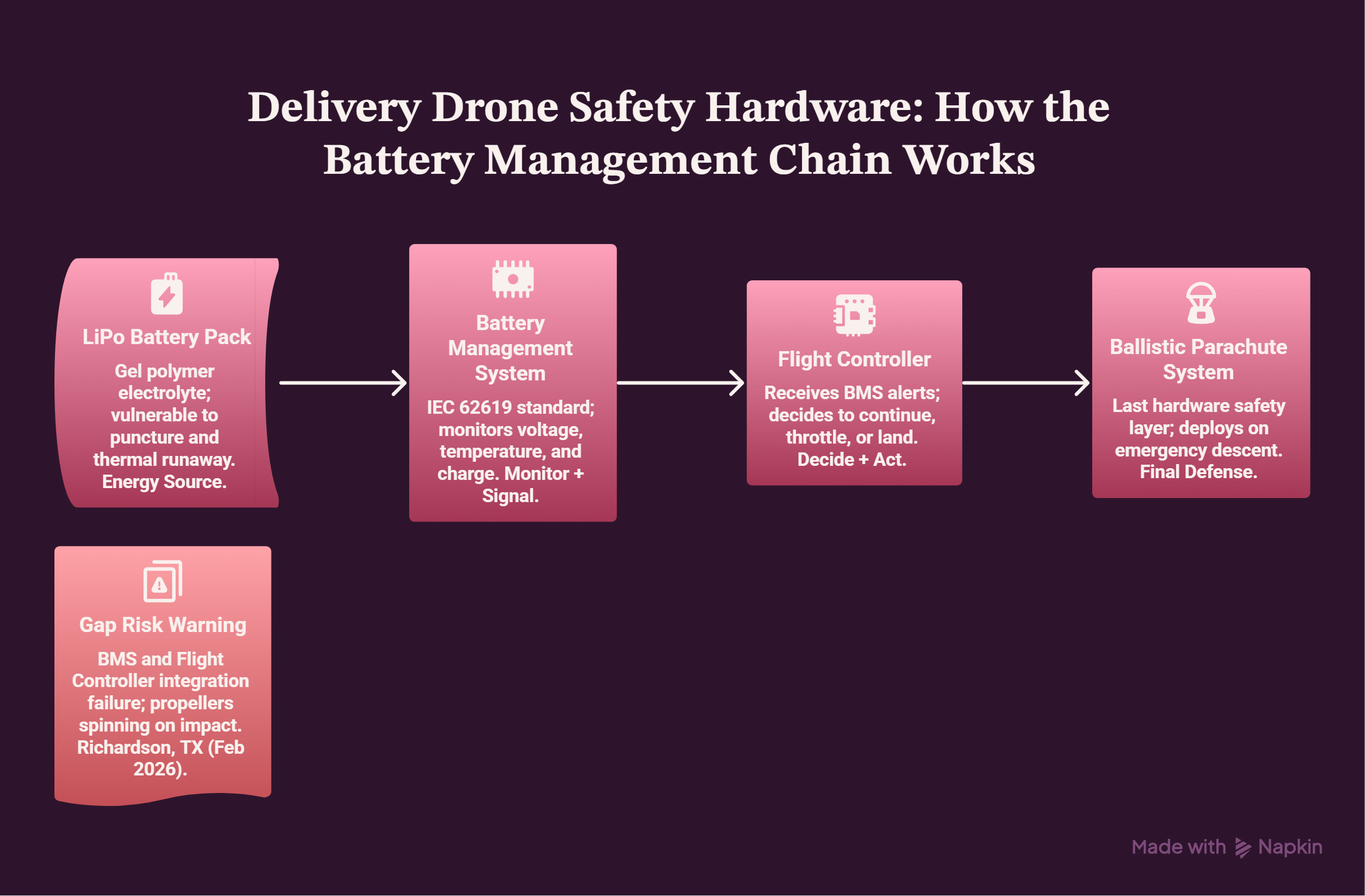
Many UAV platforms run on Lithium Polymer (LiPo) pouch packs — a form of lithium-ion chemistry that uses a gel polymer electrolyte instead of a liquid. LiPo isn’t a different chemistry than Li-ion; it’s a structural variation of the same thing. But the structure matters in a crash. LiPo pouch cells don’t have the hard metal shell that cylindrical Li-ion cells (like 21700 or 4680 formats) have. Hit one hard — which is what happens in a drone crash — and it’s generally more at risk of swelling, breaching, and cascading into thermal failure than a rigid cylindrical cell. Construction format is only part of the story — mounting, protective packaging, and pack-level design all factor into how a cell actually responds to impact.
The Amazon brushfire from the development days? Acres gone. We still don’t know the official root cause — Amazon hasn’t disclosed it. Could be battery thermal runaway. Could be an ESC (Electronic Speed Controller) failure. Could be propulsion system fault. All of those are documented fire causes in LiPo-powered aircraft. Not great. The Richardson, Texas crash left burning electronics and still-spinning props on impact. Investigation still open.
Aviation-grade Battery Management Systems (BMS) — a key piece of delivery drone safety hardware — when built and integrated right — monitor cell voltage, temperature, and charge state at the cell level, not just the pack. IEC 62619 sets the safety baseline for the cells and batteries themselves — it doesn’t prescribe one specific drone BMS architecture, but a well-engineered BMS built around IEC 62619-compliant cells is what handles cell imbalance, thermal thresholds, and overcurrent in practice. Here’s what a proper BMS is built to do:
- Spot cell imbalance and flag bad cells before the drone takes off
- Track in-flight temperature and signal thermal or current problems to the flight controller
- Isolate a bad cell before it takes down its neighbors
Then the flight controller decides what to do — including whether to land now. Both are core delivery drone safety hardware components. Both have to work. Both have to talk to each other correctly. What happened at Richardson is documented: props still spinning on descent, smoke, a burning smell reported by a resident. What caused it is not — that investigation is still open, and nothing here should be read as confirming what failed. What the incident does offer is a useful illustration: this is one example of what a BMS-to-flight-controller chain can look like when something in it doesn’t hold up under conditions nobody planned for. “Nobody was seriously hurt” is technically true. “The system worked as designed” is a stretch.
Zipline runs redundant power for flight computers and comms, separate from the main propulsion battery. If the main pack dies, the aircraft still has what it needs — a core delivery drone safety hardware backup — to execute a safe descent via its onboard ballistic parachute system.
That parachute is not for show. It’s the last delivery drone safety hardware layer between a bad day and a tragic one.
Delivery Drone Safety Hardware Layer 4: The Parachute as Last Resort
Zipline puts a parachute on every aircraft — for emergencies, bad weather, unplanned failures, or ATC requests. Slow descent. Controlled. That’s the plan.
A parachute adds weight, which kills range and payload. Carrying one anyway says something about delivery drone safety hardware philosophy: an uncontrolled crash costs more than the hardware to prevent it.
Not every operator sees it that way. The FAA’s Part 135 certification — held by seven US drone operators as of April 2025 — requires demonstrated safety measures. Parachutes aren’t on the list as a requirement. Rules still being written.
The Texas apartment crash? Amazon called it a “Safe Contingent Landing.” Eyewitness video showed the delivery drone safety hardware failsafe failing — props spinning on impact, sparks on the ground. Not a clean descent. Investigation not closed yet. What it really shows is the gap between how a failsafe works in the lab and how it performs when the failure mode wasn’t in the test plan.
Delivery Drone Safety Hardware Layer 5: UTM and System-Level Collision Avoidance
Individual delivery drone safety hardware only goes so far. At the end of the day, you need something above the aircraft level — a way for hundreds of drones from different operators to know about each other.
That’s the FAA’s UAS Traffic Management (UTM) framework. Per FAA documentation, it’s a shared-status system — operators, service providers, and the FAA all see the same airspace picture — letting multiple BVLOS ops run in the same space without traditional ATC voice comms. It’s all API-driven, automated systems talking to automated systems. UTM is one layer of a broader urban infrastructure stack — if you want to understand how drones, sensors, and edge compute fit into the city around them, our piece on smart city hardware covers the full 6-layer picture.
I’ve noticed people assume UTM prevents collisions. It doesn’t — not physically. UTM reduces the risk. Actual avoidance still needs onboard Detect and Avoid (DAA) and operators who respond when UTM flags a conflict. The FAA and NASA have been building this since 2015. Still not fully deployed.
The bigger story in 2026 is the FAA’s Part 108 rulemaking — aimed at routine BVLOS without human visual observers at scale. The question it forces: are automated DAA systems — the core of delivery drone safety hardware — good enough to fly over people without a human watching? The Tolleson crash — two drones into a crane their sensors missed — is exactly the kind of data point that shapes the answer.
Hardware redundancy keeps your drone from falling. UTM cuts the odds of hitting someone else’s. DAA — the system-level capability spanning sensors, fusion, and decision logic — is what has to work when both of those fall short.
Delivery Drone Safety Hardware Layer 6: C2 Link Security
Here’s something the delivery drone safety hardware conversation almost always skips right past.
A drone with perfect IMUs and three redundant flight controllers is still a 10-pound object flying over your neighborhood if its position data is wrong or its command link goes down. The hardware attack surface on autonomous aircraft isn’t that different from what we covered in self-driving car hardware security — the threat vectors are the same, the stakes just move from the road to the sky.
Aviation and defense researchers have flagged two main signal threats: position signal interference (drone gets bad location data, flies somewhere wrong) and command link disruption (drone loses contact with the control system and falls back to a failsafe that might not fit where it actually is).
Delivery drone safety hardware answers to both signal threats:
- FHSS (Frequency Hopping Spread Spectrum) radios jump frequencies fast enough to make sustained jamming hard to pull off against a moving, frequency-agile target. It’s a base layer. Not a full solution.
- Encrypted and authenticated C2 links are commonly required during FAA BVLOS approval reviews — evaluators check link integrity, authentication, and how it handles stress, as part of the risk-based waiver process. No blanket rule for every operator. Waiver-specific. Architecture-specific.
- Multi-constellation GNSS — GPS, GLONASS (Russia), Galileo (EU), BeiDou (China) — helps with availability and single-constellation dropout. (Those signals originate from satellites whose own PCB engineering faces extreme constraints — covered in our piece on satellite PCB engineering.) But it’s not a strong defense against someone spoofing all of them at once. Sophisticated attacks can hit multiple constellations simultaneously. The stronger protection is cryptographic GNSS authentication — Galileo’s OSNMA (Open Service Navigation Message Authentication), activated by the European GNSS Agency in July 2025, authenticates that the navigation message actually originated from the satellite constellation rather than a ground-based source — though it’s message-origin authentication specifically, not a complete guarantee against every replay or relay-style attack. Still not a mandated certification requirement from aviation regulators, but increasingly talked about for safety-critical drone use. Add inertial cross-checking and visual odometry. Also RAIM (Receiver Autonomous Integrity Monitoring) — which flags when GNSS consistency drops below acceptable levels. RAIM is an integrity check, not a spoof defense. Important to keep those two things separate. Together, these layers do what multi-constellation alone can’t.
Not theoretical future stuff. Active delivery drone safety hardware certification and design requirements, right now. For the broader hardware-level implications of cryptographic upgrades on embedded systems — including what happens when current encryption becomes breakable — our piece on post-quantum cryptography in embedded systems covers the board-level reality in detail.
Where Delivery Drone Safety Hardware Goes From Here
Delivery drones are safe enough to run commercially today — in tight corridors, with the right delivery drone safety hardware stack. They are not safe enough yet to fly everywhere, over everyone, at full scale.
I think that’s an honest read. Don’t sweat the doom takes. But don’t wave off the crashes either.
The gaps in delivery drone safety hardware are real and the industry knows them. Better all-weather sensor fusion. Lighter power solutions — solid-state Li-ion cells (QuantumScape, Solid Power) on one path, hydrogen fuel cells already shipping for long-endurance UAV platforms (Doosan Mobility Innovation) on another. No clear winner yet. Standardized BMS protocols. Parachute systems that don’t gut payload economics. A UTM framework that can keep up with the pace of commercial deployment pushing up against it.
Amazon CEO Andy Jassy said in April 2026 that Prime Air should hit 500 million annual drone deliveries by end of decade — a target Prime Air VP David Carbon first put on the record at an Amazon media event. Zipline crossed 2 million total commercial deliveries in January 2026, raised a combined $800 million across two separate 2026 financing rounds ($600M in January, $200M in March) at a $7.6 billion valuation, and posted 15% week-over-week US growth for seven straight months as it moved into Houston, Phoenix, and Seattle. The volume is coming. Whether the delivery drone safety hardware is ready or not.
The engineers working on delivery drone safety hardware — redundant IMUs, sensor fusion pipelines, battery thermal management — aren’t doing science fiction. They’re working on the delivery drone safety hardware gap between a drone that falls and a drone that doesn’t. Right now, that’s exactly the right problem to be solving.
About the Author
Imran Valiani | Sales Director, PCB Electronics Manufacturing
20+ years working with major Bay Area and global tech clients. Founder of Silicon to Software, where I write about the hardware layer — PCB fab, AI gear, autonomous systems, and cyber — the stuff most tech writers have never touched. Literally.
Follow: X @SiToSoftware | LinkedIn
For more analysis of embedded hardware, electronics, and system-level engineering constraints, explore the Embedded Systems & Electronics Engineering Resource Hub.
This article was developed with AI assistance and edited, fact-checked, and reviewed by the author. See my full AI disclosure.
Sources
Incident Reports & News Coverage
- FAA statement to AZFamily — Tolleson, AZ crane collision, October 1, 2025: azfamily.com
- CNBC — Amazon faces FAA, NTSB probe after delivery drone crash (October 2025): cnbc.com
- AeroTime — Amazon MK30 Tolleson crane collision coverage (October 2025): aerotime.aero
- TechCrunch — Amazon suspends US drone deliveries following crash at testing facility (January 2025): techcrunch.com
- BGR — Amazon Drone Failed Miserably And Crashed Into An Apartment Building (February 2026): bgr.com
- FOX 4 Dallas — Richardson, TX apartment crash eyewitness report (February 2026): fox4news.com
- Bloomberg — Amazon drone program crash history, cited by TechCrunch (January 2025): bloomberg.com
Regulatory & Standards Bodies
- FAA — Unmanned Aircraft System Traffic Management (UTM): faa.gov/uas/advanced_operations/traffic_management
- FAA — Package Delivery by Drone (Part 135) (updated April 2026): faa.gov/uas/commercial_operators/package_delivery_drone
- FAA — Drone Integration Concept of Operations (CONOPS), May 2025: faa.gov
- ASTM International — Standard Specification for Detect and Avoid Systems (ASTM F3442): astm.org
- IEC — IEC 62619:2022 — Secondary lithium cells and batteries for use in industrial applications: iec.ch
- IPC — IPC-6012D — Qualification and Performance Specification for Rigid Printed Boards: ipc.org
Technical Research & Engineering Documentation
- Embedded.com — Game of Drones Part 1: How IMU Navigation Architectures Make or Break a Drone (2026): embedded.com
- arXiv — ConfuSenSe: Sensor Deprivation Attacks on UAV Autopilots (USENIX VehicleSec 2025; arXiv:2410.11131): arxiv.org/abs/2410.11131
- GreyB / xray.greyb.com — Autonomous Navigation of Drones (September 2025): xray.greyb.com
- PX4 / Dronecode Foundation — ecosystem documentation and flight controller architecture: docs.px4.io
- ARK Electronics — ARKV6X flight controller product specification (STM32H743): arkelectron.com
- PX4 Forum — We Merged a Jetson Carrier Board and an ArduPilot Flight Controller (April 2026): discuss.px4.io
Operator Architecture & Safety Disclosures
- IAPHL — Zipline LLC Drone Delivery Service Operation (Zipline safety architecture): iaphl.org
GNSS & Cybersecurity
- European GNSS Agency (GSA) — Galileo OSNMA (Open Service Navigation Message Authentication), activated July 2025: gsc-europa.eu
Industry & Business Coverage
- FreightWaves — Amazon CEO Andy Jassy on 500M annual drone delivery target (April 2026): freightwaves.com
- Daily Hive — Amazon Prime Air VP David Carbon announcement (October 2023): dailyhive.com
- TechCrunch — Zipline charts drone delivery expansion with $600M in new funding (January 21, 2026): techcrunch.com/2026/01/21/zipline-charts-drone-delivery-expansion-with-600m-in-new-funding
- TechCrunch — Zipline snaps up another $200M (March 23, 2026): techcrunch.com
- DroneLife — Zipline 2M deliveries milestone (January 2026): dronelife.com
- Doosan Mobility Innovation — hydrogen fuel cell UAV power systems: doosanmobility.com