The Next Computer Isn’t Made of Silicon: How Living Cells and Circuit Boards Could Power the Future of Computing
Biocomputing is turning lab-grown neurons into experimental biological processors, connecting living cells to electrode arrays and silicon hardware to explore a radically different approach to computing.
Table of Contents
Let me start somewhere weird. Not at the beginning.
A petri dish. Brain cells. Pong.
That’s where this story starts — and I know what you’re thinking. You’re thinking this is one of those hype pieces. Another breathless “the future is here!” take that doesn’t hold up past the first paragraph. Fair. I’ve read a hundred of those too.
But stick with me. Because for 70 years, we’ve just assumed computers are made of sand. Refined, doped with trace elements, turned into chips — but at the end of the day, sand. Silicon. The stuff you walk on at the beach. That one assumption has driven every tech shift since the 1950s: the transistor, the GPU, the LLM, all of it.
All of it. Sand.
That’s changing. The field driving that shift has a name: biocomputing. And it’s moving faster than most people think.
A Dish Full of Neurons Learned to Play Pong
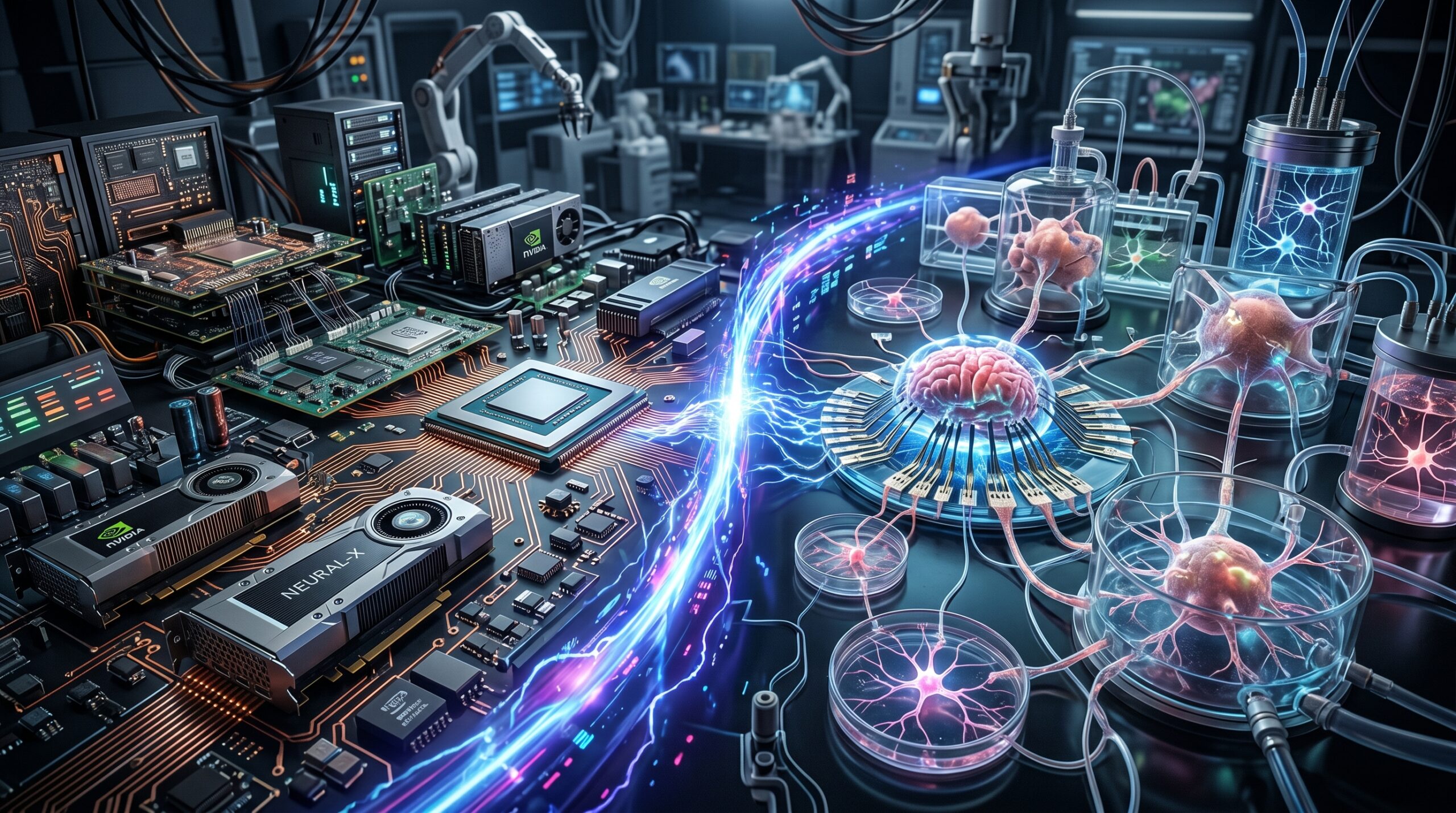
Here’s the thing that got me down this rabbit hole. Not a lab tour or a press release — a paper. December 2022, published in Neuron, one of the most respected peer-reviewed journals in the field. Scientists at Cortical Labs — an Australian startup founded in 2019 by Dr. Hon Weng Chong — grew roughly 800,000 human and mouse brain cells on a high-density multielectrode array (HD-MEA). They named it DishBrain.
Then — and I still find this a bit hard to wrap my head around — they wired it into Pong.
The cells got small jolts of power to tell them where the ball was. Their output ran the paddle. No code. No trained weights. No GPU. And within about five minutes of play, the culture showed clear signs of getting better — self-organizing, changing how it fired based on what worked. In a dish.
I think the reason this hits different from most AI news is that it breaks the mental model most of us share for how computing works. This isn’t a smarter algorithm. These are live cells. Doing something that looks a lot like learning.
Brett Kagan and his team at Neuron, Volume 110, Issue 23, called this a “Synthetic Biological Intelligence” (SBI) system. That term has stuck as Cortical Labs’ whole reason for existing.
The Part Everyone Skips: How Do You Actually Wire a Neuron to a Computer?
Here’s something the DishBrain story glosses over. “Cells got small jolts of power” makes it sound simple. It isn’t.
The extracellular neural signals picked up by electrode arrays can be in the microvolt range. That’s not a rounding error — it’s roughly a thousand times smaller than the voltage levels standard digital logic runs on. At that scale, the signal you’re trying to capture is sitting right next to the noise floor. Mains hum, nearby digital switching, even the electrode itself — all of it competes with the actual biological signal you’re trying to read.
So there’s a whole invisible chain between “neuron fires” and “computer receives a number”: the electrode picks up the signal, a low-noise analog front end amplifies it without also amplifying the noise, filtering cleans it further, and only then does an analog-to-digital converter turn it into something software can work with. Stimulating the culture runs the same chain in reverse. None of this is exotic — it’s standard mixed-signal engineering. But it’s a real, nontrivial signal chain, not a wire and a battery.
I’ll be specific about one number here, because it’s genuinely documented: the CL1 uses a 59-electrode planar array — confirmed across multiple independent technical reports on the hardware, including TechSpot’s and PCWorld’s coverage of the unit. Don’t over-read that number. Fifty-nine electrodes doesn’t mean 59 neurons, or 59 “processors,” or 59 independent computing units. It means 59 physical electrode sites forming the array that interfaces the biological culture with the electronics. The electrode count sets the spatial resolution of that interface — how finely you can observe and influence the network — not the intelligence or capability of what’s underneath it.
Silicon Is Running Out of Easy Wins
Okay, back up. Why is any of this even being tried? Here’s my honest read on it.
The silicon story is more tangled than most tech press admits. I’ve noticed that a lot of coverage still talks about Moore’s Law like it’s just… chugging along. It isn’t. Traditional transistor scaling is getting harder and more costly by the year — which is why the whole industry has gone sideways into chiplets, advanced packaging (CoWoS, Foveros, EMIB), hybrid bonding, HBM stacking, and backside power delivery.
The roadmap isn’t dead. It’s just fractured. Intel’s 18A node (the “A” literally stands for angstroms — that’s how small we’re talking) and TSMC’s N2 (2nm) are both in that extreme range now. Intel started ramping 18A in 2025, with Panther Lake and Clearwater Forest, rolling out more broadly through 2026. Heat and power delivery? Major constraints. Not solved problems.
And then there’s the energy thing. Which is, frankly, nuts.
Training GPT-3 — one model, one run — ate roughly 1,287 megawatt-hours (MWh) of power and put out 552 metric tons of CO2e. That’s the finding from Patterson et al., “Carbon Emissions and Large Neural Network Training” (arXiv:2104.10350, 2021) — the paper that basically every energy-in-AI piece cites. To put it in terms that hit home: over 120 average U.S. homes. For a year. For one training run.
The human brain runs on about 20 watts. A small light bulb. Now — I’ll be upfront — it’s not doing the same kind of work as a GPU. The tasks aren’t equivalent. But the gap in raw energy terms is so large that even if you discount the comparison heavily, you’re still looking at a very different ball game. (I’ve written separately about how brain-inspired neuromorphic chips are attacking this same energy problem from a different angle — worth reading alongside this.)
Johns Hopkins researchers — Professor Thomas Hartung and Assistant Professor Lena Smirnova, both at the Bloomberg School of Public Health and Whiting School of Engineering — published in Frontiers in Science in February 2023, formally naming this new field Organoid Intelligence (OI) (DOI: 10.3389/fsci.2023.1017235). Their projected theoretical estimate — based on known efficiency gaps between brain tissue and silicon compute, not a real benchmark — is that biocomputing could cut AI energy use by 1 million to 10 billion times. I know that sounds wild. To be clear: no lab has shown anything close to that on a real standardized test. It’s a projection. Not a result.
On the other hand, maybe I’m wrong to discount it so fast. Even a fraction of that gap, if real, reshapes the whole conversation.
Part of why the projection isn’t pure fantasy: biological neural networks don’t fire constantly. Most neurons are quiet most of the time — only the ones actually carrying relevant signal activate, and memory and computation happen at the same physical location, the synapse, instead of being shuttled back and forth between separate memory and processing units the way conventional computers work. Conventional digital systems, by contrast, run on clocked logic that toggles on a fixed schedule regardless of whether there’s useful work to do, and they burn real energy just moving data between memory and compute. That architectural difference is the actual mechanism behind the efficiency argument — not proof that biology already outperforms GPUs, but a real reason the theoretical ceiling is worth taking seriously.
What “Organoid Intelligence” Even Means
Right, let’s slow down. This is where most pieces go off the rails — either too vague or too sci-fi.
Brain organoids are not tiny brains. Don’t let anyone tell you they are. They’re small, 3D clusters of human neurons — grown from stem cells derived from donors’ skin or blood. They fire. They connect. They show plasticity. Think of them more like a stripped-down slice of brain tissue than a miniature brain. The miniature brain framing causes a lot of unnecessary panic (and a lot of unnecessary hype, honestly — both in the same week).
Organoid Intelligence (OI), per the Johns Hopkins Frontiers in Science paper, is the field that studies how to use these clusters as a computing base — hooking them up to sensor arrays, machine learning tools, and feedback loops so they can learn, both with and without being told what to do.
Here’s the part I think gets glossed over most: neurons don’t need to be told what to do in the old-school programming sense. They just… adapt. They respond to what works and what doesn’t. They wire and rewire based on results. Now, whether that qualifies as “intelligence” in any rigorous sense is genuinely a philosophical question, not a settled scientific one — but here’s my read on it: that’s not a simulation of intelligence you’re looking at. It’s closer to the real thing, just running on cells instead of chips.
If you want a concrete example of what silicon-neuron interfaces already look like in a commercial product, my breakdown of how Neuralink’s brain chip actually works covers the electrode hardware and signal processing side in detail — different application, same fundamental interface challenge.
Brett Kagan, Chief Science Officer at Cortical Labs, said it better than I could: “We’re using the substrate of intelligence, which is biological neurons, but we’re assembling them in a new way.”
The Companies Actually In the Game
Not just research groups. Real products. Two worth knowing.
Cortical Labs and the CL1
March 2025. Mobile World Congress, Barcelona. Cortical Labs shows up with the CL1 — which they call the world’s first commercially available biological computer. And look, I want to be straight with you if you work in hardware: this is non-production-grade research hardware. Full stop. It’s not a server node. It hasn’t been shown to hit the uptime, reliability, maintainability, or scale requirements that real production infrastructure demands. It’s a research tool for specialized labs.
But — and this matters — it’s a real thing you can buy. That’s not nothing. That’s actually kind of a big deal.
The CL1 keeps neurons alive on a stable planar electrode array inside a sealed unit with its own life support: pumps, gas mixing, temperature control, fluid filters. Viable for up to six months. A single unit draws roughly 25–30 watts — but a full rack of them draws 850–1,000 watts, since installations typically run 20 to 30 units together. Here’s what I think most people miss about that number: a substantial portion of the system power is associated with maintaining the biological environment, although Cortical Labs has not published an exact power breakdown between biological support and computing electronics. The neurons themselves are not yet running independently of the machinery keeping them alive. That’s a core engineering problem that hasn’t been solved. Price tag: around US$35,000 per unit, with volume pricing for rack deployments bringing that down closer to $20,000 per unit.
This is also where board-level engineering gets genuinely hard, not just biologically hard. Recording circuitry sensitive enough to pick up a microvolt-scale neural signal has to live on the same physical platform as pumps, gas lines, and fluid channels — which means routing, grounding, and shielding all have to work harder than they would on a normal digital board. You can’t let a stimulation pulse driving current into the culture bleed noise into the recording channel sitting right next to it on the same array; that’s a mixed-signal isolation problem, not a software one. And fluid proximity raises the kind of general concerns any bioelectronics design has to account for — corrosion resistance, connector reliability in a humid or fluid-adjacent environment, electrical isolation between the wet and dry sides of the system. I want to be clear that’s a general engineering consideration, not a documented CL1 design detail — Cortical Labs hasn’t published specifics on connector materials or environmental protection methods. None of this is unique to biocomputing, exactly. It’s the same discipline that goes into any sensitive analog instrumentation. It’s just that here, the “instrument” is sitting next to something alive.
They’ve also built Cortical Cloud — a Wetware-as-a-Service (WaaS) setup that lets researchers run experiments via Python SDK and browser tools. Makes sense when you think about it: most labs can’t maintain a sterile, temperature-controlled, gas-managed cell culture 24/7. So you access it remotely instead. Not a feature. A necessity.
Funding so far: $11 million, from Horizons Ventures, Blackbird Ventures, and In-Q-Tel.
FinalSpark and the Neuroplatform
Swiss startup FinalSpark went a different direction. Their Neuroplatform links 16 brain organoids through multi-electrode arrays (MEAs) — eight electrodes per organoid. Remote access. Around the clock. Via API and Jupyter.
They claim their biological chips are up to a billion times more energy-efficient than silicon. I’ve noticed this number gets thrown around a lot without context. To be fair to FinalSpark — and to be fair to the skeptics — that claim hasn’t been validated against any standard AI benchmark. Different workloads, different hardware, different ways of measuring. It’s a toss-up whether the comparison even makes sense yet. But the direction is interesting enough to keep watching.
In 2023, 36 research groups applied to work on the Neuroplatform. Eight got in. This comes directly from FinalSpark’s peer-reviewed paper — Jordan et al., “Open and remotely accessible Neuroplatform for research in wetware computing,” Frontiers in Artificial Intelligence (DOI: 10.3389/frai.2024.1376042) — not a blog post or a press release. Institutions that made the cut included teams from the University of Côte d’Azur, CNRS, the NeuroMod Institute, and the University of Michigan.
What “Manufacturing” Even Means When the Product Is Alive
This is the question I don’t see anyone in tech press actually asking, and it’s the one that matters most if you come from a hardware background.
Semiconductor manufacturing is built around making physically identical things, over and over, at extreme precision. That’s the whole game — repeatability at the atomic scale. Biological computing can’t play that game the same way because the starting material isn’t silicon. It’s cells.
The rough chain looks like this: source donor cells (skin or blood), reprogram them into stem cells, differentiate those into neurons, seed them onto the electrode array, wait for the network to mature and wire itself, then couple that network to the electrodes and calibrate the system to it. Every one of those steps is a biological process, and biological processes vary — batch to batch, culture to culture. Two units built from two different donor lines aren’t guaranteed to behave identically the way two chips off the same fabrication line are.
That doesn’t make the manufacturing “worse.” It makes it a different problem. Instead of engineering for repeatable structure, you’re engineering for repeatable function out of a substrate that’s allowed to vary underneath. I haven’t seen anyone publish real numbers on how consistent unit-to-unit performance actually is here — and to be clear, I’m not claiming Cortical Labs or FinalSpark have solved this or failed to solve it. I just don’t think the question gets asked enough.
Six Months Is a Different Kind of Reliability Specification
The six-month viability figure gets repeated a lot. What doesn’t get discussed is what that number actually means for how you think about hardware reliability.
Conventional electronics reliability runs on concepts like MTBF, accelerated life testing, and wear-out curves — you’re modeling a population of components and predicting when a percentage of them will fail, then building in redundancy or scheduled replacement around that curve. It’s a mature, well-understood framework.
Biological computing doesn’t map onto that cleanly. You’re not just dealing with component aging — you’re dealing with cell viability, gradual drift in how the network fires as it matures and ages, potential electrode degradation from prolonged contact with living tissue, calibration drift as the network itself changes, and contamination risk that a sealed silicon chip simply doesn’t have to worry about. That doesn’t mean conventional reliability thinking is useless here. It means it’s incomplete on its own — you need biological-performance metrics layered on top of the standard hardware ones, and right now that combined framework doesn’t really exist yet in any standardized way.
Six months, in other words, isn’t a spec you can treat the way you’d treat a semiconductor lifetime rating. It functions more like a biological operating-life limit — one your whole maintenance and replacement model has to be designed around, rather than something you extend through the usual reliability-engineering levers.
What This Is Actually Good For Right Now
I think the sci-fi framing does real damage here. So let’s just be blunt about what biocomputing is and isn’t useful for in 2026.
What it can do now:
- Drug testing. Organoids from donors with Alzheimer’s, autism, or epilepsy give you a human-relevant model to test drug compounds — without lab animals. Cortical Labs tested the CL1 on an in vitro epilepsy setup and found that anti-seizure drugs measurably improved how the cells performed. That’s real.
- Brain science. Watching live neural networks compute — how they wire, prune, adapt — tells us things about how learning works that silicon models can’t. That feeds back into AI design.
- Low-power processing. In settings where efficiency beats raw speed, biological chips might eventually work as co-processors — not unlike how the industry is already moving toward specialized edge AI chips instead of always routing compute to power-hungry cloud data centers. Maybe. Long road.
What’s still just ideas:
- Hybrid biological-silicon chips for AI inference
- Brain-computer interfaces
- Patient-specific medicine via your own organoid
What’s definitely not happening soon? Replacing your laptop. Not even close. Biological systems right now don’t touch state-of-the-art chips on throughput for standard tasks.
The Ethics Part (Which Nobody Wants to Read, But Should)
I’ll be honest — this section took me the longest to figure out how to write. Not because the science is hard but because the questions are genuinely unsettled.
A 2023 paper — Milford, Shaw & Starke, “Playing Brains: The Ethical Challenges Posed by Silicon Sentience and Hybrid Intelligence in DishBrain,” Science and Engineering Ethics, Vol. 29, No. 6 (DOI: 10.1007/s11948-023-00457-x, October 26, 2023) — looked hard at what DishBrain’s existence means. The authors argue the design may risk bringing about artificial suffering. They’re careful — they don’t say it does. But the caution is real and deliberate.
The live debates in the field right now — and these are legal and regulatory questions, not medical ones:
- When does a lab-grown neural network get complex enough to need formal ethics review? And who gets to draw that line?
- If a biological chip made from your cells generates IP, who owns it? Patent law wasn’t written for this.
- What did you actually consent to when you donated skin or blood that’s now running compute jobs six months later?
No government body has called any current system sentient. No regulatory agency has made a call on clinical-grade suffering in biological chips. The Milford, Shaw & Starke paper is taking a “we don’t know yet, so be careful” stance — which is actually the right call when the science is moving faster than the rules.
In my experience, regulatory frameworks almost always lag the tech. That’s not a criticism. It’s just how it goes. The Johns Hopkins OI group has baked ethics into their research roadmap from the start, which is more than most new fields do.
What It Means for AI’s Energy Problem
Here’s the part I think actually matters most for anyone building or buying AI infrastructure right now.
The current path for big AI — more data, more compute, bigger models, bigger energy bills — is not going to hold forever. Data centers are already straining grids. The water bill for cooling is getting harder to ignore. The carbon load from training frontier models is mainstream news now, not just a niche concern. I covered how nuclear energy is being pulled back into service specifically because of AI’s power appetite — that piece adds useful context on just how severe the infrastructure pressure is getting.
Biocomputing doesn’t fix all of that. Not now, maybe not ever at the scale we’d need. But it opens a different design space. One where the processing layer learns from sparse data, adapts on its own, and theoretically runs on the power of a small light bulb.
Ben Ward-Cherrier, a computational neuroscience researcher at the University of Bristol, put it plainly in National Geographic: “The development of large organoids for power-efficient neural networks could help with running complex deep learning models without significantly impacting climate change.”
Not a promise. A real research direction. Those are different things.
The Biocomputing Bottom Line
Silicon runs the world. It will for years, probably decades. I’m not here to tell you otherwise.
But the idea that all computing must stay silicon — that the only moves are smaller nodes, faster links, and more power-hungry runs — that’s the part that’s now in real question.
Before anyone gets too excited though: the scale gap here is huge. DishBrain used 800,000 cells. FinalSpark’s platform runs roughly 160,000 neurons. The human brain has about 86 billion. That’s five to six orders of magnitude more than where current systems sit. We are not building brain replacements. We are watching biological networks do something adaptive and asking if we can point that behavior at useful problems. Those two things are very different, and I’ve noticed the press tends to blur them constantly.
There’s also a security angle nobody’s really talking about yet. A biological-silicon system with cloud API access is a cyber-physical attack surface. How do you patch wetware? What if the stimulation protocol gets tampered with remotely? What happens to the privacy of donor-derived genetic material running on a shared research platform? Not hypothetical concerns — just questions that need real answers before any of this goes anywhere near production. If you’ve followed my piece on why embedded hardware has a quantum security problem, the pattern is familiar: new compute architectures consistently outpace the security frameworks meant to protect them.
A dish of 800,000 cells showed adaptive behavior in a Pong sim. A Melbourne startup is selling commercial research biological computers for $35,000. Johns Hopkins is formalizing a new scientific field. Swiss researchers are renting out cloud access to brain organoid processors by the session.
Genuinely early days. The CL1 is proof-of-concept, not infrastructure. Organoid Intelligence is being built in real time, ethics and engineering challenges still wide open.
Worth noting on the maturity curve: this has moved slightly past pure research prototype. There’s a small institutional deployment in Melbourne, a joint effort with DayOne in Singapore aiming for up to 1,000 units in phases, and a 20-unit validation run underway at the National University of Singapore. That’s real movement from lab curiosity toward institutional-scale use. It is still nowhere close to mass-market compute hardware or production semiconductor infrastructure — the scale, reliability, and manufacturing questions above don’t go away just because a few institutions are running pilots.
But here’s what I keep coming back to: computing history rewards the people who take weird-looking things seriously before everyone else does. Transistors were a lab curiosity. Neural nets were a punchline for decades. Then they weren’t.
Living computers. Not science fiction. Commercial research hardware now exists.
About the Author
Imran Valiani | Sales Director, PCB Electronics Manufacturing
20+ years working with major Bay Area and global tech clients. Founder of Silicon to Software, where I write about the hardware layer — PCB fab, AI gear, autonomous systems, and cyber — the stuff most tech writers have never touched. Literally.
Follow: X @SiToSoftware | LinkedIn
This article was developed with AI assistance and edited, fact-checked, and reviewed by the author. See my full AI disclosure.
Sources & Citations
The following primary sources were used in the research and fact-checking of this post. All technical claims, statistics, and research findings above are traceable to these documents. Readers are encouraged to verify independently.
| Claim | Primary Source |
|---|---|
| DishBrain paper published in Neuron, Vol. 110, Issue 23, Dec. 7, 2022 | Kagan et al., Neuron (2022); DOI: 10.1016/j.neuron.2022.09.001 |
| ~800,000 neurons on HD-MEA in DishBrain | Kagan et al., Neuron (2022); Cortical Labs press materials |
| Neurons exhibited apparent learning within ~5 minutes of Pong gameplay | Kagan et al., Neuron (2022) — verbatim abstract language |
| Organoid Intelligence (OI) formal field definition | Smirnova et al., Frontiers in Science (Feb. 2023); DOI: 10.3389/fsci.2023.1017235 |
| GPT-3 training consumed 1,287 MWh, emitted 552 tCO2e | Patterson et al., “Carbon Emissions and Large Neural Network Training,” arXiv:2104.10350 (2021) — primary source |
| Human brain runs on ~20 watts | Johns Hopkins OI documentation; established neuroscience baseline |
| Biocomputing projected to reduce AI energy by 1M-10Bx | Smirnova et al., Frontiers in Science (2023) — projected estimate, not a measured result |
| Intel 18A ramping production 2025, broader deployment 2026 | Intel Q3 2025 earnings release (SEC Form 8-K); Intel Newsroom — Panther Lake architecture announcement |
| TSMC N2 (2nm) volume production 2025-2026 | TSMC Q1 financial results; Counterpoint Research via Nasdaq reporting |
| CL1 priced at ~$35,000/unit; single unit draws ~25-30W, full rack (20-30 units) draws 850-1,000W | IEEE Spectrum; TechTimes; BigGo Finance; Boing Boing; Data Center Dynamics; Cortical Labs product announcement (March 2025) |
| CL1 neurons viable up to 6 months; stable planar electrode array | Cortical Labs product specs; Victorian Premier’s Design Awards documentation (2025) |
| $11M funding, investors including In-Q-Tel | Data Center Dynamics reporting on Cortical Labs |
| FinalSpark Neuroplatform: 16 organoids, 4 per MEA, 8 electrodes per organoid | Jordan et al., “Open and remotely accessible Neuroplatform for research in wetware computing,” Frontiers in Artificial Intelligence (2024); DOI: 10.3389/frai.2024.1376042 |
| 8 of 36 academic groups selected for Neuroplatform (2023) | Jordan et al., Frontiers in Artificial Intelligence (2024) — same paper, primary source |
| DishBrain ethics paper — artificial suffering, precautionary principle | Milford, Shaw & Starke, “Playing Brains,” Science and Engineering Ethics, Vol. 29, No. 6 (Oct. 2023); DOI: 10.1007/s11948-023-00457-x |
| Brett Kagan quote on neurons as “substrate of intelligence” | New Atlas / Loz Blain interview, 2023 |
| Ben Ward-Cherrier quote on organoids and climate | National Geographic biocomputing feature, 2025 |
| CL1 uses a 59-electrode planar array | TechSpot, PCWorld, Gizmodo/New Atlas, BigGo Finance, RDD10+ — independently corroborated secondary technical reporting |
| CL1 institutional deployments: Melbourne facility, Singapore/DayOne collaboration (up to 1,000 units in phases), 20-unit National University of Singapore validation | Tom’s Hardware (2026); TechTimes (Aug. 2026) |
| Bio-electronic interface signal chain (microvolt-scale signals, low-noise amplification, filtering, ADC) | Standard mixed-signal/bioelectronics engineering principles — conceptual explanation, not a CL1-specific architecture claim |
| Life-support power dominance over compute power | Engineering inference, corroborated by TechTimes’ independent framing of the same conclusion — not a published Cortical Labs power-budget breakdown |
| Biological manufacturing variability (cell sourcing, differentiation, batch variation) | Engineering inference drawn from documented iPSC-derived neuron production process — no published Cortical Labs/FinalSpark yield or consistency data exists |
| Reliability model distinction (biological vs. semiconductor MTBF) | Engineering inference — conceptual framework, not a claim about specific failure rates |
| Sparse/event-driven computation as efficiency mechanism | Standard neuroscience/computer architecture principle — conceptual explanation supporting, not proving, the OI projection |