6G Technology Hardware: Why the Infrastructure to Build It Doesn’t Exist Yet
The 6G technology hardware gap is real — and it goes far deeper than most coverage admits. From terahertz semiconductors to IPC-6018-qualified PCBs, here’s what actually needs to be built before 6G becomes commercially viable.
Table of Contents
Imagine a surgeon in New York. Not on a video call. Actually operating — via robotic hands — on a patient in rural Kenya, with zero perceptible delay. Or picture a city where autonomous vehicles talk to each other and to the road itself, in microseconds, without a central brain. Or AI inference happening not in some distant data center, but on the antenna mast outside your office window, fast enough that it feels less like computation and more like instinct.
That’s the 6G promise. And understanding 6G technology hardware — what it requires, what’s missing, and what has to be invented — is the only way to know whether any of that actually happens on schedule.
Here’s the problem — and I want to be precise about this, because most articles get it wrong. The hardware needed for mass-market 6G isn’t missing. Experimental 100–300 GHz components — power amplifiers, mixers, InP and SiGe HBT amplifiers — have been demonstrated in published research. 300 GHz wireless links work in labs right now, built from these discrete components. That’s not the same as a complete, integrated, commercial transceiver ecosystem — that doesn’t exist yet either. The gap isn’t existence of the underlying physics or the individual building blocks. It’s commercial viability — whether any of this can be built at scale, at acceptable cost, with adequate power efficiency, inside a standardized ecosystem the global supply chain can actually support. That’s a very different problem. And a much harder one.
Oh, and that “100 times faster” headline? It needs a footnote immediately. Some research programs target peak rates approaching 1 Tbps. Compare that against 5G’s ITU IMT-2020 specified 20 Gbps peak downlink and you get roughly 50x. “100x” is shorthand used in industry discussions — not a fixed specification anyone has officially ratified. This article is about why hitting any of those numbers at commercial scale is still unsolved.
Not pessimism. Reality.
First, Let’s Set the Baseline on 6G Technology Hardware
5G — the one most of us are still figuring out — runs across two 3GPP-defined frequency ranges. FR1 covers sub-6 GHz (410 MHz to 7.125 GHz). FR2 covers mmWave (24.25 to 52.6 GHz, extended to 71 GHz in Release 17). Per ITU IMT-2020, the 5G NR peak downlink is 20 Gbps under ideal conditions, with a 1 ms latency target. Real-world? Dense urban mmWave deployments in the U.S. can deliver 300 Mbps to over 1 Gbps under favorable conditions — though network-wide averages across both bands run considerably lower. (Your phone probably sees nothing close to those peaks. Neither does mine.)
Most roadmaps — 3GPP’s Release 21 planning, Ericsson’s published 6G schedule — aim for initial commercial 6G around 2030. Some operators think the realistic first wave slides into the early 2030s. Performance targets vary wildly by organization: some research programs chase peak rates approaching 1 Tbps, while ITU’s IMT-2030 framework deliberately widens the KPI set beyond raw throughput.
Here’s what the “100x faster” framing consistently buries: speed is no longer the only metric that matters. By 2026, energy efficiency — specifically, energy consumed per bit transmitted — is a primary 6G KPI. That matters for hardware design in a concrete way. A THz amplifier that hits peak throughput but melts its own packaging fails on both dimensions simultaneously. You can’t separate performance from power. Not at these frequencies.
Researchers are betting on the terahertz (THz) band — 0.1 to 10 THz — to supply the bandwidth. That sounds exciting. It is. But THz frequencies come with a physics problem nobody has fully solved.
The Terahertz Gap: Physics Is Not Cooperating
The THz band is sometimes called the “terahertz gap.” Not because the spectrum is empty — it’s enormous. Because we’ve historically lacked the hardware to use it.
THz signals face severe path loss, molecular absorption by atmospheric water vapor, and blockage that attenuates them severely — often to the point of complete signal loss depending on material, thickness, and angle. Think about how badly 5G mmWave already struggles with glass and concrete. Now imagine frequencies 10 to 100 times higher. A wall won’t stop a THz signal entirely — but it will attenuate signal strength severely enough that communication fails without active countermeasures like beamforming or RIS assistance.
To be honest, this is where most explainers gloss over the hard part. So let’s not.
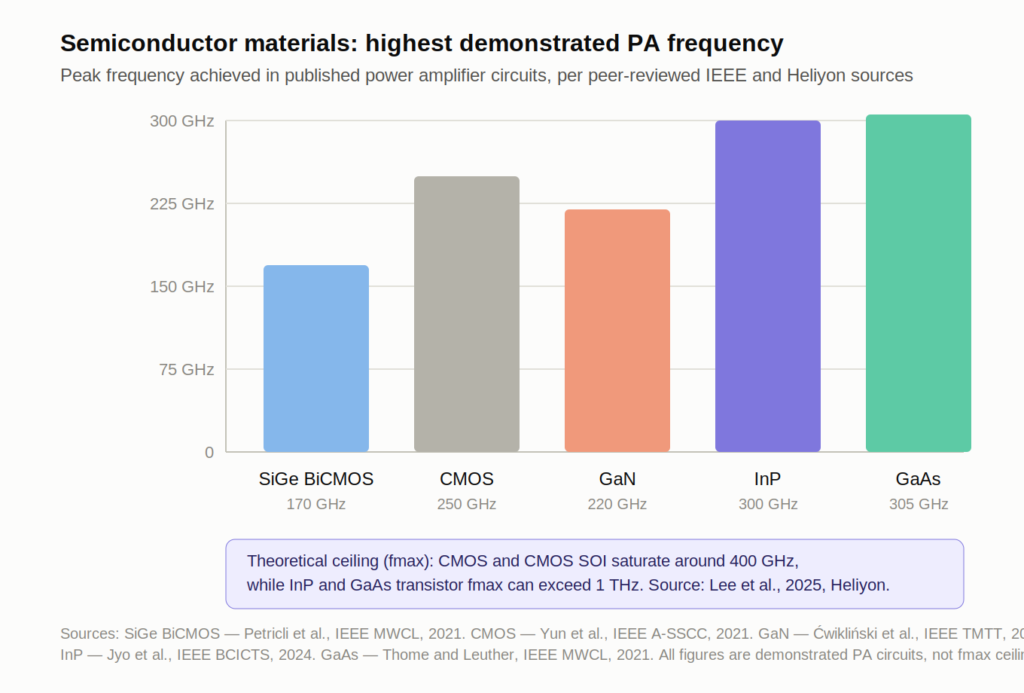
Conventional silicon faces increasingly severe constraints at sub-THz frequencies — fT/fmax rolloff, reduced transistor gain, growing parasitics, higher interconnect loss, worse noise performance, lower breakdown voltage, and shrinking output power and efficiency all compound at once. Engineers are turning to III-V semiconductors — specifically GaN (Gallium Nitride), InP (Indium Phosphide), and GaAs (Gallium Arsenide) — for amplifiers, oscillators, and mixers that can operate at these frequencies. These materials work, but III-V devices generally require compound-semiconductor fabrication processes rather than conventional silicon CMOS production lines. Integrating III-V RF devices with silicon logic therefore adds another manufacturing challenge: heterogeneous integration and advanced packaging.
High-volume, mainstream chip manufacturing — TSMC, Samsung, Intel — is overwhelmingly built around silicon CMOS. These companies also run specialty, compound-semiconductor, RF, and advanced-packaging operations, but CMOS dominates the volume economics that make a fab viable at scale. CMOS-based power amplifiers (PAs) at sub-THz suffer severe parasitic effects and hard frequency ceilings. Researchers have made progress scaling CMOS down to push through those ceilings. The fundamental material constraints, though? Still there.
A cross-technology analysis covering 25+ semiconductor approaches — GaN, InP, SiGe BiCMOS, advanced CMOS — identifies gaps that require breakthroughs. Not evolutionary improvements. Breakthroughs.
That’s a significant word. The industry chose it deliberately.
The 6G Technology Hardware Thermal Problem Nobody Talks About
There’s a second hardware challenge that barely gets airtime. Heat.
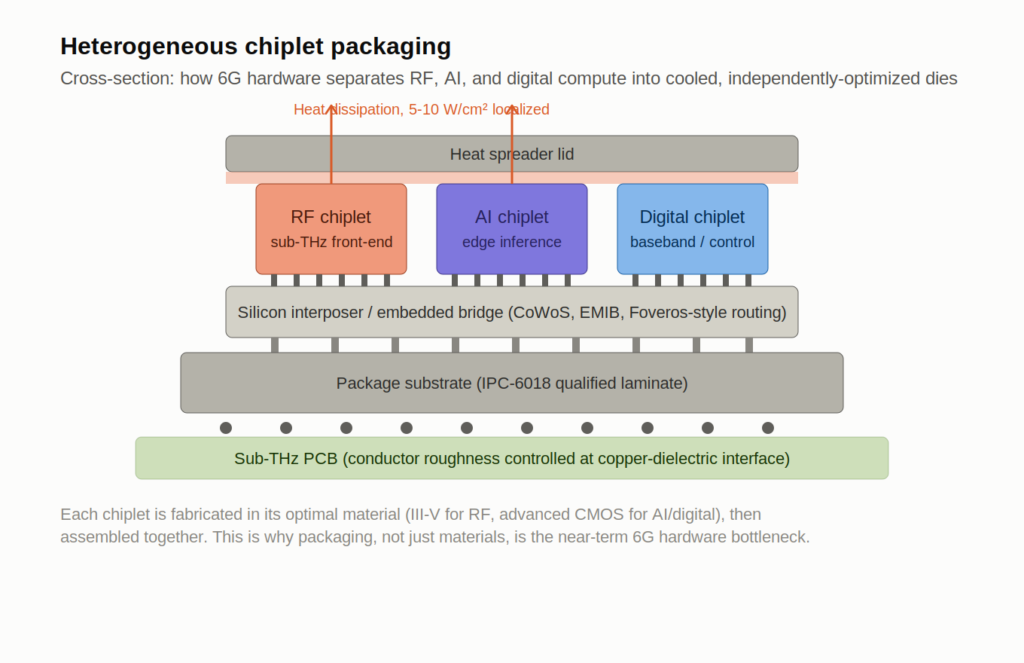
Sub-THz RF hardware creates significant thermal-management challenges. The difficulty compounds as RF front-ends, dense antenna arrays, digital processing, and power electronics get packed closer together in the same package. Thermal gradients and localized hotspots matter as much as total heat output — and RF performance itself degrades with rising temperature, which turns thermal management into a performance problem, not just a reliability one. That’s actually a familiar pattern to anyone who’s worked with modern AI accelerators, which routinely exceed 100–500 W/cm² in localized hotspots. The difficulty for 6G hardware isn’t the raw thermal number. It’s the combination of that load with extreme miniaturization — dense antenna arrays, outdoor enclosures, co-location with RF components that degrade under heat. Managing thermal gradients across a package where RF, digital, and power domains share millimeter-scale real estate is where the engineering pain actually lives.
The near-term solution the industry is converging on is heterogeneous integration — chiplet-based architectures assembling silicon and non-silicon components in 2.5D and 3D configurations using packaging technologies like CoWoS (Chip-on-Wafer-on-Substrate), Foveros (Intel), and EMIB (Embedded Multi-die Interconnect Bridge). These are general-purpose advanced-packaging technologies, not 6G-specific standards — they were built for HPC and GPU chiplet integration and are now being adapted for RF/digital/AI co-packaging. No 6G-specific packaging standard exists yet. But their existence demonstrates the underlying heterogeneous-integration capability is real, even if 6G’s specific application of it isn’t standardized. In 2026, the 6G silicon roadmap is as much a packaging problem as a materials problem. Diamond substrates and graphene heat spreaders get the press. Advanced packaging is doing the actual work.
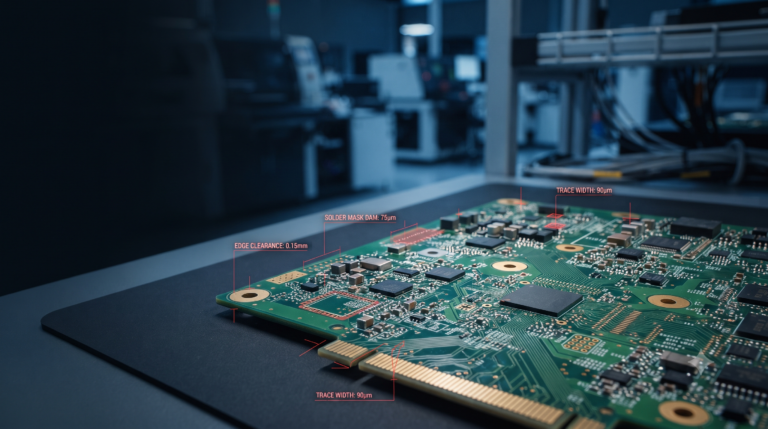
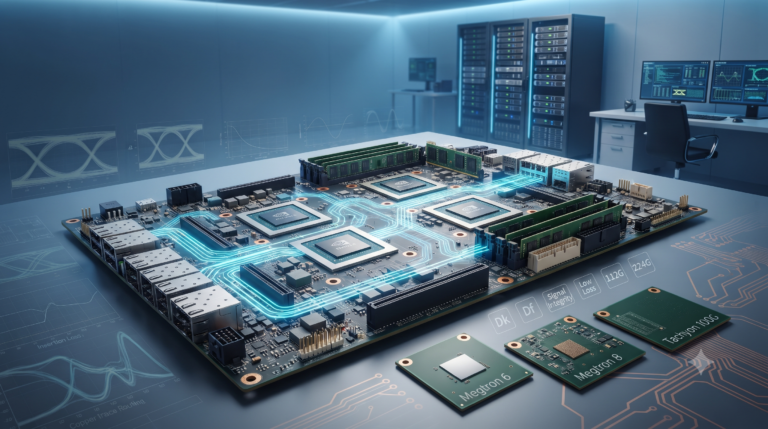
One clarification that matters — especially if you’re in PCB manufacturing. Rogers laminates, PTFE, and LCP (Liquid Crystal Polymer) are not research-grade materials. They’re already deployed in automotive radar, aerospace RF, satellite communications, and military systems today. Per IPC-6018 — the qualification standard for high-frequency/microwave PCBs — these substrates are production-qualified for high-reliability environments. What’s not solved is applying them at true sub-THz frequencies above 100 GHz, where conductor roughness, dielectric loss tangent (Df), and copper profile control become dominant variables that existing IPC-4103 slash sheet specs weren’t written to address. (I’ve written before about how laminate choice affects signal integrity in AI hardware at 112G/224G speeds — the same physics, at a different frequency ceiling.)
I’ve spent a lot of time on this specific problem. Sub-THz PCB fabrication is not “use better laminate.” At 300 GHz, conductor surface roughness at the copper-dielectric interface — measured in root mean square micrometers — directly degrades insertion loss in ways that overwhelm most other design variables. The copper profile acceptable on a 28 GHz 5G mmWave board causes unacceptable loss at 300 GHz. IPC-6018 gives you the qualification framework. It does not give you mature process specifications or yield data for volume production of sub-THz boards with the conductor roughness control these frequencies demand. That manufacturing gap is real, and almost nobody in the popular press is covering it.
As for test and measurement: Rohde & Schwarz, Keysight, and Anritsu do offer sub-THz platforms as of 2026. The ecosystem exists. But it’s immature, expensive, and nowhere near capable of the high-volume, automated production-line validation that mass-market 6G will need.
What About Antennas? Here’s Where It Gets Interesting.
Traditional antennas are passive. They radiate. Done. 6G introduces something called Reconfigurable Intelligent Surfaces (RIS) — essentially programmable walls, ceilings, and surfaces that dynamically redirect and shape THz signals in real time.
I’ve found this concept genuinely fascinating, even after years in the hardware space. Instead of a THz signal dying on impact with a building, an RIS-coated surface bounces it around the corner and delivers it anyway. RIS is composed of tunable sub-wavelength elements that manipulate incident electromagnetic waves by adjusting their reflection, refraction, or absorption — at low power compared to conventional active relays.
But RIS has not been standardized. Not yet — and the path there is genuinely uncertain. RIS was not included in 3GPP Release 19. Research tracking the standardization trajectory identifies Release 20 (2025–2026) as a critical, possibly final opportunity for RIS to be incorporated into the path toward 6G — meaning there’s a real chance it doesn’t make the cut at all, not just that it’s “early” in a smooth progression. RIS remains a technology under study, not a settled 6G standard. More importantly, there’s a legitimate debate about whether RIS gets broadly deployed at all — or stays niche. Control overhead, synchronization complexity, maintenance cost, uncertain ROI for operators. Real objections, not theoretical ones.
The NGMN Alliance — in publications released June 2026 alongside the 3GPP plenary in Singapore — is pushing Multi-RAT Spectrum Sharing (MRSS) as the pragmatic baseline for 6G migration. Their explicit concern: don’t repeat 5G’s complexity fragmentation. RIS adds complexity. Whether operators absorb that complexity at scale is genuinely open.
Real-world RIS deployment at scale? Still a future problem. And not a guaranteed one.
The AI-Native Shift: Not Just a Speed Upgrade
Here’s what actually separates 6G from every prior wireless generation. It’s not the speed. It’s the architecture.
5G uses AI as an optimization bolt-on. 6G is being designed as an AI-native paradigm — artificial intelligence woven into every layer of the network, from the physical tier to the application tier, handling real-time sensing, reasoning, and self-optimization. Not an add-on. The foundation.
What does that mean for hardware? One important architectural direction under active study is base station processors running AI inference continuously at the edge, rather than just routing packets. Edge AI hardware already exists — NVIDIA’s Grace Hopper Superchip, Qualcomm’s AI edge platforms, Intel’s vRAN accelerators all demonstrate that powerful, continuous AI inference is technically feasible in constrained, edge-deployed hardware today. These are existing analogues, not proof that every future 6G base station will need this exact architecture — the split between edge and centralized inference is still an open architectural question. But the analogue is instructive: the gap isn’t existence. It’s integration: co-locating high-throughput AI inference hardware with sub-THz RF front-ends inside outdoor-grade enclosures, within strict power budgets, meeting 6G’s sub-millisecond latency requirements. That specific combination, in a manufacturable and cost-effective package? Doesn’t fully exist yet. (There’s a pattern here.)
There has been real progress. In September 2025, researchers at Peking University, the City University of Hong Kong, and UC Santa Barbara published in Nature what they described as the world’s first all-frequency 6G chip — 0.5 GHz to 115 GHz, over 100 Gbps, 11 mm by 1.7 mm, built on a thin-film lithium niobate platform. Genuine milestone. But 115 GHz is still well short of the 300 GHz–3 THz range that represents the research community’s ambition for 6G’s most demanding use cases — not a mandatory ITU or 3GPP frequency allocation. No standard currently requires 6G systems to operate there; it’s the frontier researchers are chasing, not a fixed target every deployment must hit.
Progress. Not arrival.
Who’s Actually Working on This?
Everyone, basically. And the stakes are high enough that governments aren’t leaving it to the market.
Japan committed hundreds of millions of dollars to 6G research in January 2021 — widely reported as approximately $482 million — targeting core THz transmission, ultra-low latency, and AI-driven connectivity. China prioritized 6G under its 14th Five-Year Plan as “new infrastructure,” with state funding aimed at THz spectrum, satellite communications, quantum computing, and AI. In the U.S., NIST and related agencies have funded foundational 6G work and are building the regulatory framework. The FCC Spectrum Horizons Order opened THz spectrum from 95 GHz to 3 THz for experimental use back in 2019.
Lab demonstrations of 100 Gbps to 1 Tbps THz data links at 300 GHz exist. They work. But they’re point-to-point research systems. Not the kind of dense, distributed infrastructure — the sensor nodes, small cells, and edge computing layers that already underpin smart city deployments — that a real metro-area 6G network requires.
The Security Problem: Everyone’s Now in the Implementation Phase
Here’s what most 6G coverage still treats too casually. Security. And it’s directly tied to 6G technology hardware — not just software patches applied later.
The AI-native architecture that makes 6G exciting also massively expands the attack surface. When AI inference runs at the network edge — embedded in base stations, RIS controllers, edge compute nodes — the network stack itself becomes vulnerable: model poisoning, adversarial input manipulation against the inference layer. A 2025 survey in the World Journal of Advanced Research and Reviews puts it directly: AI-driven security in 6G could become a double-edged sword if safeguards aren’t built into the hardware from the start. Not the software. The hardware.
There’s also the post-quantum problem. NIST IR 8547 — still an Initial Public Draft, not final guidance — outlines proposed timelines for transitioning telecommunications systems away from quantum-vulnerable algorithms like RSA and elliptic-curve cryptography, suggesting deprecation after 2030 and full disallowance after 2035. This is transition planning guidance, not a binding regulatory mandate on all telecom providers. Still, it’s the clearest signal available for how long-lived infrastructure like 6G hardware needs to plan its cryptographic migration. 6G hardware needs to support post-quantum algorithms in the design phase, today. The current NIST-standardized suite centers on ML-KEM (FIPS 203, formerly CRYSTALS-Kyber) for key encapsulation and ML-DSA (FIPS 204, formerly CRYSTALS-Dilithium) for digital signatures. These work. But they require significantly greater computational and memory resources than traditional ECDH — and running them on low-power, thermally constrained sub-THz edge hardware is yet another constraint in an already brutal design space. I’ve covered this exact bind in embedded hardware more broadly — the chip in your car or hospital equipment often can’t just be patched. 6G base stations face the same wall, at a larger scale.
By mid-2026, the conversation has moved from selection to implementation and validation. 3GPP’s SA3 working group is actively driving PQC and zero-trust frameworks for 6G. The question is increasingly how to implement post-quantum cryptography — including algorithms like ML-KEM — efficiently inside sub-THz edge nodes without blowing the power budget or the latency envelope.
Also worth flagging: supply-chain attacks on base station accelerator firmware, Baseboard Management Controller (BMC) compromises, AI model theft from edge inference nodes, adversarial exploitation of AI agents in the network control plane. Adversarial attacks, model poisoning, and related AI-security techniques have been demonstrated and are actively researched against AI/ML systems generally — that’s well-established. Confirmed attacks against deployed 6G infrastructure specifically don’t exist yet, because 6G infrastructure isn’t broadly deployed yet. The point isn’t that 6G has already been breached. It’s that AI-native network nodes — with their AI accelerators, firmware, model integrity requirements, and cryptographic hardware — will inherit and expand every attack surface already demonstrated against AI systems elsewhere, unless the hardware is designed against it now.
The FCC TAC 6G Working Group Report (August 2025) frames national security interests as an explicit constraint on U.S. 6G development. The 6G hardware supply chain is a geopolitical asset. General-purpose quantum-safe cryptographic acceleration hardware and IP already exist. What doesn’t yet exist is that acceleration integrated into highly constrained, power-and-thermally-limited sub-THz edge nodes — where silicon area, latency, secure-update capability, and power budget all compete for the same limited headroom. That integration problem belongs on the list of hardware that doesn’t fully exist yet.
So When Does 6G Actually Show Up?
Honest answer: it depends what you mean by “show up.”
Most roadmaps — 3GPP, Ericsson, NGMN — target initial standardized commercial 6G in the early 2030s, with a possible first wave around 2030. 3GPP approved the Release 21 timeline on June 10, 2026: Release 21 will contain the first normative 6G specifications, with a Stage-1 freeze targeted for March 2027, Stage-2 freeze in June 2028, Stage-3 functional freeze in December 2028, and final ASN.1/OpenAPI freeze by March 2029. 6G studies and requirements work continue now under Release 20; Release 21 is where the actual normative specifications get written. Per Orange Group’s Eric Hardouin, speaking to Fierce Network in April 2026: the industry’s biggest risk isn’t delay. It’s haste — rushing standards before absorbing the lessons of 5G standalone deployment complexity.
Early 6G, whenever it lands, will be limited. Specific corridors. Enterprise campuses. Industrial zones. The blanket coverage we expect from 4G and 5G takes years to build after initial launch. This is fundamentally a hardware problem. Software gets updated overnight. Spectrum gets allocated by regulators. But chips, substrates, antennas, IPC-6018-qualified PCBs, and thermal management systems have to be designed, qualified, manufactured at scale, and physically deployed. That doesn’t compress.
That takes time. That takes breakthroughs. And honestly, that’s exactly what makes following 6G worth your attention right now — not when the first handset ships.
What to Actually Take Away About 6G Technology Hardware
- The hardware exists in labs. Commercial viability doesn’t. 300 GHz links, InP amplifiers, RIS prototypes, edge AI chips — all real. The unsolved problem is cost, yield, power efficiency, and the manufacturing ecosystem to produce them at volume.
- Speed is no longer the only KPI. ITU’s IMT-2030 framework puts energy efficiency, integrated sensing, and ubiquity alongside throughput. Hardware that hits Tbps but fails on energy-per-bit doesn’t pass. This is the same power-wall problem pushing the AI industry toward brain-inspired, neuromorphic chip designs — 6G’s edge compute layer will likely need the same kind of efficiency breakthrough.
- Packaging is where the battle is being fought. The 6G silicon roadmap is a heterogeneous integration story — CoWoS, Foveros, EMIB, chiplet architectures co-locating RF, digital, and AI compute in 2.5D/3D packages. Watch advanced packaging as closely as semiconductor materials.
- Standards fragmentation is a genuine risk. NGMN’s June 2026 publications warn explicitly that 6G could repeat 5G’s complexity mistakes. MRSS is the operator-preferred migration baseline — hardware designed without that framework may not see broad deployment.
- AI and 6G are inseparable, and that compounds the security problem. ML-KEM (FIPS 203) and ML-DSA (FIPS 204) need to be built into chips from day one, alongside defenses against supply-chain firmware attacks, AI model theft, and adversarial edge inference exploitation.
- Watch the PCB fab ecosystem. InP, GaN, SiGe BiCMOS for RF. On the substrate side, watch who cracks volume production of IPC-6018-qualified sub-THz PCBs with controlled conductor roughness at 300 GHz. That’s the unglamorous bottleneck nobody in the popular press is covering.
The surgeon operating across continents, the autonomous vehicles communicating in real time, the AI inference running on the antenna outside your window — all of it is physically possible. The math works. The physics allows it. The 6G technology hardware to deliver it at commercial scale is the only thing standing between that vision and reality.
We just need the hardware to catch up.
About the Author
Imran Valiani | Sales Director, PCB Electronics Manufacturing
20+ years working with major Bay Area and global tech clients. Founder of Silicon to Software, where I write about the hardware layer — PCB fab, AI gear, autonomous systems, and cyber — the stuff most tech writers have never touched. Literally.
Follow: X @SiToSoftware | LinkedIn
For more analysis of technologies moving from research toward real engineering constraints, explore the Emerging Technologies Resource Hub.
This article was developed with AI assistance and edited, fact-checked, and reviewed by the author. See my full AI disclosure.
Sources
- ITU-R Recommendation M.2083-0 — IMT Vision: Framework and overall objectives of the future development of IMT for 2020 and beyond https://www.itu.int/rec/R-REC-M.2083/en
- ITU-R Recommendation M.2160 — Framework and overall objectives of the future development of IMT for 2030 and beyond (IMT-2030) https://www.itu.int/en/ITU-R/study-groups/rsg5/rwp5d/imt-2030/Pages/default.aspx
- 3GPP — Release 20 Overview and 6G Study Phase https://www.3gpp.org/specifications-technologies/releases/release-20
- NIST FIPS 203 — Module-Lattice-Based Key-Encapsulation Mechanism Standard (ML-KEM) https://csrc.nist.gov/pubs/fips/203/final
- NIST FIPS 204 — Module-Lattice-Based Digital Signature Algorithm Standard (ML-DSA) https://csrc.nist.gov/pubs/fips/204/final
- NIST IR 8547 (Initial Public Draft) — Transition to Post-Quantum Cryptography Standards https://csrc.nist.gov/pubs/ir/8547/ipd
- FCC — Spectrum Horizons First Report and Order: Opens Spectrum 95 GHz–3 THz (March 2019) https://www.fcc.gov/document/fcc-opens-spectrum-horizons-new-services-technologies
- FCC TAC — 6G Working Group Report (August 2025) https://www.fcc.gov/sites/default/files/FCC-TAC-6G-Working-Group-Report-2025-Final.pdf
- NGMN Alliance — 6G Architecture and Migration Options: An Operator View (June 2026) https://www.ngmn.org/highlight/ngmn-urges-the-telco-ecosystem-to-learn-the-migration-lessons-from-5g-and-agree-to-prioritise-simplification-to-unlock-the-full-potential-of-6g.html
- Tao, Z. et al. — Ultrabroadband on-chip photonics for full-spectrum wireless communications, Nature, Vol. 645, pp. 80–87 (September 2025) https://doi.org/10.1038/s41586-025-09451-8
- IPC-6018 — Qualification and Performance Specification for High-Frequency (Microwave) Printed Boards https://www.ipc.org/TOC/IPC-6018.pdf
- IPC-4103 — Specification for Base Materials for High-Speed/High-Frequency Applications https://www.ipc.org/TOC/IPC-4103.pdf
- 3GPP — Release 21 Timeline, approved June 10, 2026, TSG#112 Singapore (RP-260868/SP-260595/CP-261259) https://www.3gpp.org/news-events/3gpp-news/rel21-timeline
- Ericsson — 6G Standardization Timeline and Technology Principles (2024) https://www.ericsson.com/en/blog/2024/3/6g-standardization-timeline-and-technology-principles
- Hardouin, E. (Orange Group / NGMN) — AI Uncertainty and Interoperability Loom as 3GPP Pushes 6G Toward a 2030 Timeline, Fierce Network (April 2026) https://www.fierce-network.com/wireless/ai-uncertainty-and-interoperability-loom-3gpp-pushes-6g-toward-2030-timeline
- Lee, J.Y. et al. — 6G Communications Through Sub-Terahertz CMOS Power Amplifiers: Design Challenges and Trends, Heliyon / ScienceDirect (May 2025) https://www.sciencedirect.com/science/article/pii/S2405844025017773
- Ogenyi, F.C. et al. — A Comprehensive Review of AI-Native 6G: Integrating Semantic Communications, Reconfigurable Intelligent Surfaces, and Edge Intelligence, Frontiers in Communications and Networks (September 2025) https://www.frontiersin.org/journals/communications-and-networks/articles/10.3389/frcmn.2025.1655410/full
- Zhao, X. et al. — Reconfigurable Intelligent Surfaces for 6G: Engineering Challenges and the Road Ahead, arXiv / IEEE (June 2025) https://arxiv.org/abs/2506.19526
- Abdallah, M. et al. — A Physical Layer Security Scheme for 6G Wireless Networks Using Post-Quantum Cryptography, ScienceDirect (2024) https://www.sciencedirect.com/science/article/abs/pii/S0140366424000756
- World Journal of Advanced Research and Reviews — Security in the Sixth Generation Cellular Networks: A Review (2025) https://journalwjarr.com/sites/default/files/fulltext_pdf/WJARR-2025-0634.pdf
- Petricli, I., Riccardi, D., Mazzanti, A. — D-Band SiGe BiCMOS Power Amplifier with 16.8dBm P1dB and 17.1% PAE, IEEE Microwave and Wireless Components Letters, 31(3), 2021 https://doi.org/10.1109/LMWC.2021.3049458
- Yun, B. et al. — 245/243GHz Power Amplifiers in 65nm CMOS Adopting 2- and 4-Way Power Combining, IEEE Asian Solid-State Circuits Conference (A-SSCC), 2021 https://doi.org/10.1109/A-SSCC53895.2021.9634180
- Ćwikliński, M. et al. — D-Band and G-Band High-Performance GaN Power Amplifier MMICs, IEEE Transactions on Microwave Theory and Techniques, 67(12), 2019 https://doi.org/10.1109/TMTT.2019.2936558
- Jyo, T. et al. — 300-GHz-Band InP HBT Power Amplifier and InP-CMOS Hybrid Phased-Array Transmitter, IEEE BiCMOS and Compound Semiconductor Integrated Circuits and Technology Symposium (BCICTS), 2024
- Thome, F., Leuther, A. — A 75–305-GHz Power Amplifier MMIC in a 35-nm InGaAs mHEMT Technology, IEEE Microwave and Wireless Components Letters, 31(6), 2021 https://doi.org/10.1109/LMWC.2021.3058101