AI Is About to Hit an Energy Wall: How Brain-Inspired Chips Could Help Computing Get Past It
As AI models grow larger and data centers consume unprecedented amounts of electricity, neuromorphic computing and brain-inspired processors are emerging as one promising piece of the industry’s response to its looming energy crisis — not a silver bullet, but a real lead worth following.
Table of Contents
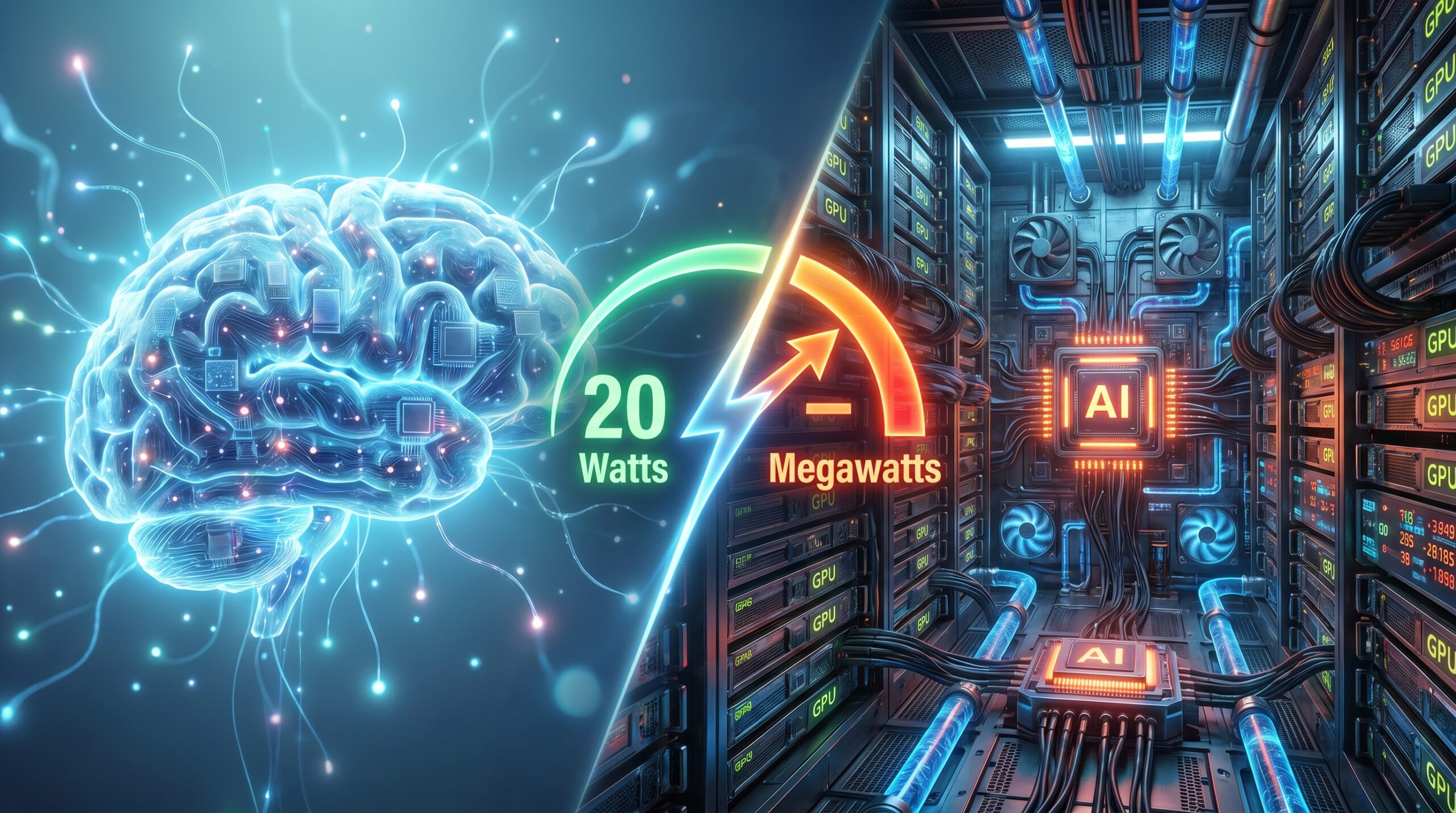
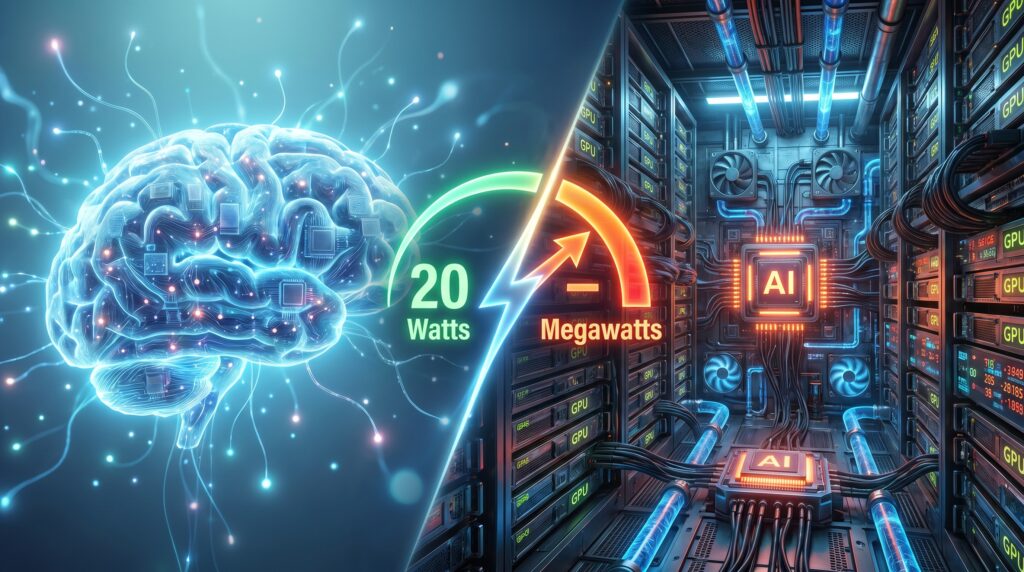
Your brain is running this article through your eyes right now on about 20 watts. That’s roughly what a small nightlight or appliance bulb pulls — on the low end of old-school incandescents, well below the 40–100W range of a typical household bulb — and I mean incandescent specifically, not LED. A 20W LED would actually be quite bright; LEDs are so efficient that the wattage-to-brightness comparison falls apart if you swap in modern bulbs. The 20W figure itself comes from long-standing neuroscience estimates built on PET (positron emission tomography) scans and ³¹P magnetic resonance spectroscopy tracking ATP turnover — researchers cited via the Human Brain Project put the figure at roughly 20 W for the whole organ. That gap between biological and digital efficiency is exactly what’s driving the current race to build neuromorphic chips — processors designed to think more like brains than calculators.
Now compare that brain efficiency to training a frontier AI model. A widely cited 2021 paper from Google and UC Berkeley researchers — building on energy-accounting methodology pioneered earlier at UMass Amherst — put the cost of training GPT-3 at around 1,287 megawatt-hours of electricity and 552 metric tons of CO2. Per MIT’s own reporting on that estimate, that’s enough to power roughly 120 average U.S. homes for a year, not just “dozens.” Worth flagging: GPT-3 is an old model by 2026 standards, and that figure has been public since 2021. Current frontier models are widely believed to be far more energy-intensive to train, though developers generally don’t publish detailed energy figures for their newest systems — so I won’t guess at one, but treat the GPT-3 figure as a historical anchor point, not today’s ceiling.
I’ll be honest: the first time I saw that comparison, I didn’t believe it. How does three pounds of fatty tissue out-compute a warehouse full of GPUs? But here’s the thing — it’s not really a fair fight. And that mismatch is exactly why a quiet corner of the chip industry is racing to build neuromorphic chips that think more like brains and less like calculators.
The Bill Is Coming Due
AI’s energy appetite isn’t some far-off hypothetical anymore. It’s showing up in utility bills right now.
According to the International Energy Agency’s 2026 “Energy and AI” report, electricity consumption from AI-focused data centers surged 50% in 2025 alone. That’s a narrower number, though — total data center electricity use, which also includes ordinary cloud storage, enterprise IT, and streaming infrastructure, is projected to roughly double from about 415 TWh in 2024 to around 945 TWh by 2030. Per the IEA, that 2030 figure is slightly more than Japan’s current total electricity consumption.
AI is the single biggest driver of that growth — it’s just not the only thing on the bill. In the United States specifically, the IEA expects data centers overall to account for nearly half of all electricity demand growth between now and 2030.
A few numbers worth sitting with:
- Per the IEA, AI accelerated servers’ electricity use is growing roughly 30% per year, far outpacing conventional computing.
- In Ireland, data centers already account for about 21% of national electricity use, with forecasts pointing toward 32% by 2026.
- Brookings cites Lawrence Berkeley National Laboratory research finding U.S. data centers could consume between 6.7% and 12% of total national electricity by 2028, up from 4.4% in 2023.
(If you want to understand how the energy industry is responding to this demand surge, I covered the supply side in depth here: Nuclear Energy’s Comeback: How AI’s Power Hunger Is Rewriting the Energy Playbook.)
To be clear, not all of that load comes from training new models. Industry estimates cited by multiple energy analysts suggest 80–90% of AI compute today goes toward inference — basically every time someone runs a query, generates an image, or asks a chatbot a question. Scale that across billions of daily requests and, well, you start to see the wall coming.
Why Your Laptop Chip Wasn’t Built for This
So why is AI so power-hungry to begin with? It comes down to architecture.
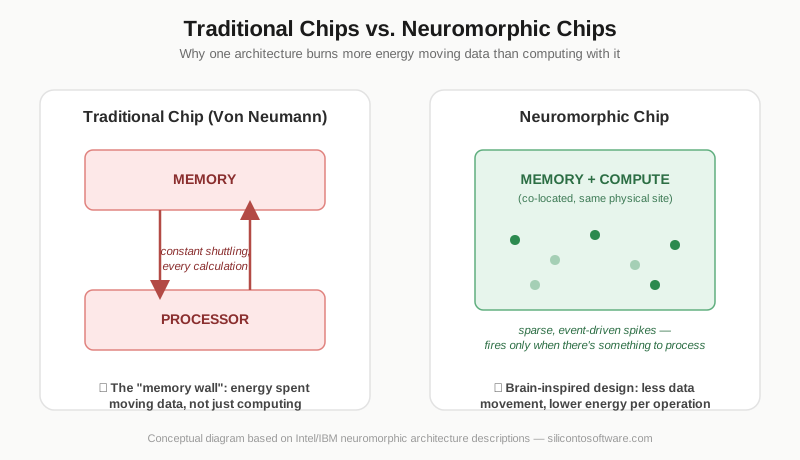
Traditional processors — the GPUs and CPUs running basically every AI system today — use what’s called the von Neumann architecture. Memory and processing live in separate places, and a lot of calculations still mean shuttling data back and forth between them, even with SRAM caches, high-bandwidth memory (HBM), and on-chip buffering doing their best to keep frequently used data close by. That shuffling burns energy, generates heat, and creates a bottleneck engineers have nicknamed (a little dramatically, but accurately) the “memory wall.”
Brains integrate storage and computation far more closely than conventional digital architectures do — memory in biological systems isn’t a separate component you write to and read from, it’s distributed across synaptic connections themselves. Neurons also aren’t constantly active: most aren’t firing at any given instant, even though background and spontaneous signaling never fully stops, which is a big part of why the brain’s average power draw stays so low. Computer scientists borrowed the term “event-driven” computation for the general idea: do work when there’s something worth doing, not on a fixed clock.
GPUs aren’t completely oblivious to this, to be fair — they do have power-saving tricks like clock gating, dynamic voltage/frequency scaling (DVFS), and increasingly, structured sparsity support that lets tensor cores skip some of the zero-heavy work. But even with those mitigations, when a GPU is mid-training-run, chewing through a dense matrix multiplication, a lot of its cores stay lit up and switching cycle to cycle, and moving data in and out of memory remains one of the biggest energy costs in the whole operation. I think of it like a house with better light switches now, but the wiring itself still runs power to rooms nobody’s standing in. Better than it used to be. Still wasteful. And that’s roughly how von Neumann-style silicon has worked for more than eighty years now, dating back to von Neumann’s 1945 architecture description.
Enter the Neuromorphic Chip
This is where neuromorphic chips come in.
Neuromorphic chips are processors designed to mimic the brain’s structure and efficiency — often, though not always, using spiking neural networks (SNNs), where artificial “neurons” communicate through discrete spikes rather than constant streams of numbers, and only activate when there’s actually something worth processing. Some designs go a step further with compute-in-memory architectures, physically merging memory and processing so data doesn’t have to travel as far. Less travel, less waste.
A few names you’ll want to know if you’re tracking this space:
Intel’s Loihi line
Intel’s Loihi 2 chips power Hala Point, deployed at Sandia National Laboratories — currently the world’s largest neuromorphic system, with 1.15 billion neurons spread across 1,152 Loihi 2 processors. Intel has demonstrated Loihi 2 solving certain optimization and sparse-coding problems at orders-of-magnitude lower energy than comparable GPU workloads on those specific tasks — it’s not a claim that it beats GPUs across the board.
IBM’s NorthPole
IBM took a different path. NorthPole keeps memory and compute tightly co-located on the same chip, sidestepping the data-bandwidth bottleneck that limits a lot of inference hardware. Worth being precise here: NorthPole doesn’t use spiking neurons the way Loihi does — it runs conventional, non-spiking low-precision inference (2-bit, 4-bit, 8-bit) with memory and compute merged on-die, rather than event-driven spike-based computation. Industry coverage calls it “neuromorphic” fairly loosely; IBM itself tends to describe it as “brain-inspired” rather than claiming the same computational model as Loihi. It’s widely described as a successor to IBM’s earlier TrueNorth chip, work that traces back to DARPA’s SyNAPSE program from the early 2010s.
BrainChip’s Akida
Akida is, to be honest, the furthest along commercially — BrainChip has positioned it for commercial deployment in edge AI, IoT, and automotive applications, though I couldn’t track down SEC filings, named OEM partners, or official shipment figures to back up the specific “millions of devices” number that circulates in some coverage, so I’m leaving that number out rather than repeating it.
The NASA-licensing claim and the on-device language-model funding details circulating in some 2026 coverage are shakier still: they trace back to the same single financial-news piece, not an official NASA or BrainChip release. Worth treating both as unconfirmed rather than settled fact until you see them corroborated elsewhere.
Certain sparse and event-driven workloads have demonstrated orders-of-magnitude efficiency improvements in published research — industry write-ups sometimes round that up to a flat “100x to 1,000x” figure, but that number depends heavily on which workload, which baseline chip, and which precision format you’re comparing. Treat it as a directional signal, not a benchmark you could cite in an engineering spec. Even on the conservative end of published results, it’s still the kind of gap that’s the difference between a phone battery lasting hours versus days.
(For a broader look at how these kinds of low-power chips are already being deployed outside data centers, see Edge AI Chips: The Future of AI Hardware and Why They’re Replacing Cloud-Based Intelligence.)
It’s Not All Solved, Though
Here’s where I have to pump the brakes a bit. Neuromorphic chips aren’t quietly waiting in the wings ready to swap in tomorrow.
Modern deep learning — the transformers and diffusion models behind today’s chatbots and image generators — is trained using backpropagation across continuous, smooth activations. Spiking neural networks fire in discrete, non-differentiable events, so standard backpropagation doesn’t apply to them directly. Researchers have built workarounds — surrogate-gradient methods, mainly — but training SNNs at GPT-scale is still an open research problem, not a solved one. Bottom line: you can’t just port a model like GPT over to a chip like Loihi and expect it to run. Worth being precise about what that means in practice: neuromorphic hardware like Loihi and Akida is primarily relevant to specialized inference and edge workloads today, not as a general replacement for the infrastructure that trains large models — training and inference are genuinely different problems, and neuromorphic chips are further along solving one than the other.
Add to that:
- A real shortage of mature development tools and programming frameworks
- No real industry-wide standardization yet
- Most deployments still concentrated in research settings or narrow edge-AI niches (sensors, drones, safety systems)
(And if you want to see where this trajectory leads beyond silicon entirely, The Next Computer Isn’t Made of Silicon: How Living Cells and Circuit Boards Could Power the Future of Computing picks up right where this post leaves off.)
One industry roundup pegged widespread commercial deployment for general-purpose AI at three to five years out — take that as a directional guess from market analysts, not an engineering roadmap with named milestones. So no, your phone isn’t about to ship with a brain chip that runs ChatGPT entirely offline. Not yet, anyway.
Why This Still Matters for the Rest of Us
Should you care about any of this if you’re not a chip engineer? I’d argue yes.
Every cloud query you send, every image you generate, every AI feature quietly baked into an app you use — it’s drawing real electricity from a real grid that’s already straining under the load. The IEA has flagged grid connection delays, equipment shortages, and longer wait times for transformers and turbines as genuine bottlenecks to AI’s continued growth. Energy isn’t just a sustainability footnote anymore. It’s becoming a hard constraint on how fast AI can scale.
Neuromorphic chips won’t single-handedly fix that. But they represent one of the more credible paths toward AI that doesn’t need its own power plant to run. Worth keeping an eye on — especially the next time your phone battery drains a little faster than you’d like after a long AI chat session (we’ve all been there).
About the Author
Imran Valiani | Sales Director, PCB Electronics Manufacturing
20+ years working with major Bay Area and global tech clients. Founder of Silicon to Software, where I write about the hardware layer — PCB fab, AI gear, autonomous systems, and cyber — the stuff most tech writers have never touched. Literally.
Follow: X @SiToSoftware | LinkedIn
For more analysis of compute, power, cooling, and infrastructure constraints, explore the AI Hardware & Data Centers Resource Hub.
This article was developed with AI assistance and edited, fact-checked, and reviewed by the author. See my full AI disclosure.
Sources
- IEA, Energy and AI (2025)
- IEA, Energy demand from AI
- IEA, Key Questions on Energy and AI (2026)
- Lawrence Berkeley National Laboratory, United States Data Center Energy Usage Report (2024)
- Brookings Institution, Global Energy Demands Within the AI Regulatory Landscape (2026)
- IIEA, Data Centres in Ireland: The State of Play — citing CSO and Carbon Brief data
- Patterson et al., Carbon Emissions and Large Neural Network Training (2021)
- MIT News, Explained: Generative AI’s Environmental Impact (2025)
- Sastry et al., Computing Power and the Governance of Artificial Intelligence (2024)
- Brain Power, PNAS (2021)
- Human Brain Project
- Intel Newsroom, Hala Point announcement
- Sandia National Laboratories, Hala Point coverage
- IEEE Spectrum, Brain-Inspired Chip Achieves Rapid Deep Learning — IBM NorthPole architecture and precision specifications
A few figures in this piece — the 100x–1,000x neuromorphic efficiency range and the 3–5 year deployment timeline — come from industry analysis rather than a single peer-reviewed benchmark, and are presented in the text as directional estimates rather than precise figures.