Counterfeit Semiconductor Chips Explained: How Fake ICs Enter Electronic Devices and Why They’re So Hard to Detect
Counterfeit semiconductors have caused billions of dollars in estimated losses and continue to threaten electronics supply chains. Learn how fake ICs infiltrate the supply chain, the risks they create for AI hardware, automotive systems, medical devices, and defense electronics, and the advanced inspection methods manufacturers use to stop them.
Table of Contents
In 2012, the US Senate Armed Services Committee closed out a year-long investigation into counterfeit semiconductor chips in the US defense supply chain. What they found was ugly. About 1,800 cases of suspect counterfeit electronic parts, involving more than a million individual components, had worked their way into that supply chain. Some of those parts turned up in Special Operations helicopter assemblies. Some landed in a Navy surveillance plane. Others showed up in mission computers for the THAAD missile defense system — and per the committee’s report, Missile Defense Agency officials said that if those suspect counterfeit devices had failed, THAAD itself would likely have failed too.
Think about that for a second. A missile-defense mission computer had received suspect counterfeit memory devices — parts that officials warned could have caused system failure.
To be honest, this isn’t just a defense-industry horror story. It’s a window into a problem that touches your phone, your car, your pacemaker if you have one, and increasingly, the AI hardware powering everything from chatbots to self-driving systems. Here’s the thing — most people have no idea how deep this goes.
What Counts as Counterfeit Semiconductor Chips
Let’s get the definition straight first. Counterfeit semiconductor chips aren’t always built from scratch in some back-alley fab (though that happens too). Industry taxonomies vary by organization, but a handful of forms come up again and again across SAE’s and ERAI’s frameworks:
- Recycled parts. Old chips pulled from scrapped circuit boards, cleaned up, and re-marked as new.
- Remarked chips. A lower-spec or rejected part gets a new label so it looks like a premium version.
- Cloned designs. Reverse-engineered copies that mimic a legitimate chip’s function, sometimes badly.
- Overproduction. Extra units made in an authorized factory, using the same masks, but sold outside the contract — no quality control, no traceability.
- Defective parts sold as good. Chips that failed testing at the original manufacturer, diverted and sold anyway.
- Forged or falsified documentation. A physically authentic — or physically counterfeit — part accompanied by fake certificates of conformance or altered traceability paperwork. This is a distinct problem from physical alteration: it’s not something inspecting the part itself will catch, since the part and the paperwork have to be verified separately, against the manufacturer or an authorized source.
I’ve found that people assume counterfeiting means total fakes. It usually doesn’t. A recycled or overproduced chip can look and even test almost fine, right up until it doesn’t.
How Counterfeit Semiconductor Chips Get Into the Supply Chain
The honest answer? Almost anywhere there’s a gap in oversight.
1. The Gray Market
Legit distributors — the ones authorized directly by manufacturers like TI, Analog Devices, or Infineon — aren’t always the source. When a part is scarce (hello, chip shortage era), buyers turn to independent brokers. Those brokers buy from other brokers, who buy from other brokers. By the time a part reaches an assembler, it may have changed hands five or six times.
The Senate investigation actually documented this exact chain. Suspect parts destined for Navy SH-60B helicopter electromagnetic interference filters changed hands five times before a Raytheon subcontractor bought them — and neither the Pentagon nor Raytheon knew the parts had originated with a company in Shenzhen, China, until investigators traced it back.
Worth being precise about the terms here, since they’re not interchangeable. A qualified independent distributor operating under AS6081A and IDEA-STD-1010-B — the standards referenced throughout this piece — isn’t the same risk category as an unregulated broker or gray-market reseller. The differentiator isn’t the label “independent” itself; it’s whether the source has documented traceability, a real quality system, and inspection controls behind it. An independent distributor with those things in place is a different proposition than a five-hop chain with none of them.
2. E-Waste Recycling Operations
Some regions have become hubs for stripping components off discarded circuit boards. Chips get desoldered, sanded down, re-blackened, and remarked with a fresh date code. To a visual inspector? Looks brand new.
Here’s the part that matters for reliability, not just detection: a part with prior use carries an unknown thermal, mechanical, and storage history. It may have been through one or more reflow cycles already, handled roughly during removal, or stored somewhere with no humidity control. None of that necessarily shows up on a basic incoming electrical test — the part can power on and function normally at room temperature. The risk shows up later, under thermal cycling, vibration, or extended operation, when whatever latent stress that prior history left behind finally catches up with it. That’s not a claim that every recycled part fails — most of the time you can’t even tell from testing alone whether a given part will or won’t. It’s the reason “it passed incoming inspection” and “it’s reliable long-term” aren’t the same statement.
That unknown history connects directly to the assembly floor, too. A part’s moisture-sensitivity level (MSL) rating assumes a known handling and storage history from the manufacturer forward — a recycled part’s actual moisture exposure prior to resale is, by definition, unknown. If that part goes through reflow without its real moisture history accounted for, trapped moisture can vaporize and cause package cracking or delamination — the failure mode commonly called “popcorning.” This doesn’t mean every recycled or counterfeit part has invalid MSL history, and it’s not a reason to guess at bake times or floor life without manufacturer data. It’s one more reason component authenticity is a manufacturing-quality and assembly-reliability issue for EMS teams, not only a sourcing decision made upstream of them.
3. Unauthorized Production
This one’s more contested than it sounds. In some threat models, a facility with legitimate access to a design or mask set produces or diverts units beyond what was authorized. Access to legitimate design data, masks, or manufacturing capability does not by itself establish that an unauthorized production run followed the same controlled wafer processing, assembly, test, qualification, binning, calibration, and traceability processes as the legitimate product. So “same silicon” doesn’t mean “same quality.”
It’s a recognized category under standards like AS6081A, but manufacturers often treat it as a contract-compliance and IP-enforcement issue rather than a classic quality-counterfeit problem — which partly explains why the reporting data on it looks thinner than for recycling or remarking.
4. Fake Authorized Distributors
Some counterfeiters build entire fake storefronts — websites, invoices, the works — that mimic a real authorized distributor almost perfectly. Buyers think they’re sourcing direct from the manufacturer’s network. They’re not.
Per the Senate committee’s 2012 findings, more than 70 percent of the suspect parts that could be traced were linked to China — though the report was careful to note that unclear origins and weak reporting systems were themselves part of the problem, not just where the parts came from.
The dollar figure that gets cited most often comes from a separate source: the Semiconductor Industry Association’s Anti-Counterfeiting Task Force estimated in a 2013 white paper that counterfeiting costs US semiconductor companies more than $7.5 billion a year, translating to roughly 11,000 lost American jobs. That figure kept getting cited as late as 2017 industry reporting, for lack of a more current official estimate — worth knowing if you see it repeated as if it’s brand new.
This isn’t abstract, either. First Lt. David Schmitz, an F-16 pilot, died in June 2020 when his ejection seat’s parachute failed to deploy during a nighttime landing accident at Shaw Air Force Base. The Air Force Research Laboratory later flagged several components inside the seat’s digital recovery sequencer — MOSFETs and flash memory chips — as suspected counterfeit, based on physical anomalies including scratching and gouging.
That finding was never confirmed beyond dispute, and the allegations became the subject of a federal product-liability lawsuit filed in 2022 against the named contractors — a claim, not a finding of liability. I’m citing it carefully rather than as settled fact: it’s a documented case of suspected counterfeit components in a safety-critical system, not proof that counterfeiting caused a death.
Why Counterfeit Semiconductor Chips Are So Hard to Detect
This is where it gets genuinely tricky, even for professionals with real lab equipment.
Visual inspection alone isn’t enough. Counterfeiters have gotten good at black-topping (sanding off original markings and repainting) and laser re-marking, reproducing logos and date codes closely enough to defeat a cursory look. A trained eye under a microscope, following a controlled inspection process, catches a lot of it. Not all of it — and not reliably enough to be the only check for anything safety-critical.
Functional testing has blind spots. A recycled chip can pass a basic functional test at room temperature and still fail under thermal stress, vibration, or extended use. A limited room-temperature check tells you the part turns on. It doesn’t establish full parametric compliance, environmental rating, or long-term reliability — that takes burn-in, temperature testing, and comparison against known-good reference parts.
Datasheets get faked too. Buyers cross-check part numbers against datasheets, but a seller-provided datasheet can be falsified along with the part. The check only holds up if it’s validated against the manufacturer’s own current documentation or an authorized source — not whatever PDF the seller hands over.
Supply chains can get genuinely opaque. At the far end of a multilayer brokerage chain, visibility into the original source is often incomplete or impossible to verify. That’s not always negligence — it’s how distributed global sourcing tends to degrade by default, though disciplined buyers do preserve traceability through authorized channels and serialized records.
So what actually catches these things?
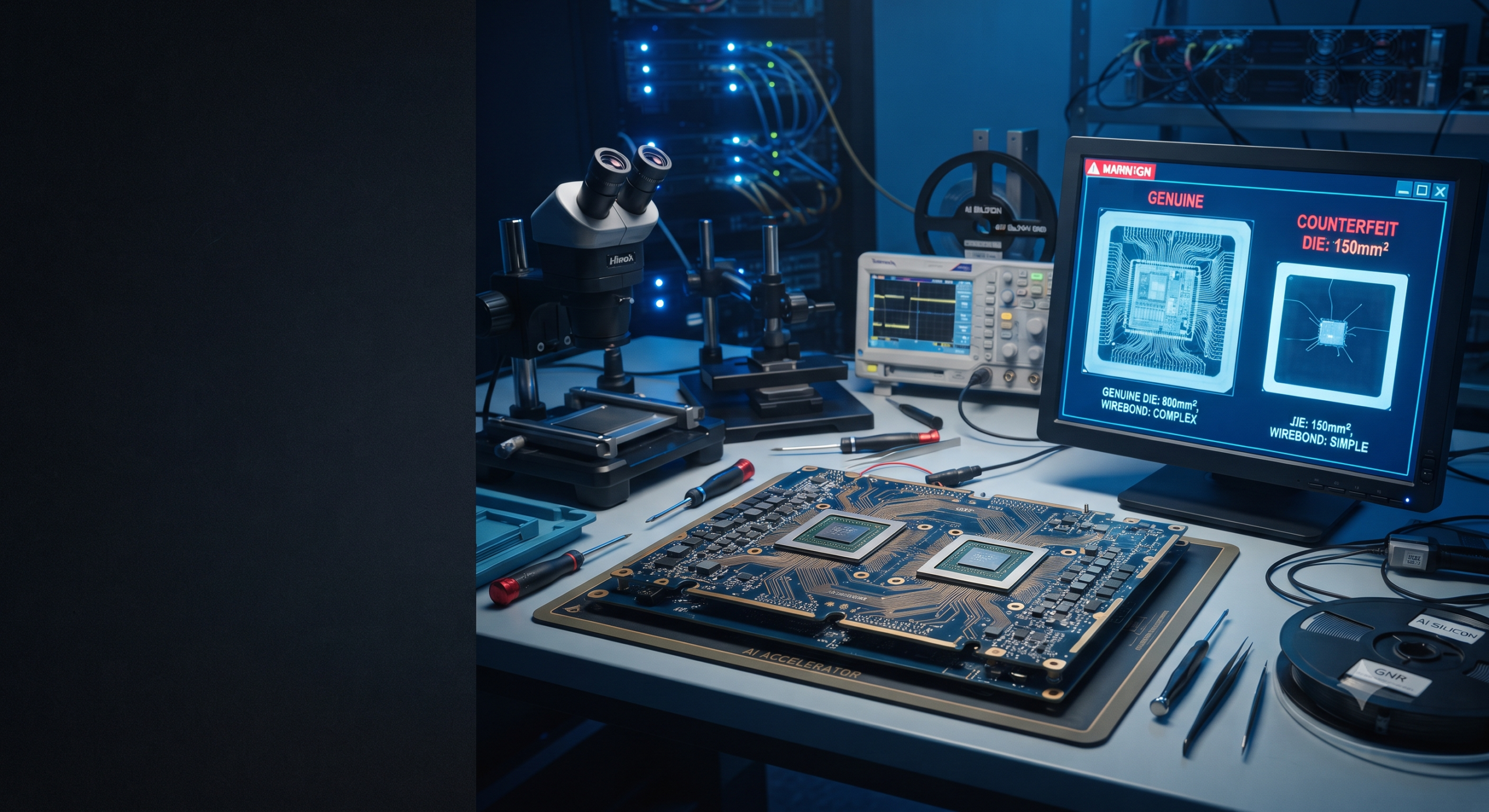
- X-ray or computed-tomography inspection to compare die size, placement, bond-wire configuration, and lead-frame geometry against known-good reference devices — it doesn’t resolve transistor-level circuitry, but it catches internal construction mismatches. What it can actually show depends on the package: a wire-bond package exposes different internal structure to X-ray than a flip-chip or other construction does, so its usefulness isn’t uniform across part types.
- Decapsulation, where the package is chemically stripped to expose the die for optical or electron microscopy, comparing die markings, dimensions, and metallization against a known-good sample. It’s destructive to the unit tested, which is why it’s typically used for sampling or investigative purposes rather than as a routine step applied to every part in a lot.
- Scanning Acoustic Microscopy (SAM), which reveals delamination, cracking, and voiding consistent with prior moisture exposure or thermal stress — suggestive of a recycled part, though not proof on its own
- XRF (X-ray fluorescence) analysis to compare the elemental composition of leads and terminations against manufacturer records, which can expose plating or material inconsistent with what a legitimate part should contain
- Structured inspection against IDEA-STD-1010-B (the open-market component inspection and acceptance standard, which covers remarking and blacktopping detection among broader visual/physical criteria), plus program-level requirements under SAE AS5553 (current revision AS5553E, updated in November 2025) for manufacturers and SAE AS6081A for distributors
Cost and turnaround vary widely. Basic screening — marking checks, dimensions, quick X-ray — can be relatively fast. Decapsulation and full electrical characterization are slower and more expensive. And — worth being straight about this — none of it is equally effective against every counterfeit type.
X-ray and SAM can help identify package anomalies consistent with prior use or thermal processing — bond-wire mismatches, delamination, cracking, voiding — but those findings are supporting evidence, not proof that a component was recycled. They’re also a lot weaker against a cloned or overproduced part built from otherwise-legitimate silicon on the original masks. In that case, the die itself isn’t damaged or fake — it’s just unauthorized. That’s a different problem, and it usually needs traceability records and supply chain documentation, not a microscope, to catch.
That gap — between “we can physically detect this” and “this counterfeit type doesn’t leave a physical trace to find” — is a big part of why the problem hasn’t gone away. It exploits the space between verifying properly and verifying fast enough to keep production moving.
Why This Matters More Now, Not Less
A few years back this felt like mostly a defense-and-aerospace problem. Not anymore.
Automotive. This isn’t hypothetical. In October 2025, Shenzhen police dismantled a counterfeit chip ring — reported by the South China Morning Post — that had been reclaiming discarded chips, laser-polishing off the old markings, and relabeling them as imported products from Infineon, Texas Instruments, and Analog Devices, moving them through companies posing as European agents. Per the reporting, the ring’s downstream targets included automotive electronics and industrial control applications. Modern cars rely on numerous microcontrollers and electronic control units, including systems tied to braking, steering assistance, and occupant protection — a counterfeit part in any of those isn’t a warranty issue, it’s a safety issue.
Autonomous vessels. The same gray-market and remarking risks apply below deck. Autonomous cargo ships are part of a broader shift toward onboard systems governed by requirements like IACS UR E27, “Cyber Resilience of On-Board Systems and Equipment” — a general onboard-systems standard that applies more broadly than autonomous vessels specifically, and one focused on cyber resilience (network segmentation, access control, software assurance) rather than physical component authenticity. E27 doesn’t mandate hardware-integrity controls the way AS6081A or IDEA-STD-1010-B do; it’s not the standard’s claim that hardware provenance matters here. But it’s a reasonable engineering inference that any cyber-resilience framework implicitly assumes trustworthy hardware underneath the software layer it’s securing — a counterfeit or unauthorized part in a navigation sensor or propulsion controller would undermine that assumption, even though IACS UR E27 itself doesn’t address hardware authenticity directly.
Medical devices. A World Semiconductor Council white paper describes a case where a counterfeit semiconductor component was identified inside an Automated External Defibrillator, producing an over-voltage condition — the paper doesn’t name the manufacturer, model, or date, so treat it as a documented industry example rather than a fully traceable incident report. Left undetected, that kind of failure could mean a defibrillator delivering an improper shock to someone in cardiac arrest. Pacemakers, insulin pumps, and diagnostic equipment weren’t part of that specific case, but they depend on the same kind of long-term component reliability, which is exactly why provenance and traceability matter there too.
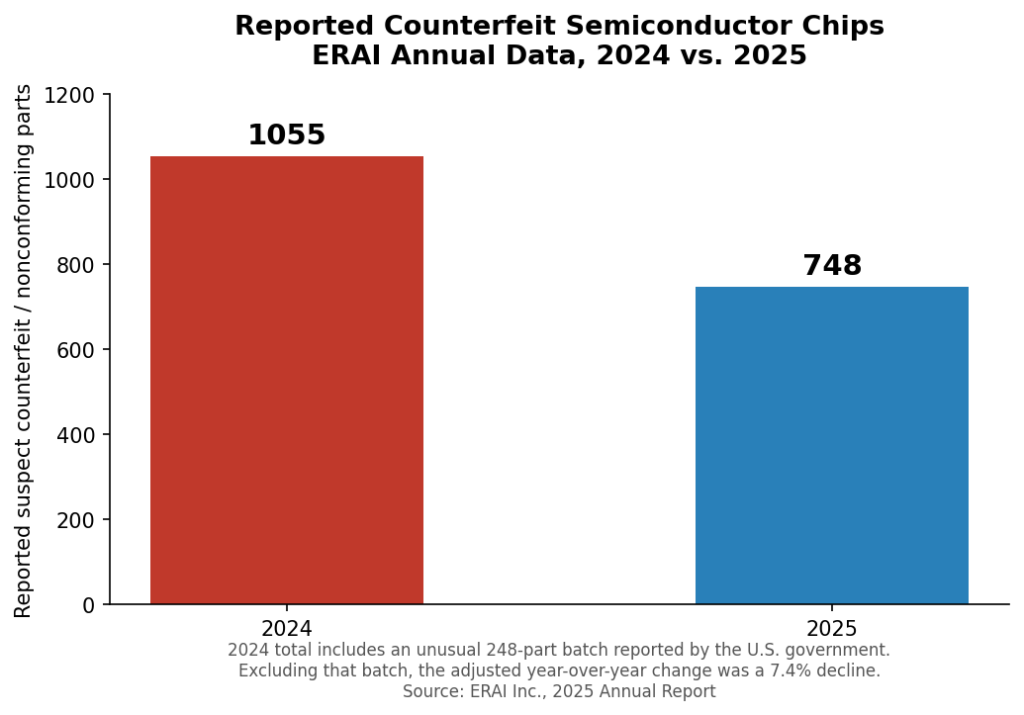
AI hardware. It’s tempting to picture counterfeit GPUs flooding AI data centers. ERAI’s own reporting tells a more complicated story. Reported suspect counterfeit and nonconforming parts rose 25 percent in 2024 — the highest volume ERAI had logged since 2015 — but that total included an unusual batch of 248 parts reported by the U.S. government in May 2024. In 2025, ERAI logged 748 reported parts, a 29.1 percent unadjusted drop. Strip out that one-off government batch, though, and the adjusted year-over-year change was a 7.4 percent decline — much closer to the reporting levels seen in 2022 and 2023 than the unadjusted figure suggests.
Worth watching going forward: the industry’s shift toward chiplets and multi-vendor advanced packaging means a single finished package can now contain die from several different suppliers assembled by a third party — a structural change to the supply chain that adds new provenance questions this piece doesn’t cover.
That happened while global semiconductor sales climbed roughly 25.6 percent. ERAI offered one possible explanation, not a firm conclusion: a substantial share of that growth came from high-end AI-related components, which the organization describes as harder to counterfeit due to their technical complexity and the export controls around them.
That doesn’t mean AI infrastructure is risk-free, though. Programmable logic ICs, analog ICs, microprocessors, and memory devices remained ERAI’s largest reported categories, and all of those sit around accelerators in a data center rack. ERAI’s data doesn’t separately break out how many of those parts were destined for AI infrastructure specifically, so treat that connection as a reasonable inference, not a measured fact.
Consumer electronics. Your phone charger, your laptop, your smart home hub — these are lower-stakes but higher-volume targets, and that volume is exactly why counterfeiters bother.
What Manufacturers Are Actually Doing About It
The response has been a mix of policy and technology.
On the policy side, findings from the Senate investigation — including its November 2011 hearing — helped shape Section 818 of the FY 2012 National Defense Authorization Act, signed into law December 31, 2011. The committee’s full findings followed in the May 2012 report cited throughout this piece. Section 818 directed the Department of Defense to strengthen counterfeit-part detection and avoidance systems, establish trusted-supplier controls, require reporting, and place significant responsibility on covered contractors for counterfeit-part remediation — with the cost and liability details worked out through later DFARS regulations rather than the statute alone.
On the technology side, manufacturers are leaning on tighter authorized-distributor-only sourcing policies and third-party test labs that specialize purely in counterfeit detection. Some manufacturers and supply-chain programs are also piloting serialization, secure identifiers, or forensic marking technologies at various points in the chain — though adoption is fragmented and varies by vendor and product class, not a universal fab-level practice.
At the level of an individual organization, the controls that actually reduce exposure are less about any single silver-bullet technology and more about a consistent chain: an approved-manufacturer and approved-vendor list narrows sourcing to known-good origins, which reduces chain-of-custody uncertainty before a part is even ordered. Lot and date-code traceability, verified against the manufacturer, lets a suspect finding on one unit be traced back to everything else in that same lot. Incoming inspection sized to the actual risk of the part and source — not a blanket policy — catches physical, marking, and package anomalies before anything reaches assembly. When something suspect does turn up, quarantine keeps it out of production while it’s evaluated, and a formal nonconformance and disposition process prevents the same suspect lot or source from quietly getting used again. None of these controls guarantees authenticity on its own — they’re layers, and a determined counterfeiter can beat any single one. External resources like GIDEP or ERAI can supplement this as shared intelligence on parts and sources already flagged elsewhere in the industry, though using them isn’t a substitute for an organization’s own controls.
None of it’s a silver bullet. But here’s the thing — the more expensive and disruptive counterfeit incidents get, the more pressure builds to close these gaps. The continued appearance of suspect parts across defense, automotive, and medical systems suggests the problem hasn’t been eliminated — the THAAD case shows why closing those gaps still matters. What ties all of it together — the recycled-part reliability risk, the MSL and reflow exposure, the traceability gaps, the layered controls — is that component authenticity isn’t only a sourcing decision made once at procurement. It’s a manufacturing-quality and reliability variable that follows a part all the way to the field.
About the Author
Imran Valiani | Sales Director, PCB Electronics Manufacturing
20+ years working with major Bay Area and global tech clients. Founder of Silicon to Software, where I write about the hardware layer — PCB fab, AI gear, autonomous systems, and cyber — the stuff most tech writers have never touched. Literally.
Follow: X @SiToSoftware | LinkedIn
This article was developed with AI assistance and edited, fact-checked, and reviewed by the author. See my full AI disclosure.
Verification — Key Sources Used
- U.S. Senate Committee on Armed Services, “Senate Armed Services Committee Releases Report on Counterfeit Electronic Parts,” May 21, 2012
- U.S. Senate, November 8, 2011 hearing record on counterfeit electronic parts in the DoD supply chain
- Semiconductor Industry Association, Anti-Counterfeiting Task Force white paper, 2013 — source of the $7.5B/11,000-jobs figure, originally from November 2011 testimony
- Public Law 112-81 (FY2012 NDAA), enacted December 31, 2011 — Section 818 statutory text
- The Aviationist, “Report unveils the presence of more than a million counterfeit electronic parts in U.S. combat planes,” May 2012
- Air Force Times, “An F-16 pilot died when his ejection seat failed. Was it counterfeit?”, September 2022 — primary reporting on the Schmitz case and AFRL findings
- Military.com, coverage of the federal lawsuit filed by Valerie Schmitz against Lockheed Martin, Collins Aerospace, and Teledyne Technologies
- ERAI Inc., 2025 Annual Report — direct source for the 29.1% headline decline, the 7.4% adjusted decline, and AI accelerator risk framing
- SAE International, AS5553E standard record (current revision, published November 2025)
- SAE International, AS6081A standard record for independent distributors
- IDEA-STD-1010-B inspection standard, Independent Distributors of Electronics Association
- IACS, UR E27 Rev.1, September 2023, “Cyber resilience of on-board systems and equipment”
- South China Morning Post, “Shenzhen police busts syndicate selling counterfeit Infineon and Texas Instruments chips,” October 2025
- World Semiconductor Council, “Winning the Battle Against Counterfeit Semiconductor Products,” anti-counterfeiting white paper — Automated External Defibrillator incident
Note: The counterfeit taxonomy reflects general industry usage across SAE and ERAI frameworks rather than a verbatim quote from any single standard’s text. Standards referenced (SAE AS5553E, SAE AS6081A, IDEA-STD-1010) reflect established industry practice as of this writing; pull current published revisions directly before citing specific requirements. The status of the Schmitz litigation is described as of its 2022 filing — current docket status wasn’t independently reconfirmed for this piece and should be checked before publication if that detail matters to the use case.