Rare Earth Magnets Explained: Why the Real Bottleneck Comes After Mining
EV motors, wind turbines, robots, and electronics all depend on high-performance permanent magnets — and the largest diversification gap sits downstream, in refining, metallization, and magnet manufacturing, not at the mine.
Table of Contents
Rare earth magnets sit inside almost every high-performance motor built today — and the supply chain behind them is more fragile than most people assume.
A customer asked me to source a magnet-grade motor once. He wanted “fully domestic.” Mined in the US. Pressed in the US. He was proud of that. Fair enough — it’s a reasonable thing to be proud of.
Then I asked where the oxide had been separated.
Silence.
He didn’t know. And honestly? That’s the whole problem right there. The ore came out of American ground. But somewhere between the mine and the finished magnet, it almost certainly passed through a Chinese separation plant. Why? Because there just aren’t many other places on Earth that can do that step at the volume he needed.
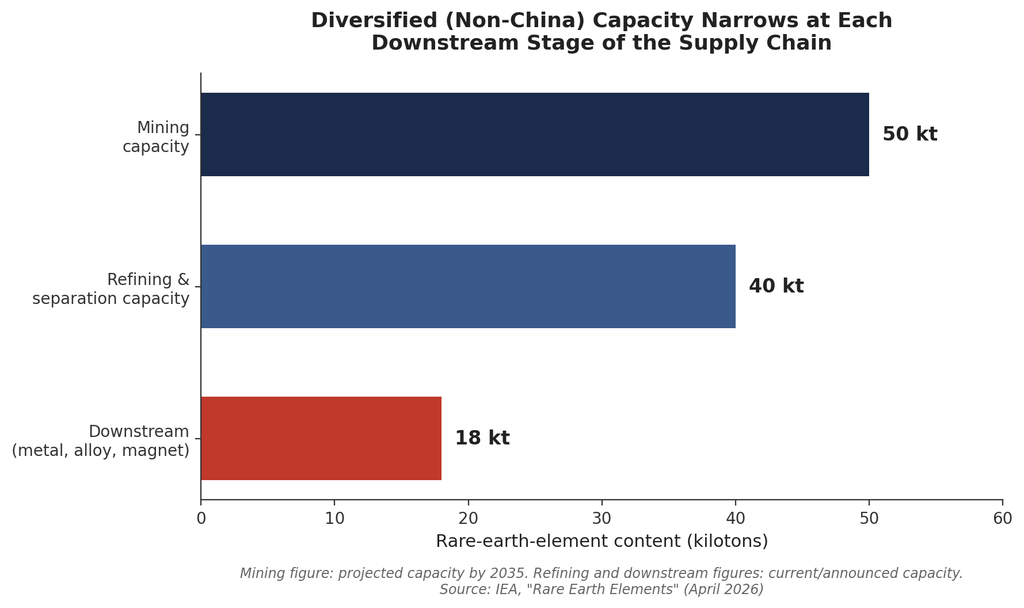
Here’s the thing about this entire supply chain: everyone’s staring at the wrong number. According to the IEA’s April 2026 “Rare Earth Elements” report, diversified mining capacity is projected to blow past 50 kilotons of rare-earth-element content by 2035. Refining and separation outside China? Still under 40 kt. Downstream metal, alloy, and magnet projects? About 18 kt. That’s roughly one-third of diversified mining capacity. Read that gap twice.
The IEA doesn’t hedge on this one. Their conclusion: magnet production remains the main bottleneck for supply diversification, with refining close behind. To actually meet demand at scale, you’d need something like a four-fold jump in non-Chinese refining and a six-fold jump in magnet manufacturing.
I’ve spent 20+ years on the technical sales side of this industry — laminates, stackups, supply chain risk, the unglamorous line items in a bill of materials nobody writes headlines about. So let’s actually walk through where this chain breaks down. Not where the headlines say it breaks down. Where it actually does.
The Stages of Rare Earth Magnet Production
The IEA breaks the value chain into extraction, beneficiation, chemical upgrading, separation, metal refining, alloying, and magnet manufacturing. That’s a mouthful. I’ll group it into three stages instead, since those are the ones with actual concentration data attached:
- Mining — pulling rare-earth-bearing ore out of the ground (bastnäsite, monazite, ion-adsorption clays).
- Refining and separation — splitting mixed rare earth oxides into individual pure elements. This takes hundreds of extraction stages, potentially, because the lanthanide elements are chemically almost identical twins.
- Downstream production — turning separated oxides into metal, casting the NdFeB alloy, sintering it, magnetizing it. Now it’s a magnet.
A magnet’s country-of-origin label tells you where the finished part left the factory. It does not tell you which of these processes happened in China. That distinction matters more than people think. A “Made in USA” final assembly can still lean entirely on Chinese separation chemistry a few tiers back — and that gap is exactly where sourcing risk hides.
Let’s talk about that gap for a second, because it’s not just semantics. Under FTC rules, an unqualified “Made in USA” claim needs all — or virtually all — significant processing and components to be US-origin. The agency actually enforces this (they issued fresh warnings to companies over shaky claims as recently as July 2026). A product assembled here from imported oxide? Depending on how much foreign content is involved, that could need a qualified claim instead — something like “Assembled in USA from imported materials.” Even that phrase has its own FTC baggage around where principal assembly actually happened.
Companies aren’t necessarily lying here. The labeling standard most people assume exists — “if it says Made in USA, everything in it is American” — just isn’t the real standard. And the space between assumption and reality? That’s where the risk lives.
Why the Mining Statistic Is the Wrong One to Lead With
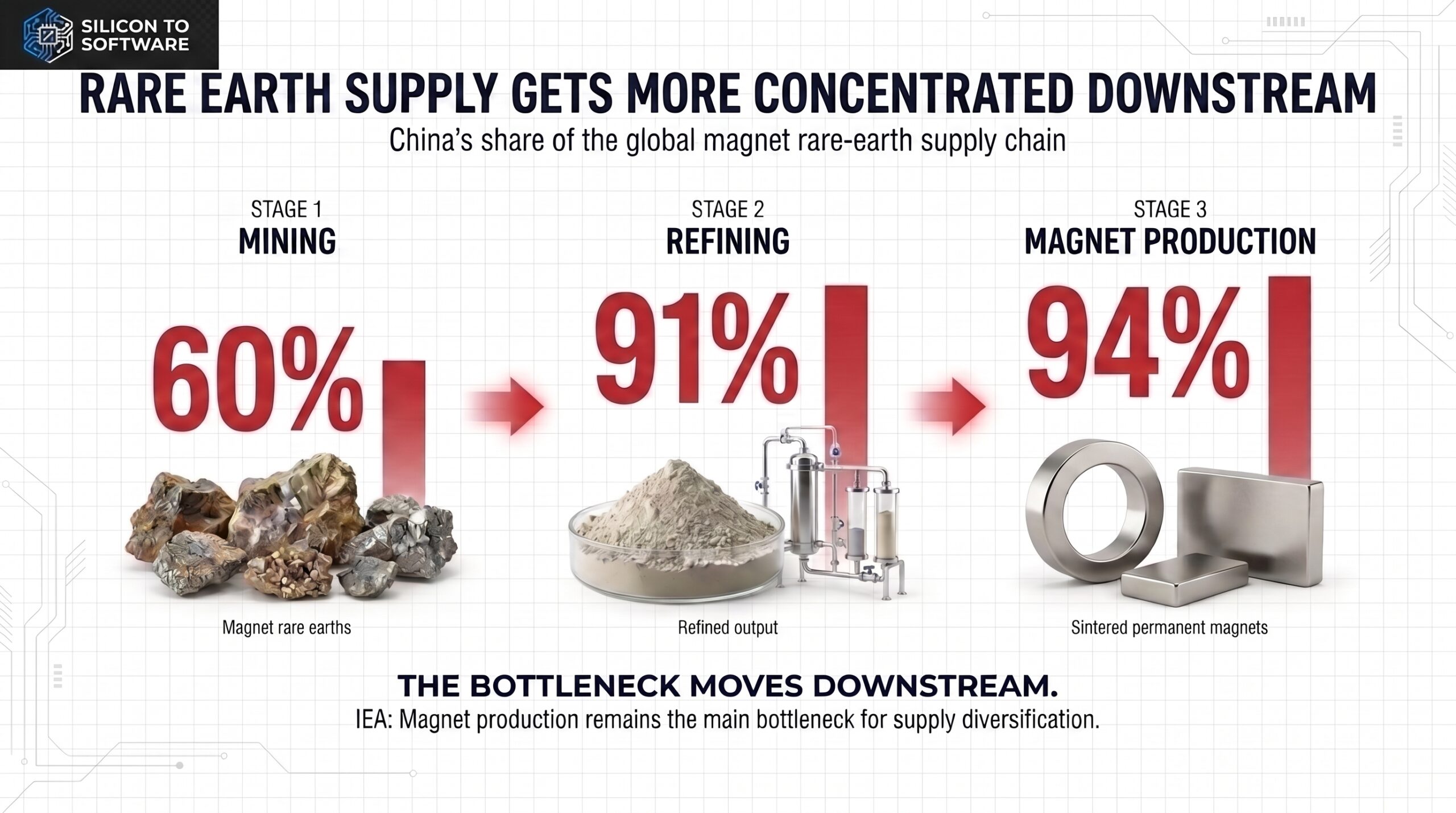
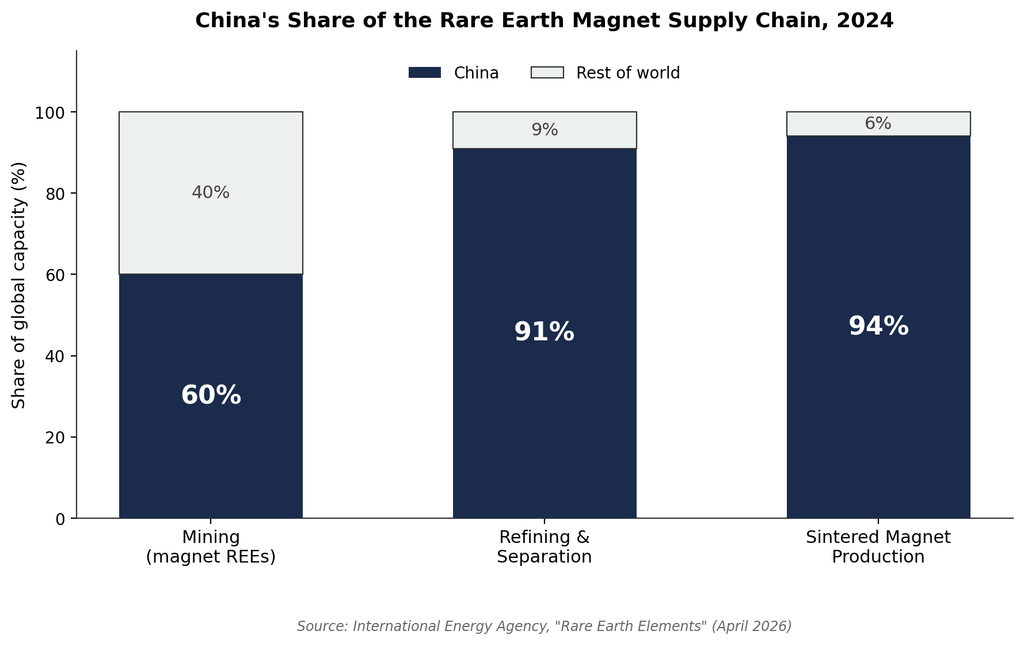
China mined roughly 60% of the world’s magnet-grade rare earths in 2024 — neodymium, praseodymium, dysprosium, terbium. That’s the IEA’s most recent baseline. You’ll also see a separate 71% figure floating around. That one’s USGS data, but it’s measuring something different — US import dependency on China (2021-2024), not global mine-production share. Same country, different metric. The actual global mine-production share, using USGS’s own tonnage numbers, works out closer to 69%.
Mining is necessary. It’s just not the primary constraint. The real gaps sit downstream.
China represented 91% of global refined output in 2024. And roughly 94% of sintered permanent-magnet production. That second figure is overwhelmingly tied to the high-performance NdFeB supply chain, though — full disclosure — the IEA’s public materials don’t spell out the exact denominator narrowly enough for me to say with total certainty it excludes every adjacent magnet type.
Ore mined in Australia or the US has, historically, still had to route through Chinese separation before it became usable oxide. That’s exactly why export restrictions work as leverage. Beijing doesn’t need to control the mine. It just needs to control the plant that turns raw ore into something an engineer can actually spec into a motor.
The Engineering and Regulatory Reasons Downstream Capacity Is Hard to Replicate
Separation is hard. Not because of geology. Because of chemistry. The lanthanide elements behave almost identically in solution — pulling one cleanly away from the other fourteen takes long cascades of solvent extraction or ion exchange, potentially hundreds of stages, tight process control the whole way through.
There’s a regulatory wrinkle too. Not every rare-earth feedstock carries the same radiological baggage — it depends heavily on the ore. Monazite-bearing deposits are the worst offenders. Where thorium shows up above certain concentrations, US processing can trigger a source material license under 10 CFR Part 40. That’s NRC’s own definition, and it’s specific: ores with 0.05% or more by weight of uranium, thorium, or a combination of the two count as source material.
Rare Element Resources found this out the hard way with their Wyoming demonstration plant. Licensed by the NRC back in 2023 because processing there generated waste with natural uranium and thorium in it. But — and this is a genuinely interesting update — Wyoming took over that regulatory authority itself, effective April 30, 2026. The original license has already transferred to the state’s own program. So a new project sited there today would probably go through Wyoming, not the NRC directly. Same regulatory weight either way, just a different address for the paperwork.
Western processing capacity didn’t just quietly fade in the 90s and 2000s. It got squeezed out — cost pressure, environmental compliance costs, deliberate industrial policy in China. Not one cause. A slow, decades-long structural shift.
Right now, ex-China refining and separation capacity sits under 40 kilotons, spread thin across Malaysia, the US, Australia, Vietnam, Japan, the UK, France, and Estonia.
And Washington’s money tells you exactly where they think the real risk is. The DoD’s July 2025 deal with MP Materials breaks into five pieces, per the company’s own SEC filing:
- Equity: $400 million in preferred stock, with room for $350 million more.
- Separation loan: $150 million, specifically for expanding heavy rare earth separation at Mountain Pass.
- Price floor: $110/kg on NdPr oxide, for 10 years. If market price drops below that, DoD covers the gap. If it climbs above it — once the new facility hits target capacity — DoD takes 30% of the excess.
- Offtake: A 10-year commitment to buy 100% of the output from MP’s planned “10X” facility. That’s expected to add roughly 7,000 metric tons annually once commissioning wraps up in 2028, which — combined with Independence’s own expansion from about 1,000 MT today to a projected 3,000 MT/year — would push MP’s total US capacity to an estimated 10,000 metric tons a year.
- Revenue guarantee: DoD guarantees the 10X facility a minimum of $140 million in annual EBITDA. Takes the first $30 million above that. Splits anything above $170 million fifty-fifty.
Five terms. None of them open a new mine. The whole package is aimed squarely at separation and magnet manufacturing — though, to be fair, the equity money itself isn’t legally tied dollar-for-dollar to those two stages the way the loan and offtake specifically are.
Then there’s Project Vault. $12 billion, launched February 2026, sort of. It’s really a $10 billion EXIM loan plus what EXIM itself calls “nearly $2 billion” in private capital — a financing structure for a stockpile, not a claim that $12 billion of minerals already exist somewhere in a vault. It runs on EXIM’s existing lending authority, not a fresh act of Congress (the CRS actually lists it as an “executive-established initiative” and notes Congress is still deciding whether to formally codify it).
One builds capacity. The other buys insurance. Only one of those actually shifts who’s in control.
Why “Every EV Motor Needs Rare Earth Magnets” Is Wrong
Some dual-motor Tesla configurations pair an induction motor up front — zero permanent magnet, zero rare earth exposure — with a permanent-magnet synchronous motor in back. Tesla’s own documentation backs this up. But motor sourcing has shifted by model, trim, and production date over the years, so don’t treat this as a universal spec for every Tesla ever built.
GM did something more interesting with the second-gen Chevy Volt (2016+). Two motors. One (Motor A) with a ferrite rotor. One (Motor B) with NdFeB. Under typical electric-only driving, Motor B does most of the heavy lifting while Motor A kicks in at higher loads — though, worth noting, the Voltec transaxle actually lets both motors swap between motor and generator duty across several operating modes. So it’s more dynamic than “one works, one waits.” GM’s own numbers: total rare earth magnet content dropped from 3.2 kg to 1.2 kg.
BMW’s i4 uses an electrically excited synchronous motor with zero permanent magnet, per BMW’s own materials. Their current iX3 does the same trick two ways. The single-motor iX3 40 runs one rear EESM. The dual-motor iX3 50 xDrive pairs that same rear EESM with a front asynchronous motor. Rotor excitation in the EESM comes from externally supplied current. BMW’s also reported real power-density gains in this generation of EESM compared to their older systems — so no, ditching the magnet doesn’t automatically mean a weaker motor. It just means a different set of trade-offs (cooling, rotor design, inverter architecture do most of the heavy lifting there).
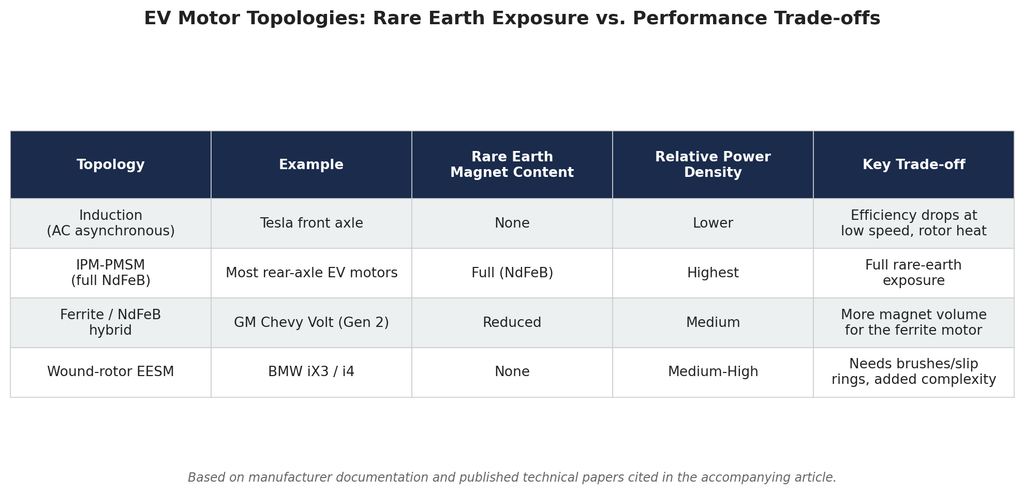
Want the real comparison between ferrite and NdFeB? Use maximum energy product — (BH)max, the standard figure of merit, specified in IEC 60404-8-1. High-grade sintered NdFeB: roughly 35–52 MGOe. Typical anisotropic ferrite: roughly 3.5–4.5 MGOe. That’s an order-of-magnitude gap at the high end (exact ratio depends on the specific grades you’re comparing, so don’t quote it like it’s carved into the standard itself). Practically, that means a ferrite motor generally needs more magnet volume — or a totally different geometry — to hit comparable air-gap performance. Not “a bigger motor.” Sometimes a completely different design.
The decision about how much rare earth exposure a motor carries? That gets made at the drawing board. Long before dysprosium ever enters the bill of materials.
Same logic applies well outside of cars, too. Humanoid robot actuators — the motors driving every joint in something like Optimus or Figure — face an even tighter power-density squeeze than a traction motor does. That’s a real, related problem I dug into separately, and it pushes almost every current design toward the same high-performance NdFeB magnets this whole article’s about. None of the alternatives above (induction, ferrite, wound-rotor) really work at that weight and space budget. Not yet, anyway.
The Coercivity Trade-Off: Where Metallurgy Meets Geopolitics
Coercivity drops as temperature climbs. EV traction motor magnets can be engineered for local operating temps approaching 180°C under heavy load — the exact ceiling depends on motor architecture and cooling, obviously. Base Nd2Fe14B has a theoretical anisotropy field of about 7.5 T. Substituting dysprosium or terbium raises that ceiling substantially — the physical mechanism behind why heavy rare earth doping improves thermal resistance, even without me pinning an exact anisotropy value to a specific alloy mix here.
But here’s the catch. That anisotropy field is a ceiling. Not what magnets actually achieve. And the gap between the two has a name: Brown’s paradox.
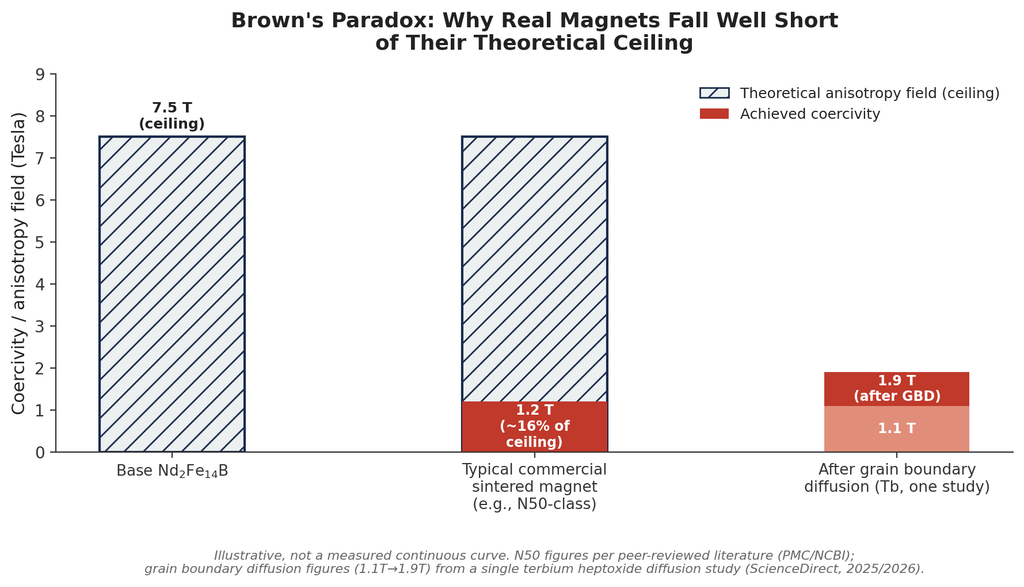
Peer-reviewed work puts the maximum theory-to-reality gap at up to one order of magnitude, in the worst cases. Typical commercial magnets land closer to a fifth of their theoretical ceiling — a high-grade N50-class magnet, for instance, usually hits around 1.2 T against that 7.5 T ceiling. Why the shortfall? Microstructural defects at grain boundaries. They act like little on-ramps for demagnetization. So raising the anisotropy field through Dy/Tb substitution raises the ceiling — sure — but it doesn’t fix those grain-boundary weak points on its own.
Grain boundary diffusion is the industry’s answer to that specific problem. Instead of mixing Dy or Tb evenly through the melt, you diffuse it into the sintered magnet afterward, so it concentrates right at those weak grain boundaries. One published study using terbium heptoxide diffusion pushed coercivity from 1.1 T to 1.9 T this way. Small remanence loss. (That’s one study, not a universal constant — worth remembering before you cite it as gospel.)
Every gram of Dy or Tb comes at a cost, diffused or not: remanence drops, because both elements couple antiferromagnetically with iron. Lower maximum energy product, even as coercivity improves. That’s the trade hiding in what looks like a routine materials-selection checkbox. Push for more thermal margin, and you’re pushing toward more heavy rare earth content — and heavy rare earths like dysprosium and terbium are among the most geographically concentrated materials in the whole magnet supply chain.
Recycling? Still low, by most industry accounts. I couldn’t find a solid, independently audited dataset behind any specific percentage worth quoting here, so I won’t. What I can point to: Hydrogen Processing of Magnet Scrap, developed at the University of Birmingham. One of the more advanced short-loop recycling approaches out there. Breaks down end-of-life NdFeB into reusable alloy powder using room-temperature hydrogen exposure. A commercial-scale facility actually launched in the West Midlands in 2026. Promising. Still a small slice of total supply, though.
The Same Pattern I’ve Documented in Chip Manufacturing
I’ve written about this exact failure mode before — the chip supply chain. The TSMC Arizona bottleneck isn’t the wafer fab everyone photographs. It’s a Japanese company’s near-total hold on ABF build-up film — by its own account, 95-100% market share, across just two plants. Nobody put that in a groundbreaking-ceremony press release. But it’s the actual reason TSMC can announce a $265 billion Arizona commitment and still have advanced-packaging capacity sold out for a year.
Rare earth magnets? Same shape. Different material. The mine is the fab — visible, fundable, photogenic. Refining and magnet manufacturing are the ABF film — unglamorous, technically brutal, sitting in the stage nobody bothered to name.
Ask a Different Question
I made basically this same argument about chip fabs: a fab is one node in a multi-stage chain, and reshoring the fab doesn’t reshore the product if the other stages are still offshore. Rare earth magnets are the same problem, fewer stages, better documented. Mining is stage one — necessary, but nowhere close to sufficient.
The IEA’s own numbers show the gap widening at each step: mining needs roughly a two-fold expansion to hit diversification targets, refining needs about four-fold, magnet manufacturing needs about six-fold. Self-sufficiency was never the right framework here. Resilience is. Figure out which stage is the actual single point of failure. Fix that one first — with the same urgency you’d give a new mine. For rare earth magnets? That’s refining and magnet manufacturing. Not the mine.
About the Author
Imran Valiani | Sales Director, PCB Electronics Manufacturing
20+ years working with major Bay Area and global tech clients. Founder of Silicon to Software, where I write about the hardware layer — PCB fab, AI gear, autonomous systems, and cyber — the stuff most tech writers have never touched. Literally.
Follow: X @SiToSoftware | LinkedIn
This article was developed with AI assistance and edited, fact-checked, and reviewed by the author. See my full AI disclosure.
Sources
Government and regulatory:
- IEA, “Executive summary – Rare Earth Elements – Analysis,” April 2026
- US Nuclear Regulatory Commission, 10 CFR Part 40 — Domestic Licensing of Source Material
- NRC, “NRC Expands Wyoming’s Authority Over Key Nuclear Materials,” April 2026
- Governor of Wyoming, “Governor Gordon Enters Into Regulatory Agreement with U.S. Nuclear Regulatory Commission,” April 2026
- Federal Register, “Rare Element Resources, Inc.; Rare Earth Element Demonstration Plant,” July 27, 2023
- FTC, “Complying with the Made in USA Standard”; FTC press release on Made-in-USA enforcement warnings, July 2026
- MP Materials Corp., SEC Form 8-K, filed July 10, 2025
- MP Materials Corp., SEC Form 10-Q, Q1 2026
- EXIM.gov, “Week in Review: Project Vault and the U.S. Strategic Critical Mineral Reserve,” February 2026
- Congressional Research Service, “Export-Import Bank: Overview and Reauthorization Debate,” congress.gov
- USGS, Mineral Commodity Summaries 2026 — Rare Earths
Standards:
Peer-reviewed research:
- ScienceDirect, “Mechanism of grain boundary diffusion process of Nd-Fe-B sintered magnets using terbium heptoxide”, published online 2025; print citation Journal of Rare Earths, Vol. 44, Issue 4, April 2026, pp. 1162-1171
- Scientific Reports (Nature), “High coercivity, anisotropic, heavy rare earth-free Nd-Fe-B by Flash Spark Plasma Sintering,” 2017
- “Most frequently asked questions about the coercivity of Nd-Fe-B permanent magnets,” peer-reviewed review article (PMC/NCBI)
- SAE Paper 2015-01-1208, “Next Generation Voltec Electric Machines; Design and Optimization for Performance and Rare-Earth Mitigation”
Industry and financial reporting:
- Federation of American Scientists, “Unpacking the DoD and MP Materials Critical Minerals Partnership,” July 2025
- Bipartisan Policy Center, “DOD Bets Big on Rare Earth Elements,” October 2025
- MP Materials, “MP Materials Selects Northlake, Texas, as the Site of ’10X,'” February 2026
- Green Car Congress, “First look at all-new Voltec propulsion system for 2G Volt,” reporting GM’s SAE technical presentation.
- BMW Group PressClub, “The All-New BMW iX3”
- University of Birmingham, HPMS recycling research and West Midlands facility announcement