Smart Glasses Could Replace Smartphones — But the Hardware Isn’t Ready Yet
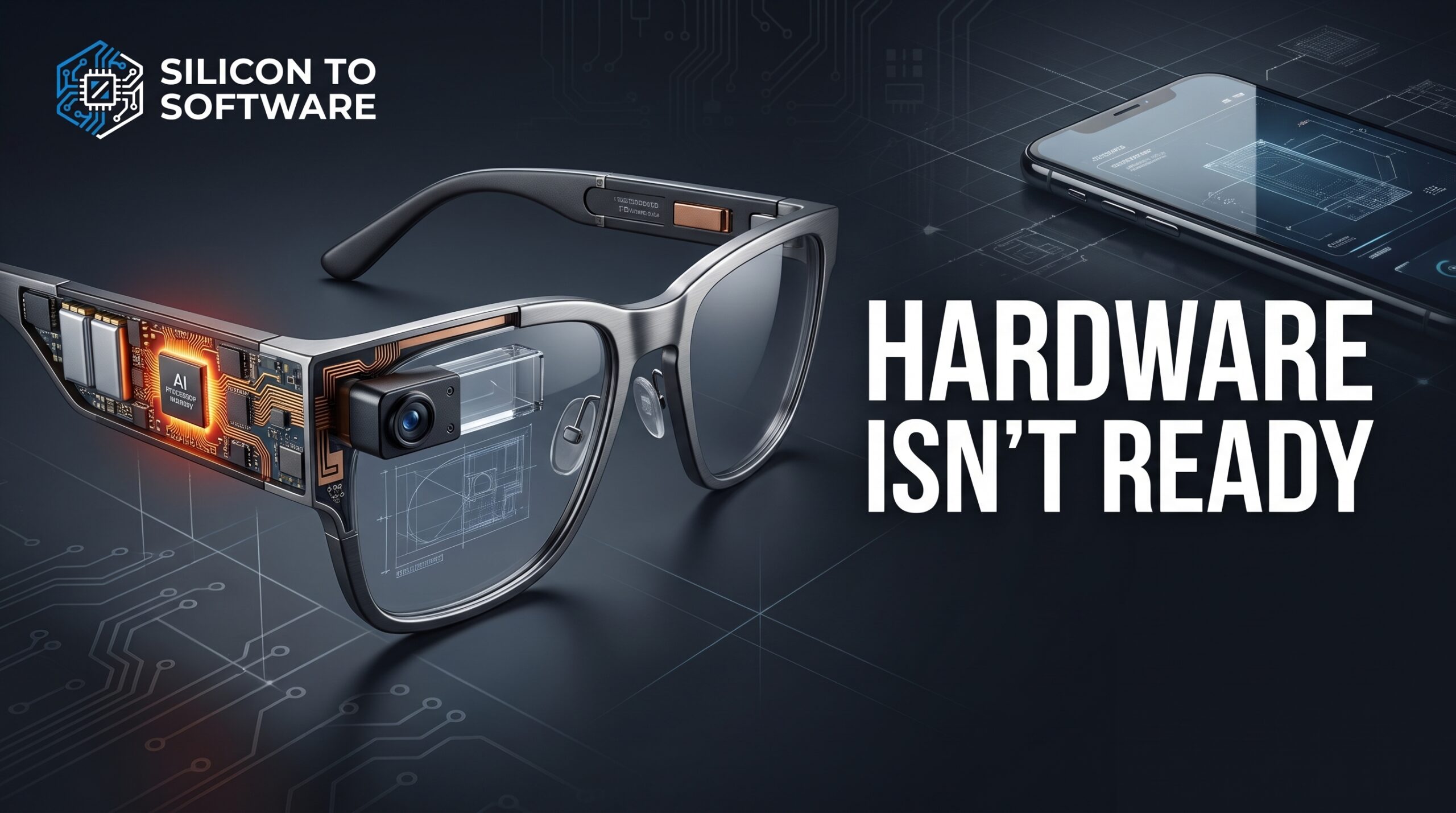
Tiny batteries, optical waveguides, AI processors, thermal limits, antennas, cameras, sensors, and advanced semiconductor packaging remain the biggest engineering barriers to replacing today’s smartphone.
Table of Contents
Every few years, the tech industry declares the smartphone is about to die — and every few years, the promised replacement is smart glasses hardware that isn’t quite ready. When Google unveiled Project Glass in 2012 and expanded the Explorer program in 2013, much of the surrounding coverage framed wearable displays as a possible successor to smartphone interaction. By 2018, Magic Leap had raised more than $2.3 billion pursuing its own mixed-reality hardware platform. Meta is now positioning glasses as an increasingly important computing interface, while Apple is investing in spatial computing through Vision Pro — though Apple describes Vision Pro as a “spatial computer,” not a smartphone replacement, and neither company has declared the phone obsolete.
Here’s the thing, though. This time feels different — but not for the reason most people assume. The software layer has genuinely improved. Current systems can support voice assistants, translation, and image analysis, with limited on-device inference now shipping in real products. But reliability, multimodal accuracy, privacy, and cloud dependence remain unresolved — this isn’t a solved problem; it’s a rapidly improving one.
The hardware is further behind than the demos suggest. I’ve tried a pair of camera glasses. Cool for about ninety minutes. Then the temple started getting warm, and the battery indicator dropped like it had somewhere better to be.
Battery Capacity Sets the Operating Envelope
A smartphone’s chassis gives its battery tens of cubic centimeters of volume and a large surface area to spread heat. A smart-glasses temple provides dramatically less usable electronics volume than a smartphone chassis, and that space must be shared among the battery, processor, antennas, and structural components — increasing cell volume usually means a trade-off in temple thickness, weight distribution, or space taken from something else, not a free upgrade.
- Every extra millimeter of battery pushes weight toward the ear, and ear-worn weight becomes noticeable faster than most people expect.
- Every added compute task — camera capture, AI processing, wireless streaming — pulls straight from that same tiny reserve.
- Charging cases extend runtime, but they don’t solve on-face battery life. They just move the problem to your pocket.
Meta rates its Ray-Ban Display for up to six hours of mixed-use battery life per charge, with the folding charging case providing up to 24 additional hours (Meta). “Mixed use” is a manufacturer-rated maximum, not an independent real-world benchmark — and six hours remains well below the all-day operating expectation people bring to a smartphone.
Battery improvements haven’t removed the severe volumetric, thermal, and weight constraints of face-worn electronics. Whether the fix comes from solid-state battery chemistry, lower-power processors, better duty-cycling, or something else entirely is genuinely open — there’s no single expected solution here, and solid-state cells face their own manufacturing and scaling hurdles before they’d be ready for anything this space-constrained.
Waveguides: Real Tradeoffs, Multiple Architectures
Waveguide displays aren’t simply “etched channels that bend light toward your eye” — that description flattens several different optical architectures into one. Surface relief grating (SRG) diffractive waveguides couple light into a substrate via a diffraction grating and extract it through a second grating; they can support relatively wide fields of view in thin structures, but generally face lower optical efficiency than reflective (geometric) waveguide designs, which use mirror arrays instead (IDTechEx).
Increasing field of view and eyebox size generally makes optical efficiency, brightness uniformity, color control, and manufacturability harder — though the exact tradeoff depends on which architecture you’re building, not a single universal rule.
It’s also important not to compare field-of-view numbers across device categories as if they’re the same measurement. Meta’s Ray-Ban Display uses a monocular 600×600 pixel display at 42 pixels per degree with a 20-degree field of view and up to 5,000 nits rated brightness (Meta) — a HUD-style notification display, not an immersive optical see-through AR system. Current products span a wide range: small monocular displays like this one sit near 20 degrees, while larger optical systems can extend substantially farther at the cost of weight, complexity, or power.
The 5,000-nit rating is intended to improve visibility under bright ambient conditions — it doesn’t guarantee outdoor readability in every lighting situation, since that also depends on lens tint, contrast, and ambient light.
On the “physics ceiling” framing: human foveal (sharp) vision spans only a few degrees, while useful visual awareness extends much farther into the periphery. There’s no universally agreed number for where “usable central vision” caps out — treat any specific figure here as one vendor’s framing, not settled vision science. Manufacturing yield and cost are major real constraints on today’s field-of-view range, alongside optical efficiency and eyebox size — not a single documented “ceiling.”
Thermal Management, Squeezed Into Millimeters
Thermal comfort is one of the most persistent constraints in face-worn electronics. A smartphone offers substantially more battery volume, board area, and heat-spreading surface than a glasses temple, although modern phones are themselves tightly packaged. Glasses have neither a laptop’s fan nor a phone’s metal heat-spreading chassis — the chip, battery, camera sensor, and radio all sit within millimeters of a part of your body you’re wearing for hours, which is why high-power camera and inference workloads may be duty-cycled or time-limited rather than run continuously.
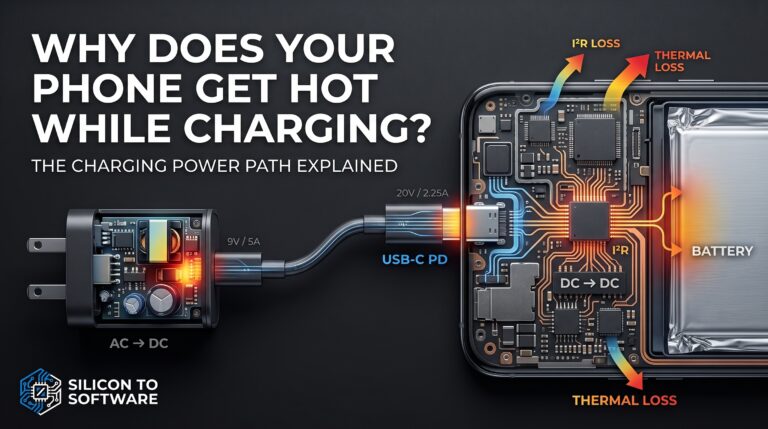
That duty-cycling behavior traces back to a specific thermal path: power drawn by the SoC, camera, and radio raises die and package temperature, which conducts through the PCB and out into the frame — the frame itself can become a primary heat-spreading path in the absence of active cooling. This creates two separate limits that don’t always align: the temperature at which the silicon itself needs to throttle to stay within its reliable operating range, and the typically lower temperature at which the frame becomes uncomfortable against skin. In general, wearable thermal designs have to manage to whichever limit is lower, which is why strategies like duty cycling, workload scheduling, reduced clock frequency or voltage, and offloading work elsewhere show up so often in this category — not as an afterthought, but as the primary lever available once passive heat-spreading runs out of room. That same throttle-or-pause logic governs a related but distinct problem on the charging side — see why your phone gets hot while charging for how it plays out while the battery is filling up, not just while you’re using the device.
An older but still-relevant academic characterization of Google Glass found battery capacity constrained by the lightweight form factor and high-power processing causing meaningful heat near the user’s skin (arXiv) — the underlying constraint hasn’t disappeared with newer hardware, even as thermal engineering has improved. Independent lab testing of current products shows just how much workload changes runtime: Android Central’s controlled test measured 30 minutes of continuous 1080p video recording before battery depletion on Ray-Ban Meta and 50 minutes on Oakley Meta HSTN (Android Central) — precise results for that specific test, not a universal figure, since real-world mixed use (with pauses between recordings) stretched both devices to 3-4 hours in the same review’s separate field test.
That’s not a software fix. The real unresolved challenge is sustaining higher camera, display, and AI workloads without unacceptable battery drain, frame temperature, or weight — not thermal management in general, which millions of shipped devices already handle for lighter workloads.
AI Processors: Real Progress, Bounded Claims
Running an AI assistant on your face means running a chip within a highly constrained power and thermal envelope — the same edge AI chip tradeoffs reshaping phones and IoT devices, just with far less room to work with: low average power with carefully controlled short bursts, rather than a fixed “single-digit watts” figure, since one watt and nine watts represent very different thermal situations against skin.
Qualcomm is one of the most prominent silicon platform suppliers targeting this category. Its Snapdragon AR1+ Gen 1, announced at Augmented World Expo 2025, is 26% smaller than its predecessor, according to Qualcomm, is built on Qualcomm’s 3rd Generation Hexagon NPU, and enables reference designs with temple heights up to about 20% lower depending on overall system layout. Qualcomm also reports workload-dependent power reductions relative to the previous AR1 generation across tasks like Bluetooth playback, video streaming, and computer vision (Qualcomm’s own product page confirms these figures directly; independent corroboration via UploadVR and 9to5Google).
At its announcement, Qualcomm demonstrated a quantized Llama 3.2 1B-Instruct model — approximately 1.23 billion parameters, using 4-bit and partial 8-bit weight quantization — running entirely on prototype glasses hardware, with no phone or cloud connection required (Qualcomm’s announcement confirms the demo itself; Qualcomm AI Hub documents the model’s general quantization scheme but doesn’t itself reference the glasses demo or AR1+). That was a reference-hardware demonstration, not confirmation that this exact implementation ships in a specific consumer product today.
That’s real, verified progress. But a 1.2-billion-parameter model is far smaller than leading cloud models, and it’s deliberately quantized for wearable memory, power, and thermal constraints — its capability can’t be inferred from parameter count alone, and it’s not necessarily “a fraction” of every model that runs on a phone, since phones themselves run models spanning hundreds of millions to several billion parameters depending on the task.
On-device inference reduces network dependence and can lower latency. Whether it reduces total energy depends on model size, memory traffic, accelerator efficiency, and radio conditions — it is not a blanket battery-saving guarantee, regardless of how often that claim gets repeated in coverage of the category.
Antennas, Cameras, Sensors: Everyone’s Fighting for the Same Square Millimeter
Every component in smart glasses competes for the same physical space:
- The battery wants more volume in the temple.
- The antenna needs clearance from metal and skin to get decent signal.
- The camera sensor needs a clear optical path and its own thermal allowance.
- The microphones and speakers need acoustic ports that don’t interfere with the frame’s structure.
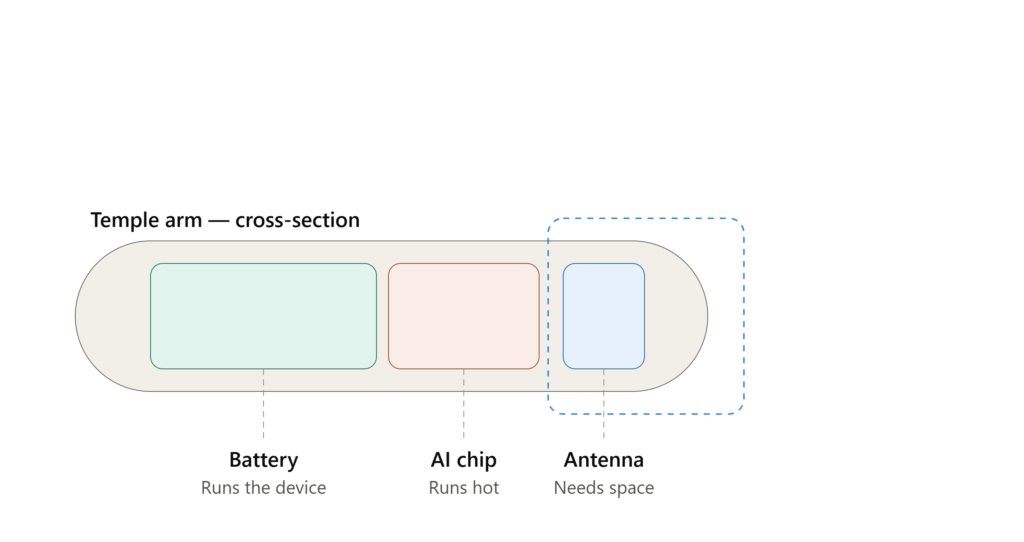
Antenna performance isn’t a self-contained problem, either — it feeds directly back into the battery and thermal constraints already covered. A poorly placed or shielded antenna generally has lower efficiency, and the usual way to compensate for lower efficiency is to transmit at higher power, which draws more from the same constrained battery and generates more heat in the same tight space. Nearby electronics, metal in the frame’s structure, the wearer’s own head and body, the PCB’s ground and reference structures, and other radios sharing the same small volume can all influence how well an antenna performs, depending on the specific architecture — which is exactly why antenna placement can’t be solved in isolation from everything else fighting for room in the temple.
Add a bigger sensor, and something else shrinks. There’s no fixed weight rule here — sub-50-gram mass is a comfort target manufacturers aim for in conventional-looking frames, not a hard requirement, which is why Meta’s Ray-Ban Display weighs 69 grams, according to Meta.
The device also bundles a separate wrist-worn Neural Band that adds EMG-based gesture input alongside the glasses’ existing voice and touch controls (Meta) — not because voice and touch don’t work, but because gesture input adds a third option without competing for space on the frame itself.
Semiconductor Packaging and Manufacturing Yield
Fitting a processor, memory, radio, and sensor hub into a temple arm requires dense packaging techniques broadly similar to what’s used in modern smartphone chips, compressed further and under a tighter thermal budget. It’s a different scale problem than the high-speed laminate and signal-integrity tradeoffs that dominate AI server hardware, but the underlying discipline — squeezing more density and performance out of less board space without sacrificing reliability — is the same. I don’t have a teardown confirming which specific packaging technology any named commercial product uses internally, so take this as a description of the general engineering challenge rather than a claim about a specific device’s internals.
The glasses form factor adds a wrinkle a smartphone board doesn’t have to deal with: a hinge. Routing power and signal lines from a temple-mounted board across a joint that opens and closes repeatedly over a product’s life is a different reliability problem than a board that’s installed once and never moves again. In general, repeated bending concentrates mechanical strain in the active flex region, making copper traces and other interconnect features — including vias or rigid terminations placed where the design allows them — potential fatigue locations depending on the construction and bend geometry, which is why flexible and rigid-flex circuit design typically calls for defined bend radii and keep-out zones. None of this means any specific commercial smart-glasses product uses a particular via architecture or rigid-flex construction — that would require a teardown this article doesn’t have — but it’s the general engineering tradeoff any hinge-crossing interconnect in this form factor has to account for.
Scaling production is a separate challenge from demonstrating a working lab prototype, because yield, optical uniformity, assembly precision, and cost all have to hold up across high volumes — that’s real, even without a precise industry-wide percentage attached to it.
Reliability: The Environment Is Part of the Design
None of the constraints above are one-time engineering problems — they have to hold up against the environment glasses actually live in: worn against skin, outdoors, for hours a day, every day.
- Sweat, skin oils, and humidity create a moisture and contamination risk that indoor electronics don’t face in the same way — in general, this pushes design toward corrosion-resistant materials, protective coatings, and sealed or gasketed connector strategies rather than open contacts.
- Repeated hinge cycling is the mechanical consequence of the interconnect tradeoff described above — every open-and-close cycle re-stresses whatever crosses that joint, which is why flex reliability is a cumulative, lifetime-of-use concern rather than a one-time pass/fail test.
- Drops and mechanical shock load the enclosure and internal attachments differently than a phone’s flatter, more uniform chassis does — component and assembly mounting generally has to account for impact along axes a smartphone wouldn’t experience the same way.
- Battery aging reduces usable capacity over the product’s life, which compounds an already-tight power budget rather than easing it over time.
- Optical alignment drift — components shifting slightly relative to each other from thermal cycling, mechanical stress, or material aging — is a particular concern for waveguide-based displays, where the image path depends on precise, sustained alignment between the display engine and the waveguide.
None of this means any specific product has experienced these failure modes — it’s the general environmental case any face-worn electronics design has to engineer around, on top of the battery, thermal, and optical constraints already covered.
So What Does Actually Work Right Now?
Audio-first AI glasses — no display, no camera, or a modest one — have reached genuine commercial availability and avoid many of the power and optical constraints an integrated display introduces. Real-time translation, transcription, and assistant access are commercially available today, though performance still varies by language, accent, background noise, and network conditions — it’s a real capability, not a uniformly solved one.
Display glasses are the harder climb, and they’re climbing it in public. Meta’s Ray-Ban Display is a legitimately impressive piece of engineering and also a walking case study in every constraint above: 69 grams, a separate wristband for input, and a manufacturer-rated six hours of mixed use per charge.
Where Smart Glasses Hardware Actually Goes
Progress in one subsystem tends to create new tradeoffs elsewhere, which is why closing the gap on smart glasses hardware needs coordinated system-level engineering rather than one breakthrough — the same lesson the industry already learned, expensively, from past metaverse hardware failures: no single component fix saves a product if the rest of the stack isn’t ready at the same time.
AI capability has moved fastest — but “the AI is ready” was always the less interesting part of the claim. Dependable multimodal performance within a wearable’s power, privacy, and connectivity budget is the harder, unfinished piece. Optical systems are commercially viable for constrained, HUD-style displays; wide-field, high-efficiency, lightweight, and affordable designs remain a much harder target, and it’s not yet clear when — or in what order — batteries, optics, thermal design, and manufacturing yield close that gap together.
I wouldn’t sell your phone just yet.
About the Author
Imran Valiani | Sales Director, PCB Electronics Manufacturing
20+ years working with major Bay Area and global tech clients. Founder of Silicon to Software, where I write about the hardware layer — PCB fab, AI gear, autonomous systems, and cyber — the stuff most tech writers have never touched. Literally.
Follow: X @SiToSoftware | LinkedIn
For more analysis of embedded hardware, electronics, and system-level engineering constraints, explore the Embedded Systems & Electronics Engineering Resource Hub.
This article was developed with AI assistance and edited, fact-checked, and reviewed by the author. See my full AI disclosure.
Sources
Every source used in this article, in order of appearance:
- Meta — Ray-Ban Display product page — battery life (6hr/24hr), general product claims
- Apple — Apple Vision Pro product page — official “spatial computer” positioning
- TechCrunch — Magic Leap raises $461 million, total funding exceeds $2.3 billion (March 2018)
- VentureBeat — Magic Leap adds $461 million, total funding to $2.3 billion (March 2018) — independent corroboration of #3; the original Reuters report on this currently blocks automated access
- Meta — Ray-Ban Display technical specifications / Neural Band page — display resolution, FOV, brightness, weight, Neural Band details
- IDTechEx — Developments in SRG Diffractive Waveguides for AI Glasses (March 2026) — SRG vs. reflective waveguide efficiency tradeoff
- arXiv — Draining our Glass: An Energy and Heat Characterization of Google Glass — academic thermal/battery characterization (2014, older hardware, general principle still applicable)
- Android Central — Oakley Meta HSTN battery life test results — independent controlled battery/recording runtime testing
- Qualcomm — Snapdragon AR1+ Gen 1 platform page — official size/power/NPU specifications
- UploadVR — Snapdragon AR1+ Is A New Chip For High-End Smart Glasses — independent corroboration of AR1+ figures
- 9to5Google — Qualcomm announces smaller Snapdragon AR1+ Gen 1 chip — independent corroboration of AR1+ figures
- Qualcomm — A World’s First On-Glass GenAI Demo — official announcement of the Llama 3.2 1B on-glass demonstration
- Qualcomm AI Hub — Llama-v3.2-1B-Instruct model page — model’s parameter count and quantization scheme (does not itself reference AR1+ or the glasses demo — see note above)
- Road to VR — Meta Unveils Ray-Ban Smart Glasses with Display — independent spec corroboration