Solid-State Batteries Explained: Why the Technology That Could Transform EVs Still Isn’t Ready
Discover how solid-state batteries promise higher energy density, faster charging, longer lifespan, and improved safety — and why manufacturing complexity, material limitations, and scaling challenges continue to delay mass-market adoption.
Table of Contents
I once watched a battery engineer hold up a lab-scale solid-state battery cell about the size of a playing card. It worked beautifully. Charged fast. Didn’t catch fire when he abused it on purpose.
Then I asked him the obvious question: when’s this going in a car? He laughed.
That’s the gap nobody puts in the press release. Every battery breakthrough looks inevitable on a slide deck and impossible on a factory floor. Solid-state batteries sit exactly there right now — proven in theory, stubborn in practice.
Here’s the thing: the chemistry behind solid-state batteries is increasingly understood. Sulfide, oxide, and polymer electrolytes all still have real unsolved chemistry problems of their own, to be fair. But translating any of that chemistry into a manufacturable, durable product, made identically a million times a day, is the bigger open problem right now.
What Makes Solid-State Batteries Different From Today’s EV Batteries
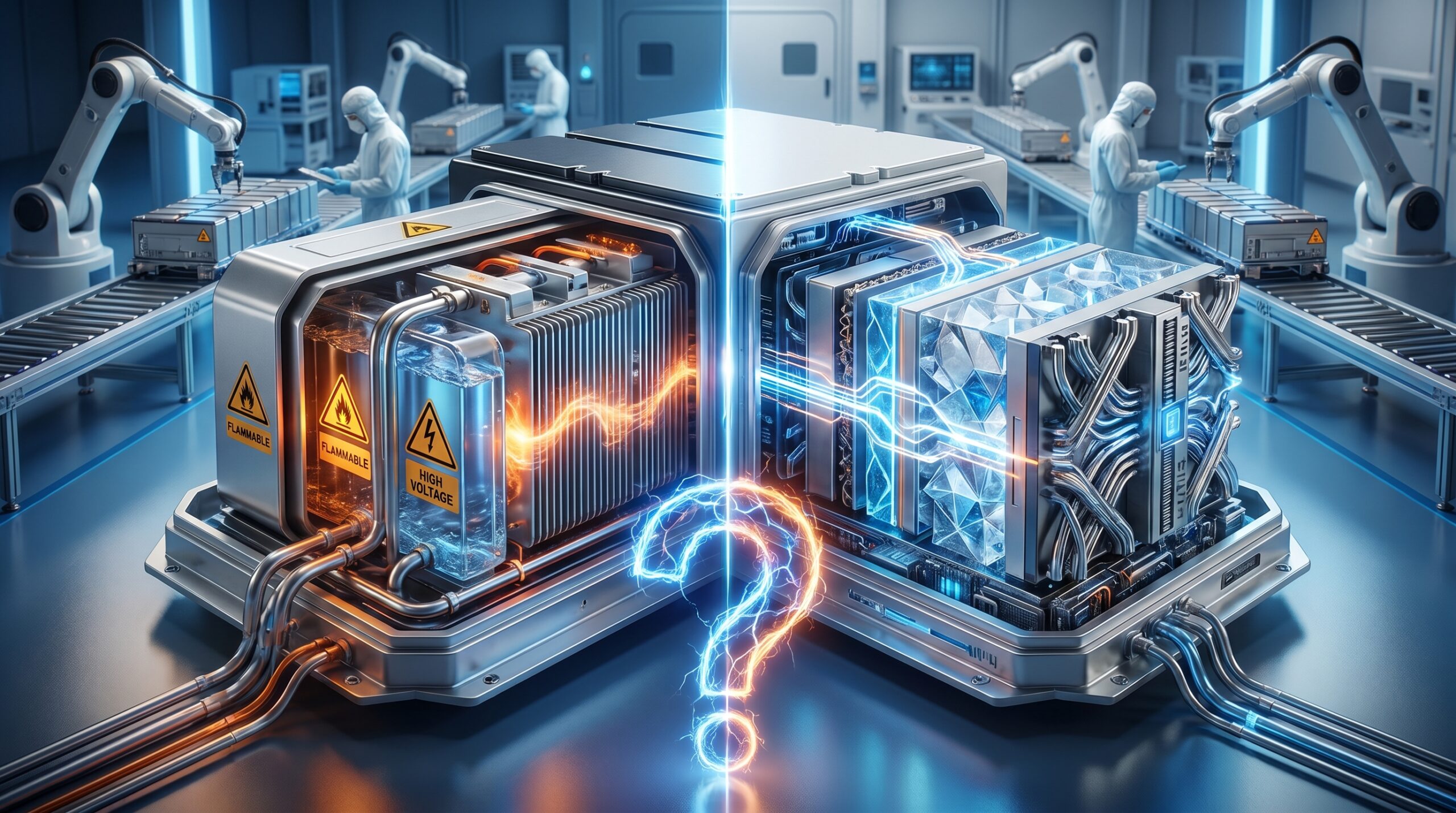
Today’s EV batteries — lithium-ion cells — use a liquid electrolyte to shuttle ions between the anode and cathode. It works. It’s also part of the reason EVs need such sophisticated thermal-management systems — though to be fair, those systems are managing heat from the inverter, power electronics, and motor too, not just the battery’s liquid electrolyte.
Solid-state batteries swap that liquid for a solid electrolyte. Could be a ceramic. Could be a polymer. Could be sulfide-based.
Why bother with solid-state batteries at all? A few reasons:
- Higher energy density — solid electrolytes can pair with lithium metal anodes, which carry higher theoretical energy density than the graphite anodes used today
- Faster charging, in theory — by avoiding some of the side reactions that limit charge rates in conventional lithium-ion cells, solid-state designs could support quicker charging. Worth being straight about this one: many solid electrolytes still have lower ionic conductivity than liquid electrolytes at room temperature, which is itself an unsolved research problem, not a free win
- Improved safety, with caveats — removing the flammable liquid electrolyte closes off one major fire-risk pathway. But lithium metal anodes bring their own reactivity concerns, especially if there’s a manufacturing defect or puncture. Safer, not risk-free
- Longer lifespan, on paper — fewer side reactions at the electrode surface could mean slower capacity fade, though this still depends heavily on solving the interface problem below. Worth a reality check: some current solid-state prototypes actually show worse cycle life than top-tier lithium-ion cells today. This is a potential advantage, not a guaranteed one across every chemistry being tried.
Toyota, QuantumScape, Solid Power, and Samsung SDI have all published research and roadmaps around solid-state chemistry. CATL has too.
The U.S. Department of Energy backs this too — and not just in spirit. DOE’s Office of Manufacturing and Energy Supply Chains selected Solid Power for up to $50 million in funding to build out continuous production of its sulfide-based solid electrolyte material. DOE’s Advanced Materials & Manufacturing Technologies Office has also run multiple lab-call programs specifically targeting solid-state battery manufacturing scale-up.
A DOE-published technical report on solid-state battery challenges puts it simply: DOE funds most of the country’s energy storage research and development, solid-state batteries included.
To be honest, none of that is controversial. The promise is real. It’s the delivery that’s messy.
The Dendrite Problem Nobody’s Fully Solved
Lithium metal anodes are the prize everyone wants. They’re also the source of the industry’s most persistent headache: dendrites.
Picture lithium ions trying to plate evenly back onto the anode every time the battery charges. Sometimes they don’t. Instead, they form tiny, spiky metal growths — dendrites — that creep through the solid electrolyte.
If a dendrite reaches the cathode, you get an internal short circuit — and to be clear, that risk isn’t unique to solid-state batteries. Conventional lithium-ion cells suffer dendrite-related shorts and lithium plating failures too.
The difference is one of degree, not kind: a liquid electrolyte can redistribute and maintain interfacial contact more effectively than a rigid solid electrolyte can, even as a dendrite pushes through, but it isn’t immune to the same failure mode. A rigid solid electrolyte, by contrast, has essentially no give at all. Rigid interfaces don’t tolerate uneven plating well.
This isn’t a fringe concern in solid-state batteries — it’s a well-established problem in the materials science field, studied broadly across academic and national-lab research on lithium metal anode systems. A 2026 solid-electrolyte roadmap published in Materials Futures (IOP Publishing) frames interfacial engineering — stopping dendrite growth and decomposition at the electrode-electrolyte boundary — as a unifying challenge across materials, processing, and cell design.
I won’t pin every claim here to one paper, because the dendrite literature spans years and dozens of research groups, but it’s the central materials-science obstacle standing between lab cells and durable, mass-produced ones.
Why the Electrode-Electrolyte Interface Matters So Much
Even when dendrites aren’t actively forming, there’s a quieter problem: keeping physical contact between the solid electrolyte and the electrodes.
Quick terminology note, because this matters: in conventional liquid-electrolyte lithium-ion cells, you’ll often hear about the SEI — Solid Electrolyte Interphase — a thin chemical layer that forms on the anode from electrolyte decomposition byproducts. That’s a specific, well-studied phenomenon. I go deeper on how SEI growth trades off against lithium-plating risk as charge rate and temperature change in why your phone gets hot while charging, which covers that same conventional liquid-electrolyte chemistry from the consumer-electronics side.
What I’m describing here in solid-state cells is a related but different problem: physical, mechanical contact loss between two solid surfaces, sometimes called interfacial contact impedance. Solid-state cells deal with both interphase chemistry and this mechanical contact issue — don’t let anyone (including a past version of this article) blur the two together.
In a liquid system, the electrolyte naturally flows into every microscopic gap, maintaining contact. A solid electrolyte can’t do that. Any gap, any void, any mechanical mismatch as the electrodes expand and contract during charging — that’s a spot where ion flow chokes.
I’ve found that this is the part most beginners skip past when they read about solid-state batteries. The chemistry sounds clean. The physical reality — keeping two solid surfaces in intimate contact across millions of charge cycles, inside a moving vehicle, through temperature swings — is brutally hard.
Why Manufacturing Solid-State Batteries Is the Real Bottleneck
Here’s where my factory-floor instincts kick in on solid-state batteries. A lab can hand-assemble a few hundred cells with painstaking care. A gigafactory needs to stamp out tens of thousands a day, with consistent quality, at a cost per kilowatt-hour that doesn’t bankrupt the automaker buying them.
That jump — from careful hands to high-speed rollers — is where solid-state batteries keep stumbling. A few specific pain points:
- Stack pressure requirements. Many solid-state designs need constant, uniform mechanical pressure across the cell to maintain electrode contact. Sustaining that pressure over thousands of cycles, inside a moving vehicle, without piling on extra pack mass or cost, isn’t just an assembly inconvenience — it’s an unsolved systems-engineering problem in its own right.
- Dry-coating and thin-film processes. Some solid electrolytes require novel coating techniques rather than the wet-slurry coating lithium-ion manufacturing already has down to a science. New processes mean new defect modes nobody’s fully mapped yet.
- Material purity and consistency. Solid electrolytes, especially sulfide-based ones, can be sensitive to moisture and require tightly controlled production environments. That raises both cost and complexity.
- Yield. Even small defect rates compound brutally once you’re producing at automotive volume. Industry sourcing on this is more specific than the round “99%” number that gets repeated casually: Factorial Energy, a solid-state and lithium-metal cell developer, has stated publicly that gigafactories need to operate at 90%-plus yield just to break even, and that its own pilot-line yield sits around 85% — among the highest reported for next-generation chemistries. A 2026 SEC filing from another battery manufacturer describes state-of-the-art fabrication lines as typically targeting 70–80% yield, with a leading line achieving just over 85%. Those publicly stated benchmarks illustrate the scale of the manufacturing challenge: a process that works well in the lab but can’t clear roughly 85–90% at automotive volume is looking at a serious cost problem, not just an inconvenience.
It’s a pattern I keep running into across frontier hardware: the technology gets proven in a lab long before the manufacturing ecosystem can support it at scale. I wrote about the same gap earlier this year with 6G technology hardware — different domain, identical dynamic.
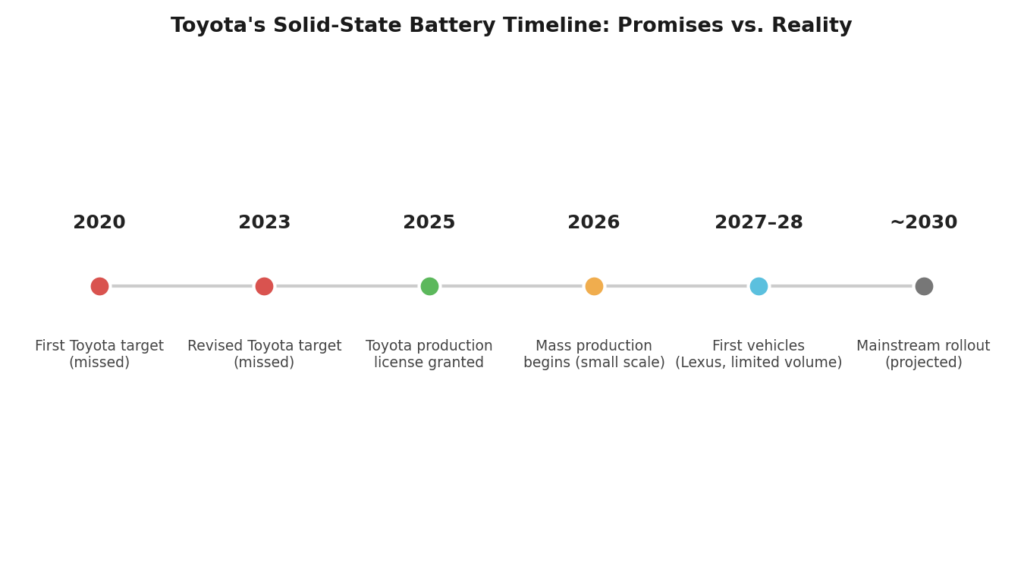
Toyota’s own track record makes the point better than I can. Toyota’s commercialization timelines for solid-state batteries have shifted multiple times over the past several years — concept-vehicle demos, prototype targets, and full commercialization dates have all moved at different points. Its current public target, reaffirmed by Toyota executive Keiji Kaita at the Japan Mobility Show, is now 2027–2028.
QuantumScape’s shareholder letters tell a similar story from the manufacturing side. The company has been candid that its separator production process — first called “Raptor,” now being replaced by a faster process called “Cobra” — has gone through multiple generations specifically because early yield and throughput weren’t good enough for automotive-scale output.
In their Q2 2025 shareholder letter, QuantumScape said directly that “the challenges of scaling production remain significant” — and acknowledged there’s still a lot of work ahead before that’s solved. That’s not corporate spin walking back a promise — that’s an honest read on where things actually stand.
So When Will Solid-State Batteries Actually Arrive?
Honestly? Information not available in any way I’d trust enough to give you a confident year. Forecasts have shifted multiple times across the industry, and I’m not going to manufacture a date just to sound authoritative.
What I can say is this: Toyota’s own reporting backs up the premium-first pattern directly for solid-state batteries. Initial production is expected to run only in the hundreds of tons in the early years, which translates to tens of thousands of vehicles at most. The company has indicated its first solid-state model is more likely to debut under the Lexus brand, where higher pricing can absorb early battery costs.
Mainstream, lower-cost rollout is expected later, generally discussed in the 2030 range. That’s one company’s data point, not an industry-wide guarantee, but it lines up with how most new battery chemistries have entered the market historically: premium and low-volume first, mainstream after the manufacturing kinks get worked out.
What to Actually Watch For With Solid-State Batteries
If you want a gut-check on real progress with solid-state batteries versus marketing noise, here’s what I pay attention to:
- Pilot production line announcements (not lab demos — actual lines)
- Specific energy density figures tied to a named, third-party-verified test, not just a company’s internal claim
- Cycle life data measured in hundreds of full charge-discharge cycles, not a handful
- Partnerships where an automaker commits actual capital, not just a research MOU
The Honest Takeaway
One thing worth being precise about before wrapping up: this whole piece is about all-solid-state batteries — fully solid electrolyte, no liquid at all. There’s a separate, intermediate category called semi-solid-state, which keeps a small amount of liquid or gel mixed into the electrolyte.
Those aren’t theoretical. NIO actually shipped a 150 kWh semi-solid pack built with cells from WeLion New Energy, hitting a real 360 Wh/kg at the cell level (260 Wh/kg at the pack level). It’s a legitimately commercial product — Nio drove one over 1,000 km on a single charge.
Here’s the part that actually reinforces this article’s point rather than undercutting it: NIO discontinued that battery in late 2025, with industry reporting — including comments attributed to CEO William Li — indicating that cost relative to the range benefit, and limited customer demand, were the major factors. That’s the manufacturing-and-cost reality this whole piece has been describing, playing out in real time on a real production line.
On the regulatory side, two things moved recently that are worth knowing. Toyota’s solid-state battery technology received an official production license in Japan on October 7, 2025 — a genuine regulatory milestone, separate from the 2027–2028 vehicle launch target.
China, meanwhile, finalized its first national standard for automotive solid-state batteries — GB/T 43568-2026, covering terminology and classification — which took effect July 1, 2026. Multiple industry outlets describe it as the world’s first national standard of its kind for automotive solid-state batteries.
Solid-state batteries aren’t vaporware. The safety case, the energy density case, the charging-speed case — all legitimate, all backed by real research from credible labs and companies. But the road from “this works in a lab” to “this works in a million cars a year” runs straight through dendrite control, interface engineering, and manufacturing yield. None of those are solved problems yet.
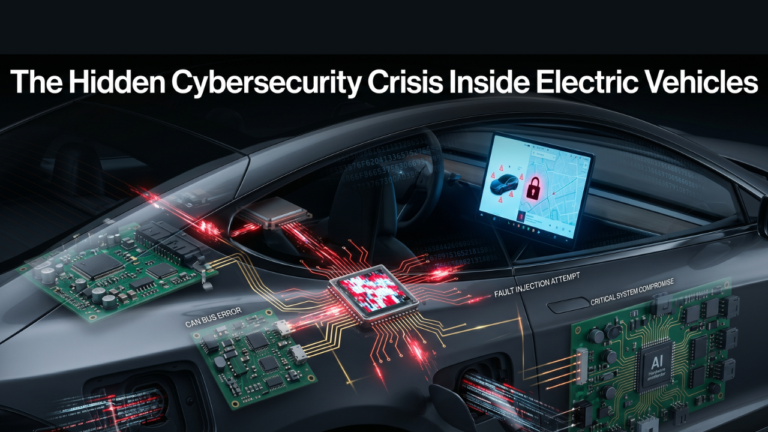
And while we’re talking about the hardware layer inside modern EVs — if you want a look at the security vulnerabilities already baked into today’s electric vehicles, that’s a separate but equally under-discussed story.
I’d love to tell you it’s almost here. But that battery engineer’s laugh stuck with me for a reason. He wasn’t laughing because the technology doesn’t work. He was laughing because everyone keeps forgetting how hard the boring part is — and the boring part is what actually puts batteries in cars.
About the Author
Imran Valiani | Sales Director, PCB Electronics Manufacturing
20+ years working with major Bay Area and global tech clients. Founder of Silicon to Software, where I write about the hardware layer — PCB fab, AI gear, autonomous systems, and cyber — the stuff most tech writers have never touched. Literally.
Follow: X @SiToSoftware | LinkedIn
This article was developed with AI assistance and edited, fact-checked, and reviewed by the author. See my full AI disclosure.
Sources
- Toyota production license, October 7, 2025 — Toyota’s Solid-State Battery Layout: Mass Production in 2027 (SMM)
- QuantumScape Q2 2025 Letter to Shareholders — SEC EDGAR filing, July 23, 2025
- Solid Power DOE award announcement — Official press release, September 20, 2024
- DOE technical report on solid-state battery funding — Challenges for and Pathways Toward Solid-State Batteries, OSTI.GOV
- 2026 solid-electrolyte roadmap — 2026 Roadmap on Next-Generation Solid Electrolytes for Battery Applications, Materials Futures (IOP Publishing)
- NIO/WeLion 150 kWh semi-solid battery launch — NIO rolls out first mass-produced 150 kWh semi-solid battery pack, CarNewsChina
- NIO discontinuation of the 150 kWh pack — Nio drops 150 kWh battery with semi-solid electrolyte again, Electrive
- China’s national solid-state battery standard, GB/T 43568-2026 — Global Landscape Analysis of Solid-State Battery Regulations, Policies, and Standards (Q2 2026), Shanghai Metals Market; confirmed independently via GB/T 43568-2026, Battery Design
- Battery manufacturing yield benchmarks — Factorial Energy, “To Scale Batteries, You Have to Solve for Yield First”; Cartesian Growth Corp III, SEC Form S-4/A, 2026 — note: this SEC filing is Factorial’s own disclosed manufacturing-yield data, filed as part of its SPAC merger disclosure; the SEC did not independently validate these figures, it is simply the public document where Factorial made the disclosure