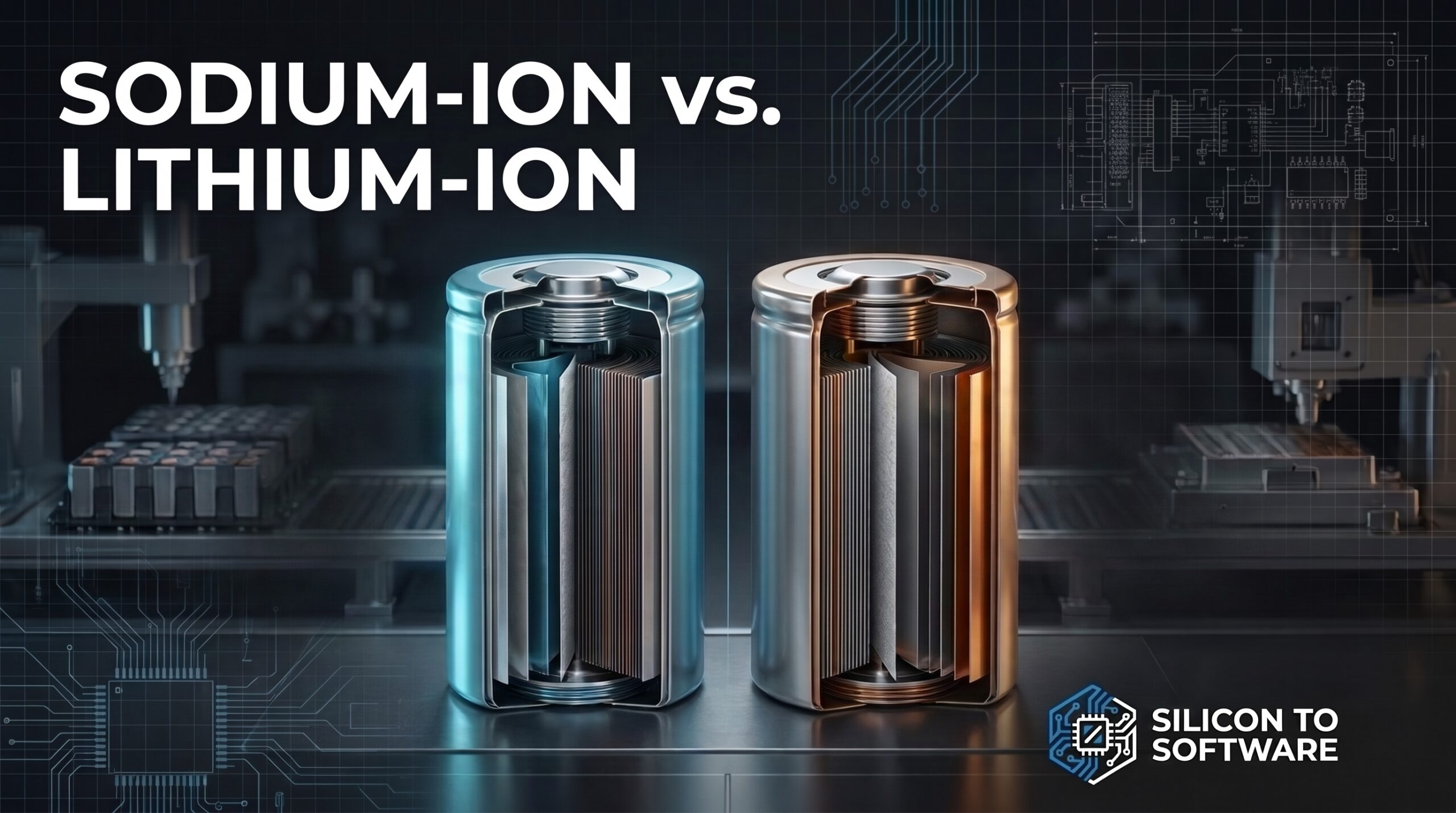
Sodium-Ion vs. Lithium-Ion Batteries: Can Sodium Really Replace Lithium in EVs?
CATL is pushing sodium-ion batteries toward commercial scale. But lower raw-material costs, energy-density limits, and manufacturing economics will determine whether they can compete with lithium-ion.
In September 2025, Natron Energy shut down. The sodium-ion startup, headquartered in Santa Clara, California, closed both its headquarters and its manufacturing plant in Holland, Michigan, effective September 3. Its WARN notice is blunt about why: on August 27, the board determined that efforts to raise sufficient new funding had failed. A year earlier, Natron had announced a $1.4 billion gigafactory in North Carolina. Trade press reports added two more problems. Delayed UL certification left about $25 million in customer orders unfilled. And a roughly 70% drop in lithium prices had undercut sodium-ion’s cost case.
Eight months later? The world’s largest EV battery maker went the other way. In May 2026, CATL filed plans with environmental authorities in Ningde to add 40 GWh of annual sodium-ion capacity. Planned investment: 5 billion yuan.
Same chemistry. Opposite bets.
So here’s the question this article chases. Sodium-ion batteries work. That part isn’t in doubt. What’s still open is whether they can compete with lithium-ion, and specifically LFP, once you count everything that matters in a real car program: energy density, cost per usable kWh, cycle life, cold-weather behavior, manufacturing scale-up, and what’s actually shipping versus what’s only been announced. I come at this from electronics manufacturing, not cell chemistry (my world is circuit boards and production lines, not electrochemistry). That background matters most where sodium-ion’s story gets decided. On the line.
To be fair, Natron’s failure doesn’t settle sodium-ion’s economics. Its cells used Prussian-blue electrodes. They targeted industrial power applications, not EV traction. What Natron shows is narrower, and maybe more useful: a sodium-ion company can have working cells and still fail commercially.
Table of Contents
What Changes Inside the Cell
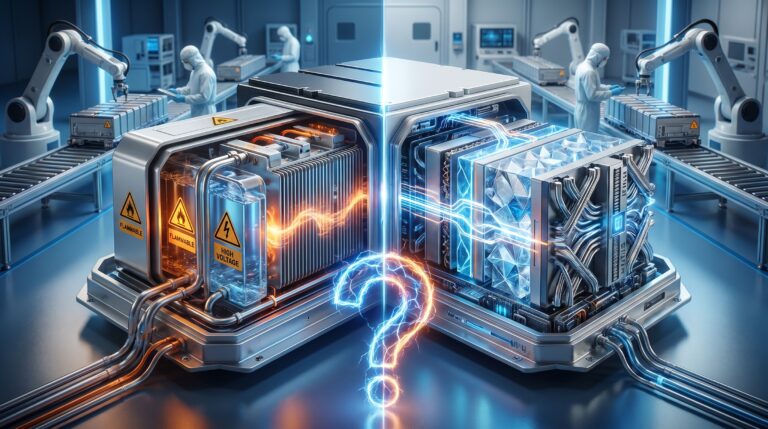
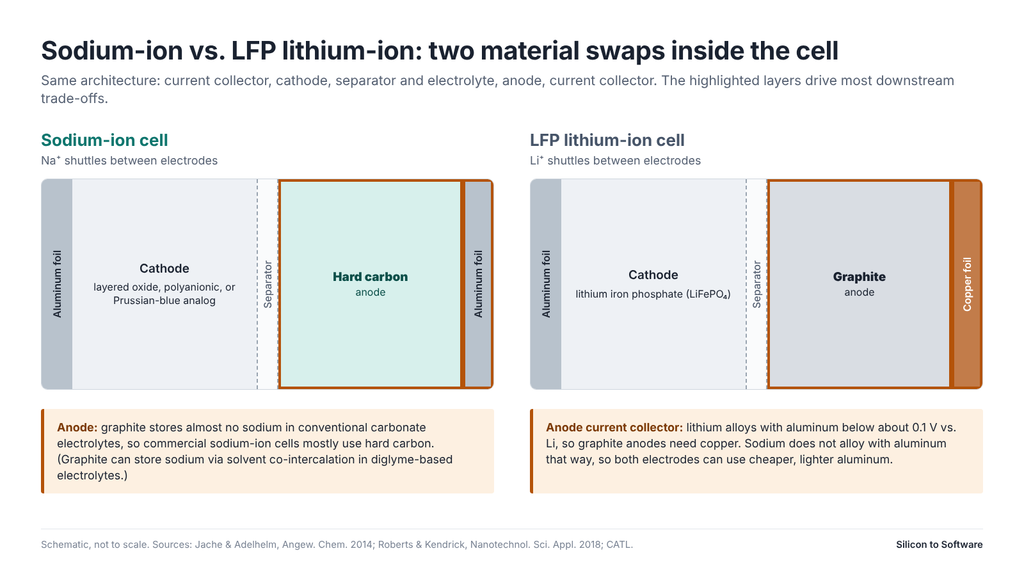
A sodium-ion cell looks a lot like a lithium-ion cell. Cathode, anode, separator, electrolyte, two current collectors. Same architecture. The differences are in the materials, and each one ripples downstream.
Hard carbon instead of graphite
Graphite is the standard lithium-ion anode. It’s a poor fit for sodium. In conventional carbonate electrolytes, graphite stores almost no sodium, because sodium doesn’t form stable binary compounds with graphite under normal conditions the way lithium does. Why, exactly? The thermodynamic reasons are still discussed, and ion size is only one of the cited factors. There is a workaround. In 2014, Jache and Adelhelm showed graphite can store sodium through solvent co-intercalation in a diglyme-based electrolyte, reaching capacities near 100 mAh/g over 1,000 cycles. Commercial sodium-ion cells mostly skip that route. They use hard carbon, whose disordered structure gives sodium more places to sit.
Aluminum current collectors on both electrodes
This one’s simple. It’s also a real win.
Conventional graphite-anode lithium-ion cells need copper foil on the anode. Why? Lithium alloys with aluminum at low potential, below about 0.1 V vs. lithium. Sodium doesn’t alloy with aluminum that way. So suitable sodium-ion designs can use aluminum as the current collector on both electrodes. Aluminum is cheaper than copper. Lighter, too.
Discharge capability is not transport authorization.
You’ll sometimes hear sodium-ion cells promoted as able to be discharged to zero volts for safer shipping. Maybe. Whether a specific cell tolerates that is a question for its manufacturer’s operating limits, not a property of the whole chemistry. And even where a cell can reach zero volts, that’s not the same as being allowed to ship it that way.
The rules are catching up. The 23rd revised UN Model Regulations introduced dedicated sodium-ion entries, UN 3551 and UN 3552. They also introduced Special Provision 400, which covers cells shipped short-circuited in a zero-energy state, for example with a busbar. Each transport mode adopts these provisions in its own rulebook (ADR for road transport in Europe, the IMDG Code for sea), and shippers have to work from the current text for their mode.
Air is stricter. Much stricter. IATA’s 2026 battery guidance requires UN 3551 sodium-ion batteries shipped on their own under Packing Instruction 976 to be offered at no more than 30% of rated capacity, unless a higher state of charge is specifically approved. Such shipments are normally prohibited on passenger aircraft.
Cathode families
Sodium-ion has three main cathode families: layered transition-metal oxides, polyanionic compounds, and Prussian-blue analogs. They trade off differently on energy density, cycle life, cost, and how hard they are to process. For its storage product, CATL refers to NFPP, a polyanionic cathode. Its passenger-battery announcements don’t say which cathode Naxtra uses. That matters. Findings for one family don’t automatically carry over to another.
What limits energy density
Here’s the thing a lot of coverage gets backwards. Sodium’s larger ionic radius limits which host structures work, and it can limit how much charge an electrode can hold. But the alkali ion itself is a small fraction of total cell mass. Energy density depends mainly on how much the host materials can store, how much ion inventory stays reversible, and the average voltage. So the real gap depends on specific cell designs, not on the element. Which is why the next section looks at named products.
Sodium-Ion vs. LFP Energy Density: Cell Specs vs. Pack Reality
Start with CATL’s own number. Its April 2025 launch gave Naxtra’s passenger battery as 175 Wh/kg. Its February 2026 release says up to 175 Wh/kg, which the company describes as the highest among sodium-ion batteries and comparable to LFP. Note the wording. This is a company-reported, cell-level maximum. CATL’s releases don’t disclose the cell format, capacity, nominal voltage, measurement protocol, or whether the figure is nominal or measured energy.
Comparing it with LFP takes care. Measurement boundaries matter:
| Product | Figure | Level | Evidence type |
|---|---|---|---|
| CATL Naxtra (sodium-ion) | Up to 175 Wh/kg | Cell | Company maximum |
| CATL Shenxing Plus (LFP), 2024 | 205 Wh/kg | Battery system | Company specification |
| CATL Qilin, 3rd gen (high-nickel NMC), 2026 | 280 Wh/kg | Level not specified in the release | Company specification |
These figures aren’t directly comparable. A battery system includes structure, wiring, and thermal hardware on top of the cells, so its energy density can’t exceed that of its own cells. CATL’s 205 Wh/kg system figure therefore implies Shenxing Plus cells above 205 Wh/kg, by CATL’s own account. That’s enough to say Naxtra’s claimed maximum sits below CATL’s best LFP, without pretending the two numbers measure the same thing.
Now the other end of the LFP range. CarNewsChina reported a workshop teardown of a 186.7 Ah CATL Shenxing LFP cell from a Xiaomi SU7 Standard Edition, based on a technician’s Bilibili video. Its calculated gravimetric energy density was 175.7 Wh/kg, consistent with rated capacity × 3.2 V nominal ÷ the measured 3.4 kg mass. (That reconstruction is mine; no discharge energy was measured, and the report says the figure applies to that single sample.) It lands right next to Naxtra’s claimed maximum. Tempting, right? But what it really illustrates is how wide the LFP range is. It’s not a controlled chemistry comparison.
CATL itself offers a counterweight. At its April 2026 Tech Day, chief scientist Wu Kai said LFP is approaching its theoretical energy-density limit. Interesting admission. So the fair summary goes like this: Naxtra’s claimed maximum overlaps the lower-to-middle range of production LFP, sits below CATL’s best LFP, and sits well below NMC. Respectable. Not a knockout.
Pack level: the announced sodium-ion Nevo A06
Naxtra uses cell-to-pack integration without modules. Its first announced passenger-car application is a sodium-ion version of the Changan Nevo A06, unveiled in February 2026. Reports put its pack at 45 kWh. CATL says it’s rated at more than 400 km on China’s CLTC cycle. As of October 13, 2026, I found no confirmation from Changan or CATL that this version has reached retail sale or customer delivery.
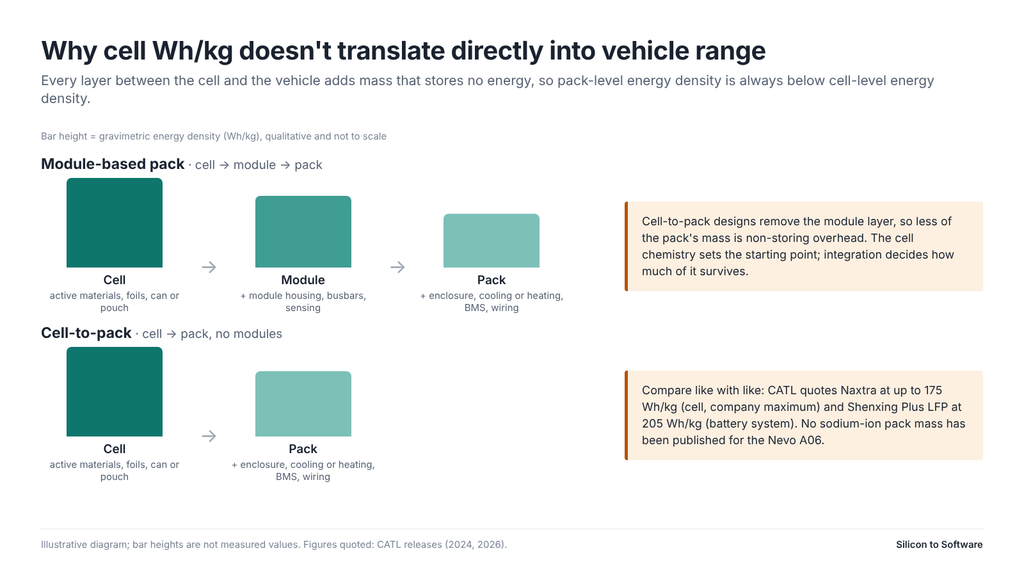
Changan also sells battery-electric and range-extender A06 versions with lithium-ion packs. Apples to apples, then? Not yet. Neither company has published the sodium-ion pack’s mass or volume, and official model-year specifications for a like-for-like comparison weren’t available to me. So the car can’t yet show how sodium-ion and LFP compare at pack level. And CLTC-rated range shouldn’t be treated as guaranteed real-world range.
Engineering consequence: sodium-ion is positioned first for EVs where a roughly 400 km CLTC rating may be acceptable, such as compact cars, urban vehicles, fleets, and range-extender hybrids. CATL projects 500–600 km battery-electric ranges as the technology develops.
Are Sodium-Ion Batteries Cheaper? Cost per Usable kWh Explained.
Material cost. That’s sodium-ion’s central appeal. Sodium-bearing raw materials are abundant and cheap, and lithium is far less abundant in the Earth’s crust. But here’s the thing: no automaker buys raw materials. They buy qualified cells, coming off a production line running at some yield. Between raw material and cell sit cathode synthesis, hard-carbon production, electrolyte, foil, coating, formation, scrap, depreciation, and supply-chain maturity. Every one costs money.
Two different cost metrics
- Initial cost per usable kWh: installed battery cost (cell or pack) divided by the energy the battery can actually deliver within its permitted operating window.
- Lifetime cost per delivered kWh: a lifecycle metric that folds in usable capacity, cycle life, degradation, round-trip efficiency, and other costs over the battery’s service life.
A chemistry can lose on the first and win on the second. Or the reverse. To calculate either, you need cell and pack cost, usable energy window, efficiency, cycle life under defined conditions, and degradation data, all on a comparable basis. For Naxtra? Most of those inputs aren’t public.
Cell cost is not pack or vehicle cost.
A cheaper cell isn’t a cheaper car. At system level, cost also depends on enclosure and structural integration, the extra mass needed to reach a given range, crash protection, thermal management, BMS calibration, power electronics matched to the cell’s voltage window, and warranty reserves. Some of these could move in sodium-ion’s favor (lower heating demand in cold climates is one example, if it’s demonstrated). Others could move against it. I found no publicly documented sodium-ion vs. LFP pack bill of materials or vehicle-level cost comparison. None.
What the evidence shows
Short version: no parity yet. No publicly available comparison identified in this review establishes cost parity between sodium-ion and LFP on either metric. Published 2026 estimates vary widely, and many come from vendors. So I’m not publishing a $/kWh comparison here.
What I can document is how much the lithium side moved. Mysteel (Shanghai Ganglian) data show Chinese battery-grade lithium carbonate averaging 195,400 yuan per tonne on May 11, 2026, with futures topping 205,000. It was about 120,000 yuan on September 30 and 105,700–112,000 yuan on October 13. Think about that. When a key LFP input swings that hard within months, any sodium-ion cost advantage measured against LFP is a moving target.
CATL’s outlook is a projection, too. CarNewsChina reported in June 2026 that CATL forecast sodium-ion costs matching lithium-ion’s by year-end. It didn’t say cell or pack. It didn’t name the lithium-ion chemistry used as the benchmark.
Lithium prices matter. A lot. They don’t decide this alone. Sodium-ion’s cost position depends on six factors together: chemistry choice, material prices, process yield, capital spending, production scale, and supply-chain maturity.
Sodium-Ion Cold-Weather Performance: What CATL Actually Claims
Cold weather is where sodium-ion makes its most distinctive claims. It’s also where the words get slippery. Quick definitions first:
- Capacity (Ah) is how much charge the battery can deliver.
- Energy (Wh) is that charge delivered across the battery’s voltage.
- Power is voltage × current: how fast the battery can deliver energy. At low temperature, internal resistance rises, terminal voltage sags under load, and power capability falls.
Three different kinds of claim
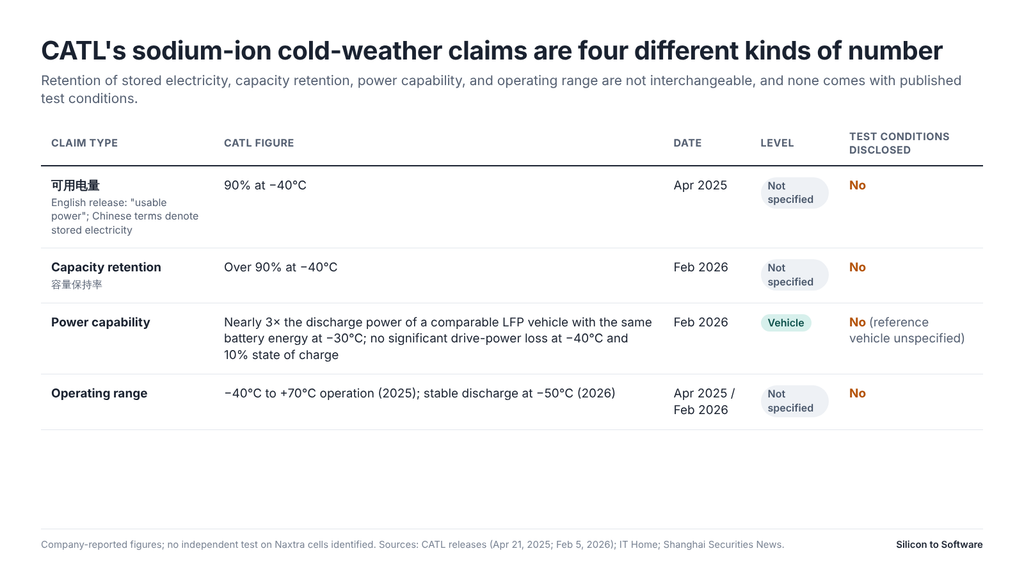
CATL’s published claims fall into distinct groups. And its Chinese and English wording doesn’t always match.
The 2025 retention claim. CATL’s English release says the passenger battery retains 90% “usable power” at −40°C. Chinese-language reports of the same launch describe it as 90% 可用电量 (IT Home) or 90% energy retention, 能量保持率 (Shanghai Securities News). Both Chinese terms denote a quantity of stored electricity. Not power. CATL didn’t publish a measurement definition or test conditions. Its light-commercial-vehicle pack is described the same way: 90% 可用电量 at −40°C and above 92% at −20°C.
The 2026 capacity-retention claim. In February 2026, CATL described capacity retention (容量保持率) above 90% at −40°C. This ti, me the quantity is named. The test protocol still isn’t.
Power capability. CATL claims nearly three times the vehicle-level discharge power of a conventional LFP vehicle with the same battery energy at −30°C. It also claims no significant degradation in vehicle drive power at −40°C, even at 10% state of charge. Impressive, if it holds. But these are CATL-reported, vehicle-level comparisons with an unspecified reference vehicle. They’re not a general sodium-ion vs. LFP multiplier.
Operating range. CATL quotes a −40°C to +70°C operating range and stable discharge at −50°C. Separately, its Chief Manufacturing Officer told Bloomberg in June 2026 that the batteries were developed to perform as low as −20°C or −30°C. A contradiction? Not necessarily. An interview remark and a specification sheet don’t share definitions, and the remark doesn’t establish a contradiction.
What’s missing is everything you’d need to compare these claims with anything else: discharge C-rate, temperature soak time, state of charge, reference temperature, and whether thermal conditioning was used. CATL hasn’t published any of it. I found no independent test reproducing the claims on Naxtra cells, either. Independent analyst Xing Lei, quoted by Scientific American, cautioned that CATL’s figures are likely best-case results from controlled tests. Fair warning.
What independent research shows
Outside CATL, peer-reviewed research shows good low-temperature performance is achievable. Not automatic. A Beihang University team reported an anode-free sodium pouch cell delivering 204 Wh/kg (whole-cell basis) at −40°C. They got there by re-engineering the electrolyte, and it’s a lab result in a different cell architecture from Naxtra. Meanwhile, a Hong Kong Polytechnic University study of a hard-carbon full cell found that an unstable interphase caused capacity fading at −20°C.
My take? Cold-weather capability is engineered through electrolyte and interface design. Sodium doesn’t hand it to you. The research makes CATL’s claims plausible. It doesn’t validate Naxtra’s specifications.
CATL estimates that winter effective range can exceed 90% of the displayed figure. Chinese state-media coverage adds that vehicles could simplify or remove battery heating systems. Both remain potential system-level benefits. Still unproven. I found no published vehicle-level comparison of thermal-management energy against an equivalent LFP pack. Not one.
Cycle Life: Company Figures, Missing Test Conditions
More than 10,000 cycles. That’s CATL’s claim for the Naxtra passenger battery, and separately for its Tectrans II 45 kWh light-commercial-vehicle pack. The catch? CATL hasn’t published the test conditions for either. No depth of discharge. No C-rate. No temperature. No end-of-life threshold.
To be honest, the contrast with its storage product is telling. For Tener Sodium, CATL does publish conditions: 15,000 cycles at 25°C and more than 10,000 at 45°C. That’s a different product designed for a different duty cycle, though, and its figures don’t transfer to the passenger battery.
Engineering consequence: without stated conditions, the 10,000-cycle passenger figure is a company claim. It can’t be compared directly with LFP ratings, and it doesn’t establish service life in a vehicle. Long-duration, publicly documented fleet-aging data for current sodium-ion passenger cells remain limited. Calendar aging and cycling both matter in any use case, and their relative weight shifts with utilization and temperature: lightly used private cars lean toward calendar aging, while high-utilization fleets and battery-swap packs lean toward cycle count.
Sodium-Ion Battery Manufacturing: Reusable Lines, New Problems
This is where my own industry background applies. I’ve found that in electronics manufacturing, a new material on an existing line is rarely a simple swap. Equipment may carry over. Process windows usually don’t.
Sodium-ion follows that pattern. Sound familiar? Researchers at Karlsruhe Institute of Technology note that sodium-ion electrode processing is expected to be a drop-in for lithium-ion. Expected. They also note that detailed comparisons of slurry, coating, and drying behavior were still lacking, and their own work examined those parameters directly.
Field data on commercial cells is sobering. A 2026 EES Batteries study looked at initial-release sodium-ion 18650 cells from two manufacturers. Manufacturing consistency? Comparable to lithium-ion standards. Capacity retention? Significantly short of manufacturer specifications. The study also linked one batch’s failure modes to a wider operating voltage window.
At the materials level, cathode supplier Ronbay Technology told investors in July 2026 that converted LFP lines can produce sodium-ion cathode material. Then came the warning. Carrying over LFP methods directly can mean lower efficiency, higher processing cost, and weaker product performance.
CATL’s four reported scale-up challenges
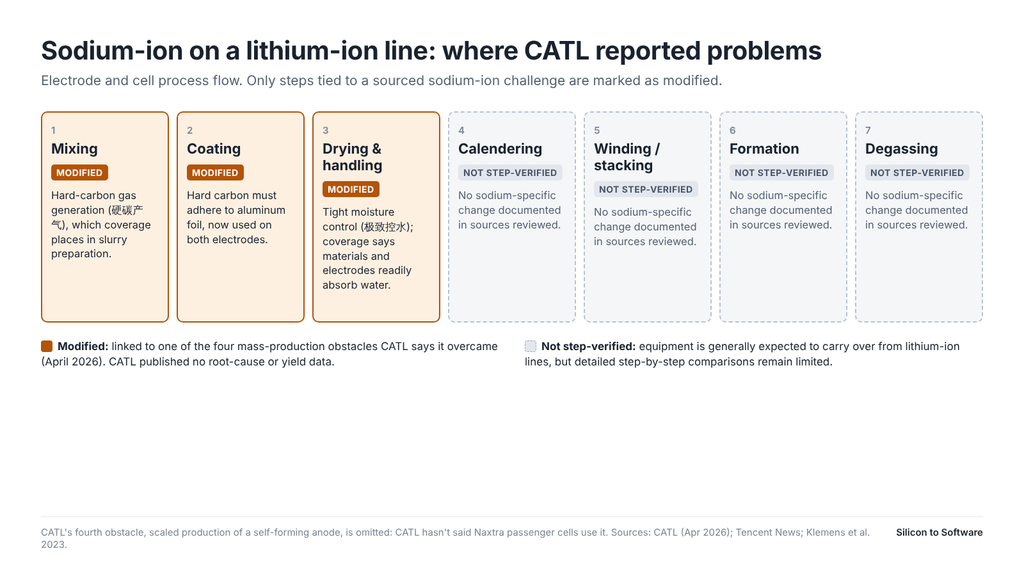
CATL’s April 2026 release names four obstacles it says it overcame in its own sodium-ion mass production. It doesn’t publish root-cause analyses or yield impacts. So the consequences described below are engineering interpretation, not CATL-reported process data:
- Moisture control. Coverage says CATL’s materials and electrodes readily absorb water. That raises dry-room requirements and limits how long electrodes can wait between process steps.
- Hard-carbon gas generation (硬碳产气). CATL’s term. Chinese coverage places the problem in slurry preparation, where it would affect mixing, coating quality, and yield. Whether other hard-carbon formulations behave the same way isn’t established here.
- Adhesion between aluminum foil and hard carbon. This bears on coating integrity, calendering, and long-term electrode stability.
- Scaled production of a “self-forming anode” (自生成负极). A CATL executive described this approach in 2025 as dispensing with a conventional graphite anode and depositing metal directly on the current collector, in the context of CATL’s dual-core battery products. CATL hasn’t said whether Naxtra passenger cells use it.
Also, line compatibility is not the same as qualified high-volume manufacturing. That takes first-pass yield, scrap, formation time, and batch-to-batch material variation, all under control. CATL publishes none of these figures.
Then there’s hard carbon itself. Chinese industry reporting in 2026 points to hard carbon as the pressure point. Trade publication GGII wrote in May that sodium-ion’s industrialization bottleneck is now focused on the hard-carbon anode, and Shanghai Metals Market described hard-carbon anode supply as falling short of demand throughout the first half of 2026. Supply capacity and cost data weren’t available for this article.
Production milestones
Watch the dates. CATL’s own statements show the passenger-car timeline moving:
- April 2025: Shanghai Securities News reported CATL saying Naxtra passenger batteries would begin formal mass-production shipments (正式量产出货) in December 2025.
- September 2025: CATL said passenger-car sodium-ion batteries were in development with customers and would reach batch supply in 2026, according to customer schedules.
- April 2026: CATL said formal large-scale mass production (正式规模化量产) would begin at the end of 2026, which Xinhua reported as Q4 2026.
CATL hasn’t said whether the 2026 target describes the same milestone as the original December 2025 date, or a later scale-up stage. Either way? Scale-up is where the timeline is being decided.
Equipment reuse lowers the cost of entry. It doesn’t decide final cost. That still comes down to the six factors from the cost section.
Sodium-Ion Commercial Deployment in 2026: A Scorecard
Coverage of sodium-ion often merges stages that need to stay separate. Here they are, pulled apart.
| Stage | Status (as of Oct. 13, 2026) | Basis |
|---|---|---|
| Planned investment and capacity | 5 billion yuan, 40 GWh Fuding expansion (24-month construction); Jining base plans 160 GWh of sodium-ion capacity | Regulatory filing, reported; company statement |
| Production lines | CATL says its sodium-ion mass-production lines are fully commissioned and operational; commissioned GWh capacity, utilization, and yield not disclosed | Company statement (June 2026) |
| Industrialization claim | CATL reports overcoming four mass-production obstacles and having large-scale delivery capability | Company statements (April 2026) |
| Capacity ambition | Zeng: capable of 100 GWh annual capacity within three to five years | Executive statement |
| Passenger-car production timeline | Dec. 2025 mass-production shipments (2025) → batch supply in 2026 per customer schedules (Sept. 2025) → formal large-scale mass production by end-2026 (2026) | Company statements, as reported |
| Safety qualification | CATL announced Naxtra passed GB 38031-2025 on Sept. 5, 2025, after cell- and pack-level testing by CATARC. The standard took effect July 1, 2026. A certification result, not proof of zero fire risk. | Company announcement |
| Storage agreement | Signed April 27, 2026, with HyperStrong: a strategic cooperation agreement covering 60 GWh over three years, which CATL later called a “commercial contract.” The announcements don’t disclose minimum purchase obligations. | Company announcements |
| Storage shipments (systems) | Projected: first China deliveries planned for Sept. 2026, ~1 GWh cumulative expected by year-end. Actual shipments not disclosed as of Oct. 13. | Company plan |
| Vehicle forecast (installed in EVs) | Projected: 10,000–20,000 EVs in 2026 | Executive projection |
| First passenger model | Sodium-ion Nevo A06, described by CATL and Changan as the first mass-production sodium-ion passenger car; unveiled Feb. 2026 for a mid-2026 launch. Earlier small-volume sodium-ion EVs exist, including the JAC Yiwei (HiNa cells) and a 2023 Chery model with CATL’s first-generation cells, which Scientific American reported had a 170 km range and sold poorly. | Company announcement; reporting |
| Retail sales/customer deliveries | Not independently confirmed as of October 13, 2026. No verified Changan or CATL announcement establishing retail sales or customer deliveries was identified. | Public confirmation not established |
The storage rows correct a common misreading. A 60 GWh three-year agreement is an announcement, and its binding volume is undisclosed. CATL’s own projected shipment figure for 2026? About 1 GWh. Actual shipments haven’t been disclosed. That’s a big gap.
The vehicle side is smaller still. If 10,000–20,000 cars carried 45 kWh packs like the A06, that would be about 0.45–0.9 GWh installed over 2026. (That’s my calculation from an assumed pack size and a company forecast, not a reported figure.) For scale, China installed 335.6 GWh of power batteries in vehicles in the first half of 2026, with LFP accounting for about 81%, according to China Automotive Battery Innovation Alliance (CABIA) data. Under 1 GWh, next to 335.6. Tiny.
Engineering consequence: CATL reports operational production lines and large-scale delivery capability. Even so, the 2026 public record still shows announced agreements and capacity plans far larger than projected shipments, and no confirmed vehicle deliveries.
CATL’s 30–40% Sodium-Ion Forecast: Which Market?
The strongest case for broad replacement comes from CATL itself. According to an April 2026 report in Sina Finance, Robin Zeng told CATL’s April 3 annual shareholder meeting that sodium-ion could replace 30–40% of the existing battery market share. I found no official transcript.
But 30–40% of what? The statement doesn’t specify which applications the denominator includes. The same report describes Zeng positioning sodium-ion for cost- and safety-sensitive short-to-medium-range transport and energy storage, as a complement to lithium. Whether the 30–40% includes stationary storage isn’t established. I’m not assuming it does.
CATL has framed sodium-ion’s potential in at least three other ways:
- An initial goal of replacing 20–30% of LFP in small or short-range cars, later raised to over 50% of the LFP market (Zeng, reported by Reuters in 2025 and by Chinese press).
- The potential to meet over 40% of domestic passenger-vehicle demand (CATL, 2025, as reported). This appears to describe range requirements sodium-ion could meet, not an adoption forecast.
- Range capability covering over 50% of new-energy-vehicle range requirements (CATL and Changan, February 2026).
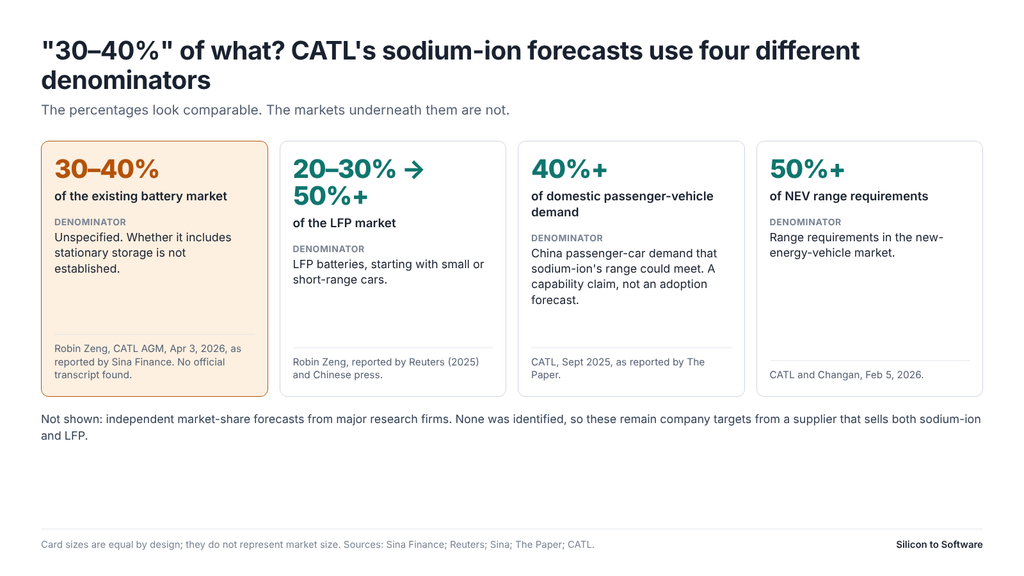
Different denominators. Big difference. Each implies a different future for EVs.
There’s a stronger version of the replacement argument than any single forecast. Stationary storage could give sodium-ion the manufacturing volume it currently lacks, and if storage orders scale, learning-curve effects in cell production, materials supply, and yield could lower sodium-ion cell costs in ways that carry over to EV cells. Could. That’s a hypothesis, and the transfer isn’t automatic: EV cells face stricter requirements than storage cells for power, packaging, crash safety, qualification, and warranty. Public data can’t test it yet.
I didn’t identify independent market-share forecasts from major research firms. Until they exist, CATL’s figures are long-term targets from a company that sells both chemistries.
Can both be true? Yes. A substantial overall market share and a complementary role in EVs can coexist.
Can Sodium Replace Lithium in EVs? What the Evidence Supports
Established as of October 2026:
- CATL has announced sodium-ion investment plans, including a 5 billion yuan, 40 GWh expansion filed with regulators. It says its mass-production lines are commissioned and operational, but hasn’t disclosed their capacity, utilization, or yield. Its stated passenger-car timeline moved from December 2025 mass-production shipments to formal large-scale mass production at the end of 2026. It projects about 1 GWh of storage shipments this year; actual shipments haven’t been disclosed.
- Naxtra’s claimed cell energy density of up to 175 Wh/kg overlaps the lower-to-middle range of production LFP. It sits below CATL’s best LFP and well below NMC. Methodologically equivalent comparisons aren’t yet available.
- The sodium-ion A06 has been announced, but its retail availability is unconfirmed, and the pack data needed for a like-for-like comparison is not public.
- CATL’s −40°C claims describe retention of stored electricity (2025) and capacity (2026), without disclosed test conditions. Its power claims are separate, vehicle-level comparisons. None has independent validation, though peer-reviewed research shows sodium-ion’s low-temperature potential when properly engineered.
- Cost parity with LFP has not been established on either initial cost per usable kWh or lifetime cost per delivered kWh, at cell or pack level.
What would support broad replacement in EVs:
- Independent pack-level data showing energy density approaching mainstream LFP.
- Pack-level cost advantages on both metrics that hold even when lithium is cheap, possibly driven by storage-scale manufacturing.
- Independent cold-weather and aging data confirming CATL’s specifications.
- Verified passenger-car deliveries growing well beyond validation scale.
What would keep sodium-ion in specific segments:
- LFP continuing to improve at the cell level, though CATL’s chief scientist says it is approaching its limit.
- A cost advantage that appears only when lithium prices spike.
- Hard-carbon supply or yield constraints slowing the ramp, or further schedule changes.
So where does that leave us? Today’s evidence doesn’t support “sodium will replace lithium.” It doesn’t support “sodium is a niche,” either. It supports something narrower. Sodium-ion has moved from laboratory to factory. What it hasn’t done yet is show, with independent data, that it can beat LFP on cost per usable kWh in a car. That’s the comparison engineers should watch.
About the Author
Imran Valiani | Sales Director, PCB Electronics Manufacturing
20+ years working with major Bay Area and global tech clients. Founder of Silicon to Software, where I write about the hardware layer — PCB fab, AI gear, autonomous systems, and cyber — the stuff most tech writers have never touched. Literally.
Follow: X @SiToSoftware | LinkedIn
This article was developed with AI assistance and edited, fact-checked, and reviewed by the author. See my full AI disclosure.
Listen to the Silicon to Software podcast on Apple Podcasts, Spotify, or RSS.com — and watch on YouTube.
Sources
- CATL — “Naxtra Battery Breakthrough & Dual-Power Architecture: CATL Pioneers the Multi-Power Era”
CATL, 2025.
https://www.catl.com/en/news/6401.html - CATL — “CATL and CHANGAN Launch World’s First Mass-Production Sodium-Ion Passenger Vehicle”
CATL, 2026.
https://www.catl.com/en/news/6720.html - CATL — “CATL Debuts World’s First Field-Validated Sodium-Ion BESS, Bringing Sodium Storage to Commercial Reality”
CATL, 2026.
https://www.catl.com/en/news/6861.html - CATL — “CATL’s Naxtra Battery Passes New National Standard Certification”
CATL, 2025.
https://www.catl.com/en/news/6563.html - CATL — “CATL Becomes China’s First to Pass the Certification of New Standards for EV Batteries”
CATL, 2025.
https://www.catl.com/en/news/6482.html - CATL — “CATL Unveils Shenxing PLUS, Enabling 1,000-km Range and 4C Superfast Charging”
CATL, 2024.
https://www.catl.com/en/news/6239.html - CATL — “宁德时代“极域之约”超级科技日:以全材料体系重划行业技术标尺”
CATL (Chinese-language release), 2026.
https://www.catl.com/news/9829.html - CATL — “3年60GWh!宁德时代携手海博思创签署全球最大储能钠电合作协议”
CATL (Chinese-language release), 2026.
https://www.catl.com/news/9847.html - Ningbo Ronbay New Energy Technology Co., Ltd. (宁波容百新能源科技股份有限公司) — “Investor Relations Activity Record No. 2026-002”
Ronbay investor-relations filing, July 30, 2026.
https://pdf.dfcfw.com/pdf/H2_AN202608031827584924_1.pdf - Natron Energy, Inc. — “WARN Notice”
Filed with the Michigan Department of Labor and Economic Opportunity, 2025.
https://www.michigan.gov/leo/-/media/Project/Websites/leo/Documents/WD-DATA_PUBLIC_WARN_NOTICES4/2025/2025-08-29_WARN-Notice_Natron-Energy-Inc.pdf - United Nations — “Recommendations on the Transport of Dangerous Goods: Model Regulations, Volume I, Twenty-third revised edition (ST/SG/AC.10/1/Rev.23).”
United Nations, 2023.
https://digitallibrary.un.org/record/4066022 - IATA — “Battery Guidance Document: Transport of Lithium Metal, Lithium Ion and Sodium Ion Batteries (Revised for the 2026 Regulations)”
International Air Transport Association, 2026.
https://www.iata.org/contentassets/05e6d8742b0047259bf3a700bc9d42b9/lithium-battery-guidance-document.pdf - Bradley, D.C., Stillings, L.L., Jaskula, B.W., Munk, L., and McCauley, A.D. / U.S. Geological Survey — “Lithium”
USGS Professional Paper 1802-K, 2017. DOI: 10.3133/pp1802K.
https://pubs.usgs.gov/pp/1802/k/pp1802k.pdf - Jache, B. and Adelhelm, P. — “Use of Graphite as a Highly Reversible Electrode with Superior Cycle Life for Sodium-Ion Batteries by Making Use of Co-Intercalation Phenomena”
Angewandte Chemie International Edition, 2014, 53, 10169–10173. DOI: 10.1002/anie.201403734.
https://doi.org/10.1002/anie.201403734 - Roberts, S. and Kendrick, E. — “The re-emergence of sodium ion batteries: testing, processing, and manufacturability”
Nanotechnology, Science and Applications, 2018, 11, 23–33. DOI: 10.2147/NSA.S146365.
https://doi.org/10.2147/NSA.S146365 - Klemens, J. et al. (Karlsruhe Institute of Technology) — “Challenges and Opportunities for Large-Scale Electrode Processing for Sodium-Ion and Lithium-Ion Battery”
Batteries & Supercaps, 2023, 6(11). DOI: 10.1002/batt.202300291.
https://doi.org/10.1002/batt.202300291 - Wittman, R.M., Anseán, D., et al., Dubarry, M. — “Initial characterization and cycling of two batches of commercial hard-carbon/NaxNiyFezMn1−y−zO2 sodium ion 18650 batteries as a potential replacement for lithium-ion batteries”
EES Batteries, 2026. DOI: 10.1039/D5EB00161G.
https://doi.org/10.1039/D5EB00161G - Zhu, Q., Wang, J., et al., Dong, S., Wang, H. (Beihang University) — “A >200 Wh kg−1 anode-free Na pouch battery at −40°C enabled by manipulating electrolyte equilibrium”
National Science Review, 2025, 12(6), nwaf124. DOI: 10.1093/nsr/nwaf124.
https://doi.org/10.1093/nsr/nwaf124 - Lin et al. (The Hong Kong Polytechnic University) — “Exploring room- and low-temperature performance of hard carbon material in half and full Na-ion batteries”
Electrochimica Acta, 2019, 316, 60–68. DOI: 10.1016/j.electacta.2019.05.106.
https://doi.org/10.1016/j.electacta.2019.05.106 - Mysteel (Shanghai Ganglian) — “上海钢联碳酸锂价格_市场行情分析_产业链深度解读”
Mysteel, lithium carbonate price page, accessed October 13, 2026.
https://list1.mysteel.com/zhishi/shgltsljg.html - Angeline Shi / Fastmarkets — “China battery production surges 53% in H1 as energy storage demand and exports drive growth beyond EV market”
Fastmarkets, 2026 (reporting China Automotive Battery Innovation Alliance data).
https://www.fastmarkets.com/insights/china-battery-production-surges-53-in-h1-as-energy-storage-demand-and-exports-drive-growth-beyond-ev-market/ - Shanghai Metals Market (SMM) — “2026H1钠电硬碳负极回顾:供不应求贯穿整线,产能突围与品质升级并进”
SMM, 2026.
https://news.smm.cn/news/103999416 - Bloomberg — “CATL Sees Its Sodium Batteries in at Least 10,000 EVs This Year”
Bloomberg, 2026.
https://www.bloomberg.com/news/articles/2026-06-24/catl-sees-its-sodium-batteries-in-at-least-10-000-evs-this-year - Reuters — “China’s CATL launches new sodium-ion battery brand”
Reuters, 2025 (syndicated via AOL).
https://www.aol.com/chinese-battery-maker-catl-launches-072613723.html - Scientific American — “A salt battery could make EVs more winterproof—if it holds up on the road”
Scientific American, 2026.
https://www.scientificamerican.com/article/catl-sodium-ion-battery-aims-to-improve-ev-winter-range-loss/ - Cora Werwitzke / electrive — “CATL markets sodium battery for light commercial vehicles”
electrive, 2026.
https://www.electrive.com/2026/01/22/catl-markets-sodium-battery-for-light-commercial-vehicles/ - Sebastian Schaal / electrive — “Changan Band Oshan adopts CATL sodium-ion batteries”
electrive, 2026.
https://www.electrive.com/2026/01/30/changan-band-oshan-adopts-catl-sodium-ion-batteries/ - Florian Treiss / electrive — “CATL targets up to 20,000 vehicles with sodium-ion batteries”
electrive, 2026.
https://www.electrive.com/2026/06/26/catl-targets-up-to-20000-vehicles-with-sodium-ion-batteries/ - Phate Zhang / CnEVPost — “CATL’s sodium-ion batteries begin deployment in production-ready passenger vehicles”
CnEVPost, 2026.
https://cnevpost.com/2026/02/05/catl-sodium-batteries-begin-deployment-in-production-passenger-vehicles/ - Phate Zhang / CnEVPost — “CATL plans 40 GWh sodium battery capacity expansion after securing world’s largest order”
CnEVPost, 2026.
https://cnevpost.com/2026/05/09/catl-plans-40-gwh-sodium-battery-capacity-expansion/ - Adrian Leung / CarNewsChina — “BYD vs CATL battery cells dissected: Xiaomi SU7 teardown reveals key differences”
CarNewsChina, 2026.
https://carnewschina.com/2026/08/11/byd-vs-catl-battery-cells-dissected-xiaomi-su7-teardown-reveals-key-differences/ - Liu Miao / CarNewsChina — “CATL expects up to 20,000 EVs to be equipped with sodium-ion batteries in 2026″
CarNewsChina, 2026 (headline spelling as published).
https://carnewschina.com/2026/06/25/catl-expects-up-to-20000-evs-to-be-euipped-with-sodium-ion-batteries-in-2026/ - Murray Slovick / Electronic Design — “CATL’s Next-Gen Sodium-Ion Battery Supports 500-km EV Range”
Electronic Design, 2025.
https://www.electronicdesign.com/markets/automotive/article/55322650/electronic-design-catls-next-gen-sodium-ion-battery-supports-500-km-ev-range - Julian Buckley / Power Progress — “Battery manufacturer Natron Energy ceases operations”
Power Progress, 2025.
https://www.powerprogress.com/news/battery-manufacturer-natron-energy-ceases-operations/8084660.article - Xinhua (新华网) — “市场最前沿|满电6分钟 宁德时代发布新一代超充电池”
Xinhua, 2026.
https://www.news.cn/fortune/20260421/6f8b371cfb8a45c6b7d1c71a263cbf8f/c.html - Science and Technology Daily (科技日报) — “热点回应丨钠离子电池能否终结“电动爹”?低温性能与安全优势引关注”
Science and Technology Daily, 2026.
https://www.stdaily.com/web/gdxw/2026-02/06/content_471443.html - Shanghai Securities News (上海证券报) — “宁德时代发布钠新电池 全场景电池版图浮现”
Shanghai Securities News, 2025.
https://paper.cnstock.com/html/2025-04/22/content_2053080.htm - IT Home (IT之家) — “宁德时代钠离子电池“钠新”发布:175Wh/kg 行业量产最高水平能量密度,不起火、不爆炸”
IT Home, 2025.
https://www.ithome.com/0/847/793.htm - Cailian Press (财联社) — “针刺+电钻不燃不爆 宁德时代钠离子动力电池年底量产 曾毓群展望“多核时代””
Cailian Press, 2025.
https://www.cls.cn/detail/2010576 - The Paper (澎湃新闻) — “观察|电池巨头宣布乘用车钠电明年批量装车,剑指四成乘用车市场需求?”
The Paper, 2025.
https://m.thepaper.cn/detail/31630901 - Sina Finance (新浪财经) — “曾毓群定调:宁德时代攻坚第6代钠电池,目标替代30%市场”
Sina Finance, 2026 (originally published by 旺材锂电).
https://finance.sina.com.cn/roll/2026-04-15/doc-inhuqskv8336035.shtml - Sina (新浪) — “宁德时代:2026年将推动钠电池大规模市场应用 主要在换电/储能/乘用车”
Sina, 2026.
https://k.sina.com.cn/article_7879848900_1d5acf3c401902rrcs.html - GGII (高工锂电) — “交付压力下,钠电硬碳负极接受量产拷问”
GGII, 2026 (republished by Sina Finance).
https://finance.sina.com.cn/stock/relnews/cn/2026-05-25/doc-inhzchzh3481242.shtml - 有车CLUB / Tencent News (腾讯新闻) — “宁德时代超级科技日重磅上新 2026年底计划建成4000座超换一体站”
Tencent News, 2026.
https://news.qq.com/rain/a/20260422A02PIG00