Tesla Battery Supply Chain: Lithium Refining, Cathode, and LFP Cells by the Numbers
From spodumene to Megapack: what Tesla makes in-house, what it still buys, and where the gaps are.
Tesla’s Q3 2026 shareholder update contains two sentences about the Tesla battery supply chain that are worth reading side by side.
The first announces a milestone: “We shipped the first Megapacks comprised solely of our own LFP cells.”
The second reports a constraint: “battery availability continued to be the limiting factor in increasing auto volumes in the quarter.”
Tesla now makes its own cells for grid storage, and in the same quarter batteries limited how many cars it could build. Those are different battery supply chains. The capacity table a few pages later shows how much of each one Tesla actually controls.
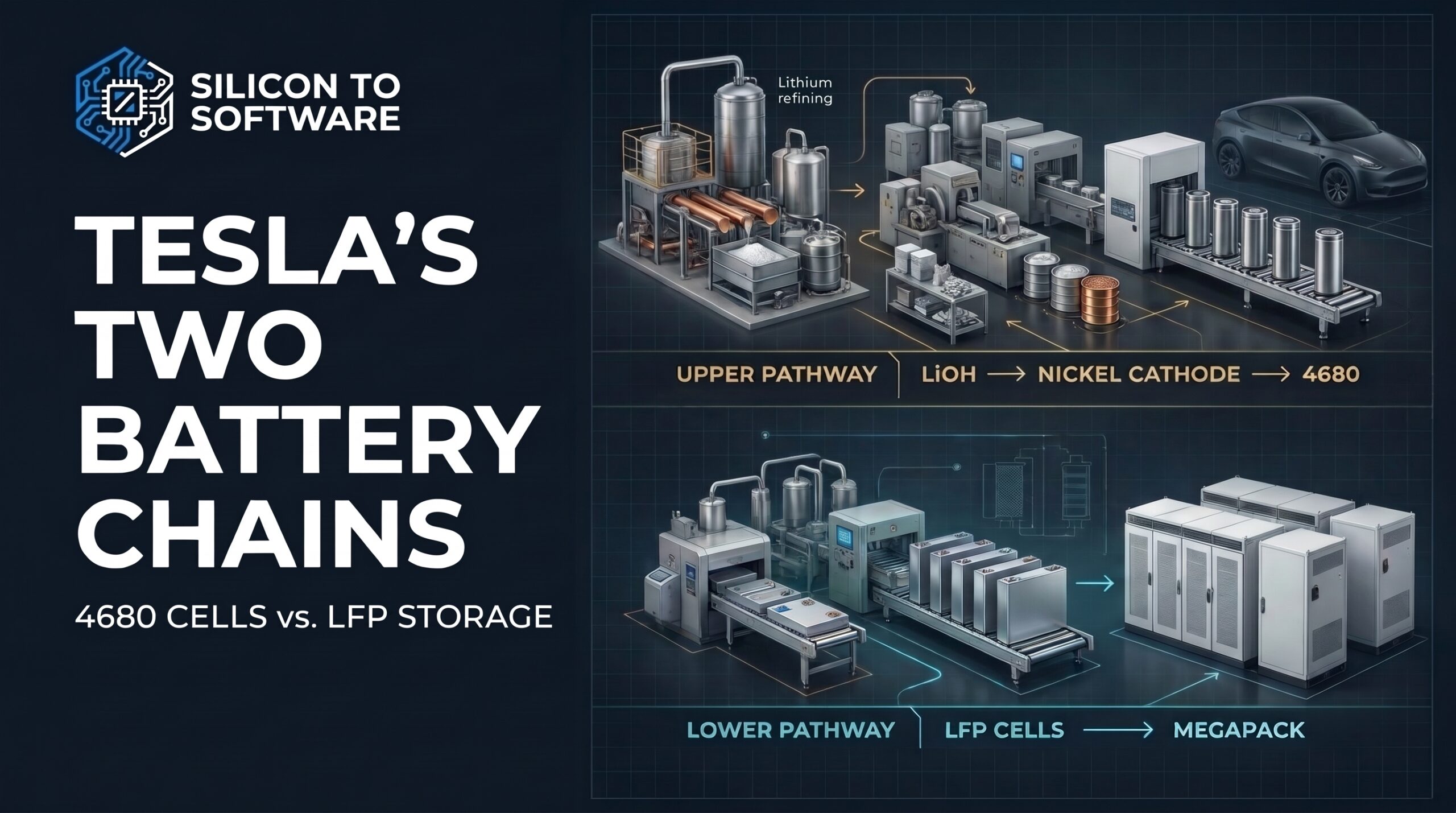
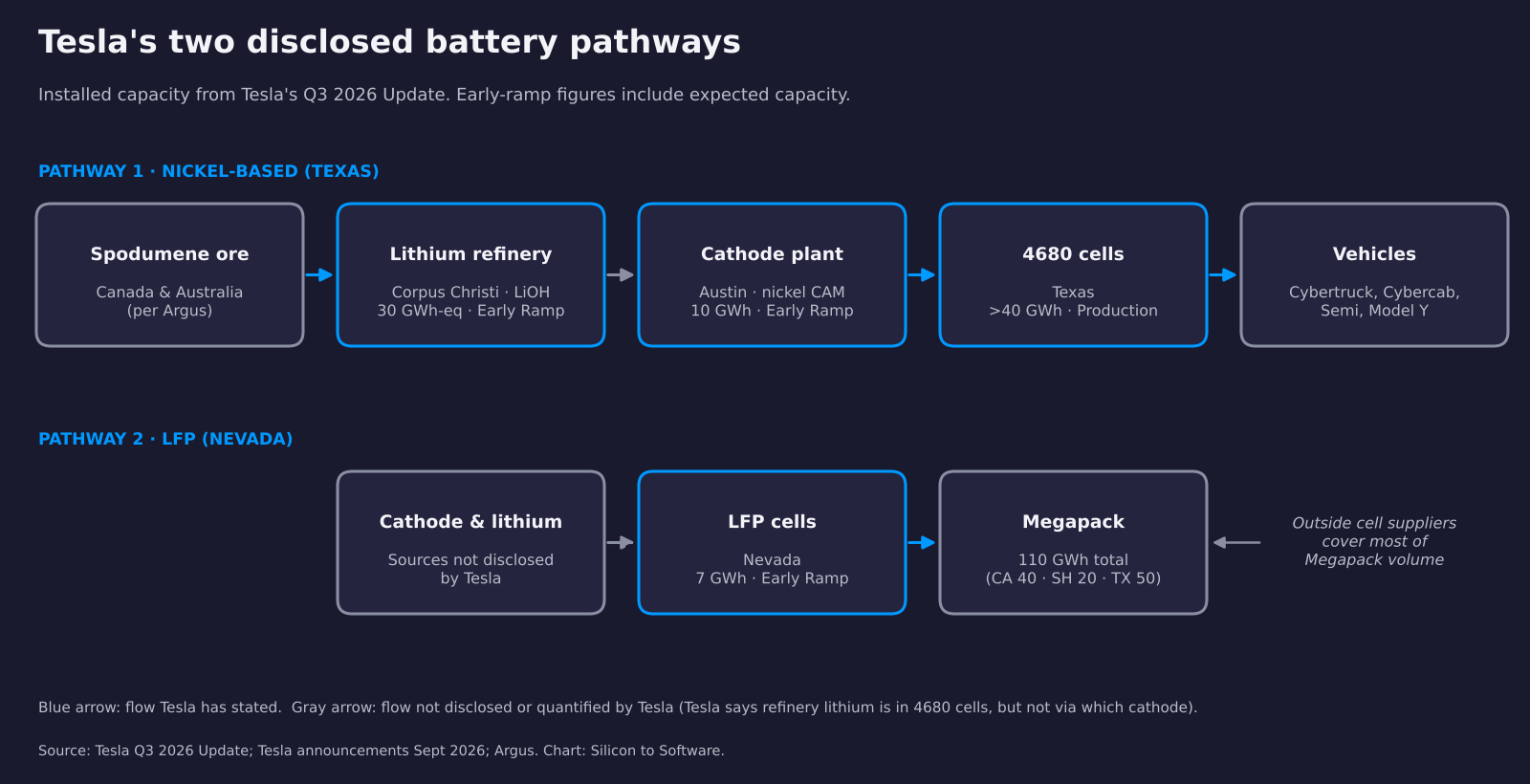
That table lists four battery manufacturing and materials operations: lithium refining in Texas, cathode materials in Texas, LFP cells in Nevada, and 4680 cells in Texas. Tesla’s text groups three of them in one sentence: “cathode material production and lithium refining in Texas and LFP cells in Nevada for our energy storage products.” Read that way, they look like one vertically integrated chain, with ore going in one end and finished cells coming out the other. Some coverage has described it that way. One battery-industry site called it a localized “lithium refining—cathode material—LFP cell” chain.
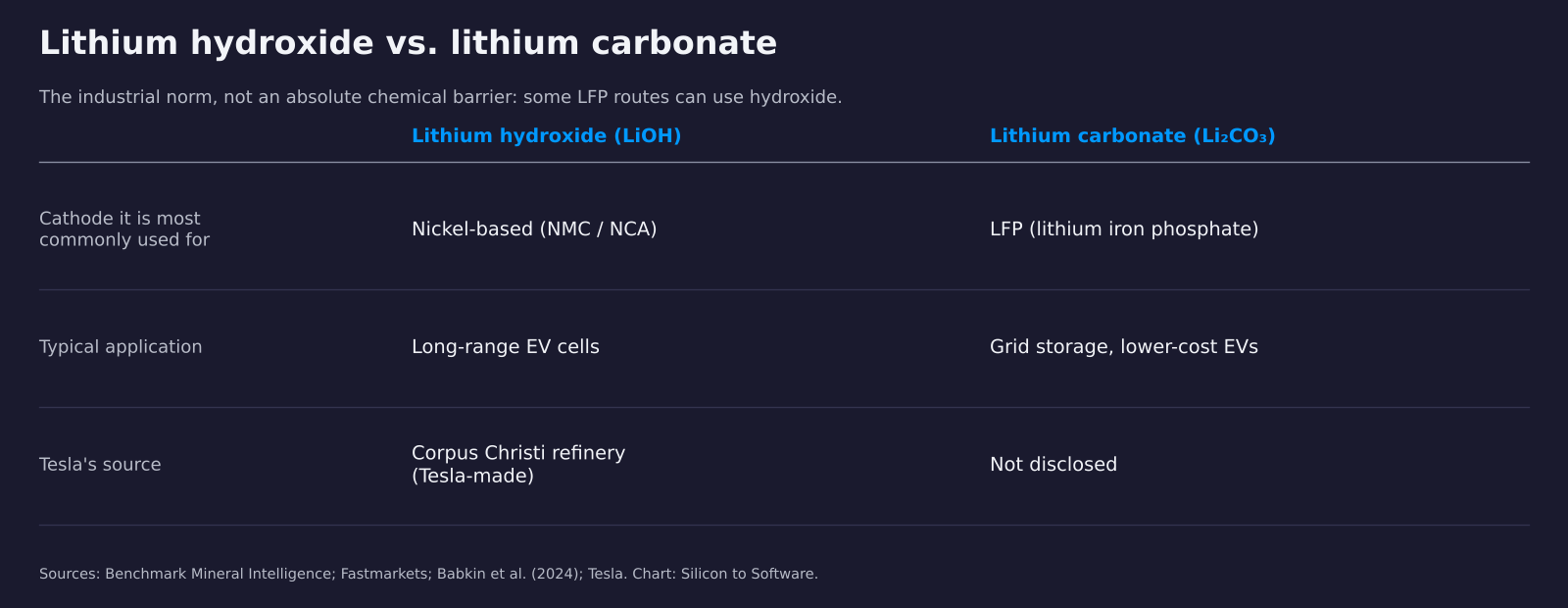
Tesla’s own disclosures don’t support that reading. The Texas refinery makes lithium hydroxide, the lithium compound most commonly used for nickel cathodes. The only cathode Tesla has shown coming out of Austin is nickel cathode for the 4680. The Nevada line makes LFP, which is most commonly built from lithium carbonate. On what Tesla has disclosed, its most integrated pathway feeds its cars. Tesla hasn’t shown that it supplies the Megapack it just celebrated.
I’ve been on the other side of this kind of decision more than once. As a PCB supplier, I’ve watched customers bring in a second supplier to cut their risk, whether the trigger was tariffs, lead times, or a push to reshore from Asia. Qualifying the new shop always took longer than the customer expected, and for a good while most of the volume stayed with the original supplier. The second source was real, but at first it covered only a small share of demand.
Tesla’s situation looks similar, at gigawatt-hour scale.
Table of Contents
Tesla Battery Supply Chain Capacity, Line by Line
These are the battery and Megapack rows from Tesla’s Q3 2026 installed-capacity table:
| Line | Location | Capacity | Status |
|---|---|---|---|
| Lithium refining | Texas | 30 GWh | Early Ramp |
| Cathode materials | Texas | 10 GWh | Early Ramp |
| LFP cells | Nevada | 7 GWh | Early Ramp |
| 4680 cells | Texas | >40 GWh | Production |
| 4680 cells | Berlin | — | Construction |
| Megapack | California / Shanghai / Texas | 40 / 20 / 50 GWh | Production |
The three Megapack lines add up to 110 GWh. That total is my addition. Tesla doesn’t print it.
Two lines in the footnote matter more than any row: “Installed capacity ≠ current production rate,” and “Early ramp capacity includes expected capacity.” The 7 GWh next to Nevada LFP is not 7 GWh of cells produced. Part of it is capacity Tesla expects to have.
The reported number hasn’t moved either. Energy-Storage.news reports that Tesla listed the Nevada line at 7 GWh, early ramp, in its Q4 2025 results on January 28, 2026. Tesla’s Q1 2026 update shows the same row, and so does Q3. That’s reported capacity, not output, so actual production may have grown without the table changing.
In PCB terms, Tesla has passed first-article inspection. It hasn’t yet shown it can hold yield at volume.
Why Tesla Is Bringing Battery Production In-House
Tesla’s own numbers show the pressure:
- Tariffs. Energy Generation and Storage revenue fell 16% year over year, from $3.42 billion to $2.88 billion, and Tesla attributes part of the decline to “tariff-related customer refunds.” According to reporting on Tesla’s 10-Q, $339 million of refunds owed to certain storage customers under contract reduced energy revenue. At the same time, $526 million of IEEPA tariff refunds Tesla received reduced the segment’s cost of revenue. Those accounting effects run in both directions, so the revenue decline alone doesn’t measure the economics of imported cells. It’s reasonable to infer that tariffs had been a large cost for the energy business, given the size of the refunds.
- Supply concentration. Bloomberg reports Tesla has relied heavily on Chinese LFP cells for Megapack, with CATL as its leading battery supplier as of 2025. The chemistry that goes into Megapack sits with one supplier in China, where imported cells face US tariffs.
- Leverage. My view is that a buyer who has run a cathode kiln or an LFP cell line knows what the process costs, and negotiates with CATL, LG, and Panasonic from that knowledge.
Chain One: Lithium Hydroxide, Nickel Cathode and the 4680 in Texas
The Corpus Christi lithium refinery
Tesla’s Gulf Coast refinery near Corpus Christi takes spodumene concentrate, processed from hard-rock lithium ore, and turns it into battery-grade lithium hydroxide. According to Tesla’s site manager, the process runs through an alkaline leach, purification, and crystallization. Tesla describes it as acid-free and calls the plant the first spodumene-to-lithium-hydroxide refinery in North America.
Argus reports Tesla began operating the refinery in December 2024. Tesla confirmed production in January 2026. The Q3 table lists the plant at 30 GWh, early ramp. That’s Tesla’s battery-energy-equivalent figure for a chemical plant whose output is measured in tonnes. Tesla doesn’t disclose the conversion assumptions, and like every early-ramp row, the figure includes expected capacity. It’s a nameplate, not a run rate.
The risk is the ramp, not the startup. Albemarle idled the last operating train at its Kemerton hydroxide plant in Western Australia in February 2026, citing the challenges facing Western hard-rock lithium conversion. Benchmark estimates Kemerton produced about 7.5 kt LCE (lithium carbonate equivalent) in 2025, a small fraction of its nameplate. Weak prices drove that decision as much as plant performance, but it shows how hard hydroxide conversion is to run profitably at scale outside China.
The nearby Kwinana hydroxide plant tells a similar story. In November 2025, IGO, which owns 49%, said the refinery’s lithium hydroxide output had reached 46% of nameplate in the latest quarter, and its CEO said, “After three years, it’s just not working.” Tianqi, the 51% owner and operator, said in April 2026 that it expects Kwinana to become competitive.
Purity specs, recovery yield, and reagent handling all have to hold at full rate before a refinery’s nameplate number means anything.
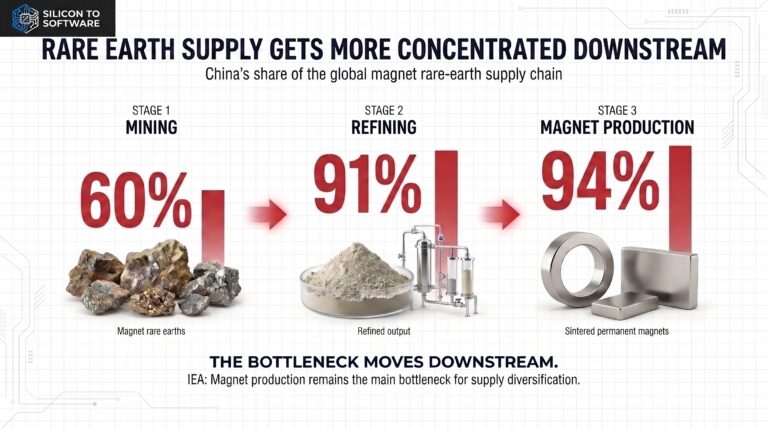
The ore is still imported. Per Argus, it comes from North American Lithium in Canada and Liontown’s Kathleen Valley mine in Australia. Tesla refines lithium. It doesn’t mine it, so “mine to cell” describes none of this. Rare earth magnets show the same pattern: the hard part of diversifying supply comes after the mine, in refining and processing.
The Austin cathode plant
Hydroxide is the most common lithium input for nickel-based cathodes, and nickel-based cathode is what Tesla makes at Gigafactory Texas. According to EVwire, the plant mixes nickel, manganese and cobalt precursors with lithium hydroxide, fires the blend in a kiln and removes magnetic impurities to produce cathode active material for 4680 cells. On September 23, 2026, Tesla’s Robotaxi account posted “First Cybercab made using our in-house cathode material.” Elon Musk added that it was “made with nickel cathode manufactured locally at Gigafactory Texas.”
The choice of hydroxide is about process, not preference. Researchers from FMC’s lithium division reported that using hydroxide instead of carbonate for nickel-rich NMC gives better physical properties, including higher tap and packing density, at lower synthesis temperatures. Tesla hasn’t disclosed the nickel content of its cathode. Either way, the refinery and the cathode plant are aligned around the same chemistry.
Tesla has also said refinery lithium is reaching its cells. On September 4, 2026, Tesla’s Cybertruck account posted “First Cybertruck made with 4680 cells containing lithium from our Gulf Coast Lithium Refinery.” That’s a company-stated milestone. Tesla hasn’t disclosed the volumes, or whether that lithium reaches the cells through the Austin cathode plant or through outside cathode suppliers.
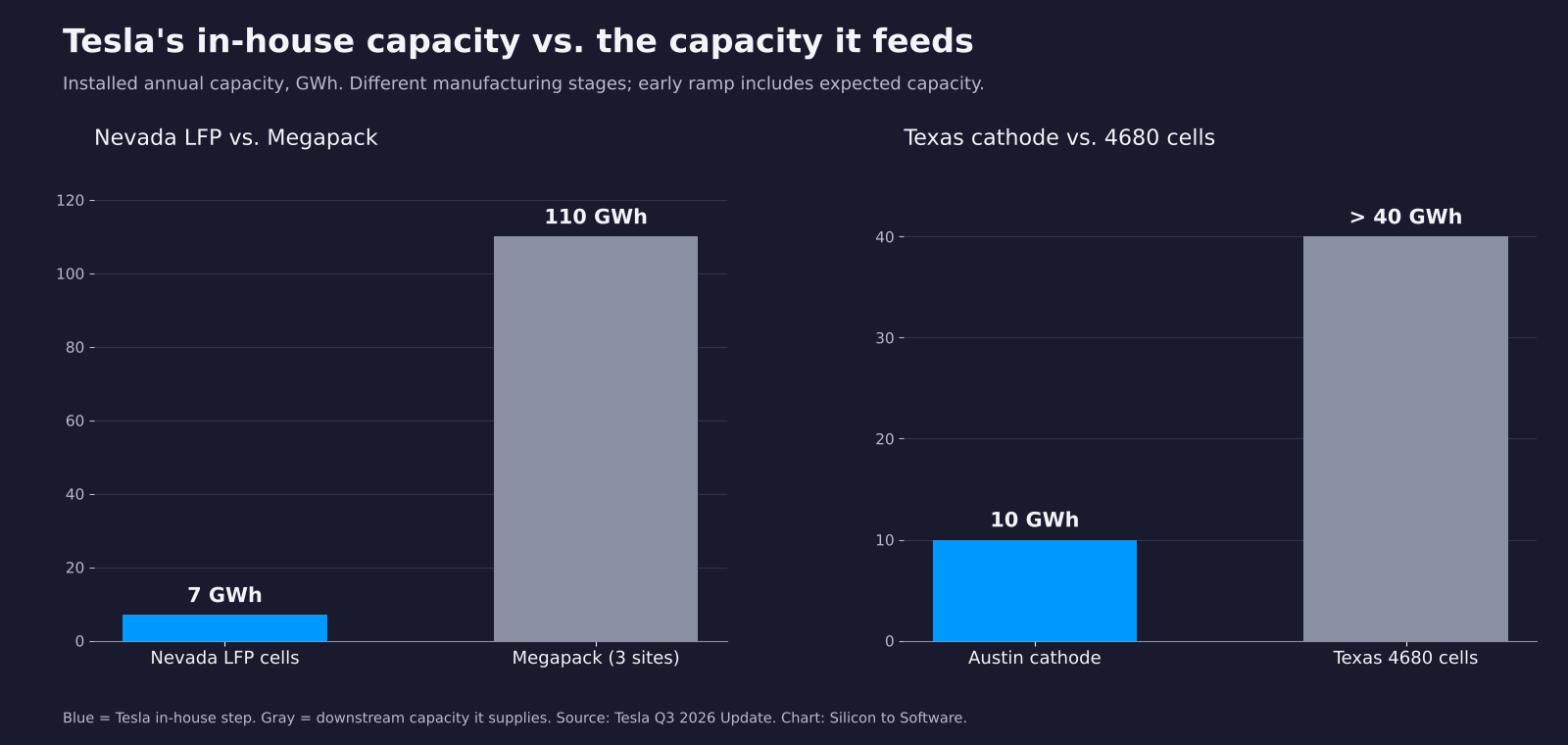
The Texas numbers show an in-house capacity gap. Cathode capacity is 10 GWh, against more than 40 GWh of 4680 cell capacity, so Tesla’s own cathode can cover at most about a quarter of it on a capacity-to-capacity basis. Tesla can buy cathode, so this doesn’t prove the cathode plant limits 4680 output. It does mean that at full stated 4680 capacity, and assuming comparable energy-equivalent definitions, Tesla’s own cathode couldn’t supply it alone. The rest would have to come from somewhere. Tesla hasn’t said where.
The refinery shows the same kind of mismatch: 30 GWh of refining capacity against 10 GWh of cathode capacity. Both are nameplate figures, and Tesla hasn’t disclosed refinery utilization or where its hydroxide goes, so the difference doesn’t show a surplus. It’s one more material flow the public record doesn’t trace.
This pathway ends at the 4680. Tesla’s Q3 update says it is increasing 4680 production “to support the ramps of both Cybercab and Tesla Semi along with higher Model Y volumes.” For how Tesla makes the dry cathode, see Tesla 4680 Dry Electrode Process: Why the Cathode Took Years, and What’s Still Unproven. This piece covers where that cathode’s lithium comes from. Tesla’s most integrated disclosed pathway ends in vehicles. Tesla hasn’t shown it supplying Megapack.
Chain Two: Nevada LFP Cells and the First All-Tesla Megapacks
The Nevada line makes LFP (lithium iron phosphate) cells for energy storage. It has 7 GWh of capacity; it’s in early ramp, and it now supplies Megapacks built entirely with Tesla cells. Tesla calls that “an important milestone to localizing this important battery type.”
LFP is most commonly made with a different lithium compound. Benchmark Mineral Intelligence states that LFP batteries need lithium carbonate, while NMC and NCA batteries require lithium hydroxide. Fastmarkets describes the same split. That’s the industrial norm, not an absolute chemical barrier. A 2024 peer-reviewed review of LFP precipitation synthesis (Babkin et al., Russian Chemical Bulletin) covers hydroxide, carbonate, and nitrate as lithium sources, and one compound can be converted into the other. But Tesla’s update doesn’t say its Texas plants supply the Nevada line, and nothing it has shown from Austin is iron phosphate.
Tesla’s quarterly disclosures don’t identify:
- Where Nevada gets its LFP cathode.
- Where it gets its lithium. A Chinese report cited by autoevolution described a lithium carbonate supply deal with Yahua Group. Tesla hasn’t confirmed it.
- What equipment the line runs on. A 2024 SMM report said Tesla would build it with idle CATL equipment. That’s historical secondary reporting, not a Tesla statement about the line today.
LFP gives up energy density for durability and cost, which suits a grid battery far better than a car. For how LFP compares with the next chemistry contender, see Sodium-Ion vs. Lithium-Ion Batteries.
So Tesla now owns the cell step for LFP. Nothing it has disclosed shows it making the materials that go into that cell.
Megapack doesn’t depend on Nevada either. SMM reports that cell supply for Megapack 3 spans the United States, Southeast Asia, and China. Tesla hasn’t published a supplier or country breakdown of its own.
Tesla LFP Capacity vs. Megapack Demand: The 6% Gap
Seven divided by 110 is about 6.4%. On nameplate, Tesla’s own LFP cell capacity is roughly 6% of its Megapack capacity. That’s my arithmetic, comparing capacity to capacity, and the 7 GWh includes expected capacity. Cell capacity and Megapack capacity aren’t measured the same way, either. Usable energy, state-of-charge reserves, and inverter and auxiliary losses mean a gigawatt-hour of cells doesn’t make a gigawatt-hour of Megapack, so read the ratio as an order of magnitude.
Actual deployments make the gap look smaller. Tesla deployed 36 GWh of storage in the first nine months of 2026, Powerwall included, which annualizes to about 48 GWh. Seven GWh is about 15% of that. Against US Megapack capacity alone (90 GWh, excluding Shanghai), Nevada is about 8%. These are my calculations, and they mix capacity with deployments.
None of these ratios measures Tesla’s actual internal cell share, because they compare capacities at different manufacturing stages. Tesla hasn’t disclosed the split between its own and purchased cells. But Nevada’s 7 GWh of capacity, part of it still expected, is small next to 36 GWh of deployments in nine months, so outside suppliers must still provide most of the cells in Tesla’s storage products. Deployments and cell output don’t line up quarter by quarter, because of inventory and timing, but the gap is too wide for timing to close.
The next large contracted source of domestic LFP for Megapack isn’t Tesla’s either. In March 2026, the Interior Department confirmed a $4.3 billion agreement for LG Energy Solution to make LFP prismatic cells for Megapack 3 in Lansing, Michigan, with production scheduled to launch in 2027. LG’s Lansing plant started production in August 2026, and LG expects it to reach more than 35 GWh at full capacity. That capacity is shared with NMC cells for Toyota, and neither company has disclosed how much is dedicated to Tesla.
On the vehicle side, the same Battery section says battery availability “remains a limiting factor on the pace of our global vehicle production ramp.” Tesla’s vehicles also use cells from outside suppliers such as Panasonic, LG, and CATL, so the vehicle constraint isn’t only about Tesla’s own lines.
Capacity tables can’t show throughput, yield, or which step is actually binding. They don’t show:
- first-pass and formation yield
- equipment uptime
- pack and module integration
- whether a US-assembled cell depends on imported cathode, anode, electrolyte, or separator
What they do show is how much of each step Tesla owns. In Texas, the smallest in-house step is cathode at 10 GWh. In Nevada, it’s the cell line at 7 GWh. Both sit against downstream capacity several times larger.
The Strongest Case Against This Reading
The best counterargument goes like this. Refining and cathode are the costly, China-concentrated steps. Benchmark estimates China controls roughly 70% of global lithium refining capacity and dominates cathode active material production. On that view, Tesla integrated exactly where integration pays. LFP’s raw materials are cheaper and widely traded. One possible strategic rationale is that a 7 GWh line exists to teach Tesla the process and strengthen its hand with suppliers, not to supply volume. LG’s Lansing lines cover the domestic-supply problem without Tesla building every step.
As a strategy, I agree with that. But it’s a strategy of options, not self-sufficiency. Tesla reports its largest passenger-vehicle backlog in four years while identifying battery availability as a constraint on further vehicle production growth. It hasn’t quantified how much of that constraint comes from cells, packs, specific suppliers, or individual vehicle programs. Its list of critical projects starts with vehicle pack capacity in Berlin.
The gap is also partly by design: Tesla planned for LG and imported cells to carry most of Megapack’s volume. The point here isn’t that Tesla missed a target. It’s that “vertical integration” describes ownership, not supply. I made the same argument about US chip fabs: a fab is one node, not a supply chain.
What to Watch in Tesla’s Next Quarterly Updates
Tesla’s next shareholder update is expected in early 2027. Four lines in it will show whether the gaps in the Tesla battery supply chain are closing:
- The Nevada row. It has said 7 GWh, early ramp, since January. A higher number, or a move to “Production,” is the first reported evidence of scale.
- Cathode against 4680. Cathode at 10 GWh is the smallest in-house step in the Texas pathway. Berlin’s 4680 line, now under construction, widens the gap in in-house coverage unless cathode capacity grows with it.
- Lansing. Whether LG’s dedicated Tesla lines start shipping cells in 2027.
- Ore sourcing. Whether spodumene supply moves toward North American mines, or toward recycled feedstock, which Tesla has said the refinery can process.
Tesla has reported production milestones in lithium refining, cathode materials and cell manufacturing. What it hasn’t publicly disclosed is evidence of sustained output at the scale its capacity table implies, or a domestic material supply chain for its Nevada LFP cells. In Texas, the smallest in-house step is cathode, and in Nevada it’s the cell line. Those are the rows the next update should get its closest reading.
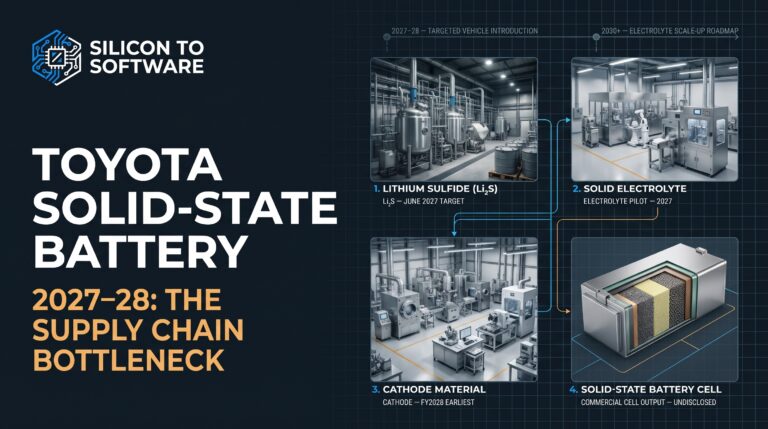
For more on the materials behind next-generation cells, see Solid-State Batteries Explained.
About the Author
Imran Valiani | Sales Director, PCB Electronics Manufacturing
20+ years working with major Bay Area and global tech clients. Founder of Silicon to Software, where I write about the hardware layer — PCB fab, AI gear, autonomous systems, and cyber — the stuff most tech writers have never touched. Literally.
Follow: X @SiToSoftware | LinkedIn
This article was developed with AI assistance and edited, fact-checked, and reviewed by the author. See my full AI disclosure.
Listen to the Silicon to Software podcast on Apple Podcasts, Spotify, or RSS.com — and watch on YouTube.
Sources
Tesla primary documents
- Tesla — “Q3 2026 Update”
Tesla Investor Relations, 2026.
https://assets-ir.tesla.com/tesla-contents/IR/TSLA-Q3-2026-Update.pdf - Tesla — “Form 10-Q, Quarterly Report for the Period Ended September 30, 2026”
U.S. Securities and Exchange Commission (EDGAR), 2026.
https://www.sec.gov/Archives/edgar/data/1318605/000162828026066775/tsla-20260930.htm - Tesla — “Q1 2026 Update”
Tesla Investor Relations, 2026.
https://assets-ir.tesla.com/tesla-contents/IR/TSLA-Q1-2026-Update.pdf - Tesla — “Q4 and FY 2025 Update”
Tesla Investor Relations, 2026.
https://assets-ir.tesla.com/tesla-contents/IR/TSLA-Q4-2025-Update.pdf
Tesla announcements (reported)
- Drive Tesla Canada — “Tesla Begins Building Cybertrucks With 4680 Cells Using Lithium Refined in Texas”
Drive Tesla Canada, 2026. (Quotes Tesla’s Cybertruck account post of September 4, 2026.)
https://driveteslacanada.ca/news/tesla-cybertruck-4680-cells-lithium-refined-in-texas/ - Teslarati — “Tesla Cybercab gets initial tie-in to localized, in-house cathode plant”
Teslarati, 2026. (Quotes Tesla’s Robotaxi account post of September 23, 2026, and Elon Musk’s post of September 24, 2026.)
https://www.teslarati.com/tesla-cybercab-initial-tie-in-localized-in-house-cathode-plant/ - Simon Alvarez / EVwire — “Tesla has built its first Cybertruck with cathode material made at Giga Texas”
EVwire, 2026.
https://evwire.com/p/tesla-cybercab-in-house-cathode-giga-texas
Lithium refinery and lithium chemistry
- Electrek — “Tesla releases rare look at its lithium refinery, confirms production start”
Electrek, 2026.
https://electrek.co/2026/01/15/tesla-rare-look-lithium-refinery-confirms-production-start/ - Barchart — “Tesla fires up America’s first major lithium refinery”
Barchart, 2026.
https://www.barchart.com/story/news/37108879/tesla-fires-up-americas-first-major-lithium-refinery - Argus — “Tesla on track to produce cathode, LFP cells”
Argus Media, 2025.
https://www.argusmedia.com/metals-platform/newsandanalysis/article/2713873-Tesla-on-track-to-produce-cathode–LFP-cells - Argus — “Tesla begins ops at Texas lithium refinery”
Argus Media, 2026.
https://www.argusmedia.com/de/news-and-insights/latest-market-news/2776390-tesla-begins-ops-at-texas-lithium-refinery - Fastmarkets — “Tesla starts construction of US lithium hydroxide refinery”
Fastmarkets, 2023.
https://fastmarkets.com/insights/tesla-starts-construction-of-us-lithium-hydroxide-refinery - B. Fitch and M. Yakovleva (FMC Corporation, Lithium Division) — “Study of the Effect of Lithium Precursor Choice on Performance of Nickel-Rich NMC”
232nd ECS Meeting, The Electrochemical Society, 2017. Conference abstract.
https://ecs.confex.com/ecs/232/webprogram/Paper105830.html - Benchmark Mineral Intelligence — “Battery Supply Chain Glossary: Lithium”
Benchmark Mineral Intelligence.
https://www.benchmarkminerals.com/glossary/lithium - Fastmarkets — “FOCUS: The war between EV battery cathodes”
Fastmarkets, 2021.
https://www.fastmarkets.com/insights/focus-the-war-between-ev-battery-cathodes/ - A. V. Babkin, A. V. Kubarkov, E. A. Styuf, V. G. Sergeyev, O. A. Drozhzhin, E. V. Antipov — “Preparation of battery-grade LiFePO4 by the precipitation method: a review of specific features”
Russian Chemical Bulletin, vol. 73, no. 1, pp. 14–32, 2024. DOI: 10.1007/s11172-024-4119-8
https://link.springer.com/content/pdf/10.1007/s11172-024-4119-8.pdf - lifepo4-battery.com — “Tesla Plots $20 Billion Battery & Lithium Push Amid Growth Shift”
lifepo4-battery.com, 2026.
https://www.lifepo4-battery.com/News/tesla-20b-battery-lithium-investment-2026.html
Australian hydroxide refineries
- Albemarle — “Albemarle Announces Plans to Idle its Kemerton Lithium Hydroxide Processing Plant”
Albemarle Corporation, 2026.
https://www.albemarle.com/de/en/news/albemarle-announces-plans-to-idle-its-kemerton-lithium-hydroxide-processing-plant-a - Benchmark Mineral Intelligence — “What does Albemarle’s idling of Kemerton mean for Australia’s lithium outlook?”
Benchmark Mineral Intelligence, 2026.
https://source.benchmarkminerals.com/article/what-does-albemarle-s-idling-of-kemerton-mean-for-australia-s-lithium-outlook- - Chloe Coutinho / Australian Mining Review — “IGO sees ‘no pathway’ for Kwinana refinery”
Australian Mining Review, 2025.
https://australianminingreview.com.au/news/igo-sees-no-pathway-for-kwinana-refinery/ - S&P Global Commodity Insights — “Kwinana lithium hydroxide plant to be competitive soon: Tianqi JV CEO”
S&P Global, 2026.
https://www.spglobal.com/energy/en/news-research/latest-news/metals/042226-kwinana-lithium-hydroxide-plant-to-be-competitive-soon-tianqi-jv-ceo
Nevada LFP, Megapack and cell supply
- Energy-Storage.news — “Tesla’s energy division gross margin declines 19% despite battery storage deployment rebound”
Energy-Storage.news, 2026.
https://www.energy-storage.news/teslas-energy-division-gross-margin-declines-19-despite-battery-storage-deployment-rebound/ - Bloomberg via Transport Topics — “Tesla Signs $4.3 Billion Battery Supply Pact With LG Energy”
Transport Topics, 2025.
https://www.ttnews.com/articles/tesla-lg-battery-supply - Shanghai Metals Market (SMM) — “Tesla Starts Megapack 3 Production in Texas”
SMM, 2026.
https://news.metal.com/newscontent/104046720-tesla-starts-megapack-3-production-in-texas - Shanghai Metals Market (SMM) — “Tesla Purchases Idle CATL Equipment to Build Battery Production Line in U.S.”
SMM, 2024.
https://news.metal.com/newscontent/102609245/Tesla-Purchases-Idle-CATL-Equipment-to-Build-Battery-Production-Line-in-US - autoevolution — “Tesla Prepares To Start In-House Production of LFP Cells, Lines Up Suppliers”
autoevolution, 2024.
https://autoevolution.com/news/tesla-prepares-to-start-in-house-production-of-lfp-cells-lines-up-suppliers-235678.html
LG Energy Solution, Lansing
- Energy-Storage.news — “LG Energy Solution’s US$4.3 billion agreement with Tesla, and LFP manufacturing with GM”
Energy-Storage.news, 2026.
https://www.energy-storage.news/lg-energy-solutions-us4-3-billion-agreement-with-tesla-and-lfp-manufacturing-with-gm/ - electrive — “LG Energy Solution launches battery production in Lansing”
Electrive, 2026.
https://electrive.com/2026/08/19/lg-energy-solution-launches-battery-production-in-lansing - Electrek — “Tesla (TSLA) Q4 2025 earnings preview: another year of decline in the books”
Electrek, 2026. (Confirms the January 28, 2026 Q4 2025 results date.)
https://electrek.co/2026/01/27/tesla-tsla-q4-2025-earnings-preview-another-year-decline/