Tesla 4680 Dry Electrode Process: Why the Cathode Took Years, and What’s Still Unproven
A manufacturing-yield look at Tesla’s dry-cathode problem: calendering, PTFE binders, latent defects, and why repeatable scale-up is the real test.
Information current through November 2, 2026.
One of the earliest publicly documented problems with the Tesla 4680 dry electrode process didn’t come from a chemistry lab. It came from the steel rollers.
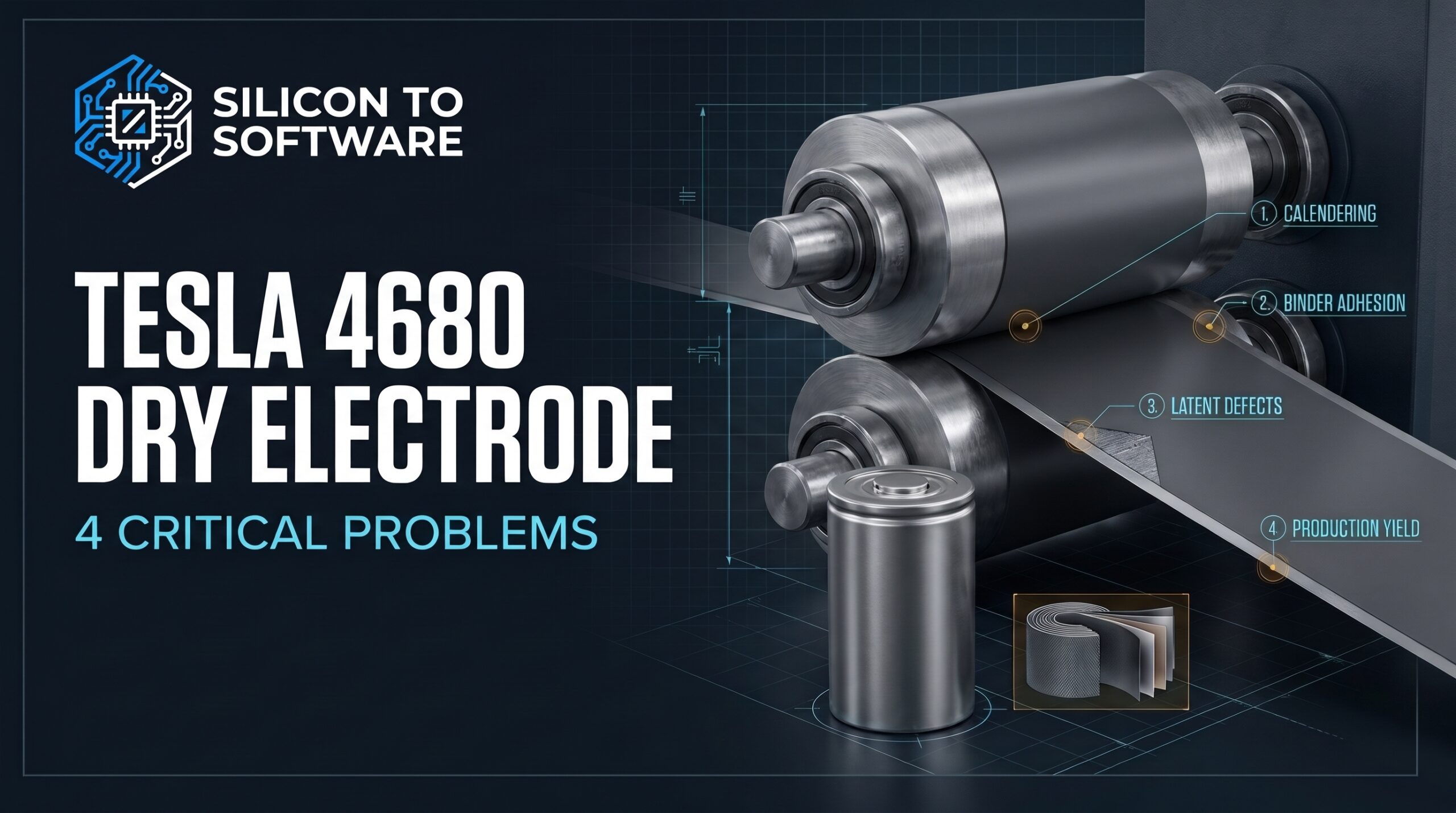
On the Q2 2021 earnings call, Musk said the problem was calendering, the step where the cathode material is squashed to a set height. He compared it to very hard pizza dough and said it was damaging the calender rolls. The damage hadn’t happened with smaller rolls. It appeared when the rolls got bigger, and Tesla hadn’t expected it. On the same call, Drew Baglino, then Tesla’s senior vice president of powertrain and energy engineering, said the large rollers on the anode side were working without concerns, and described the cathode issue as an engineering problem rather than a science problem.
I’ve spent more than 20 years in PCB and electronics manufacturing, and I know that sequence well. I’ve watched new processes pass every first-article check and then lose yield once they hit volume panel sizes. The lab result was real. The process window wasn’t.
Tesla now reports progress. Its Q4/FY2025 update said it produces dry-electrode 4680 cells with both anode and cathode made in Austin. The 4680 introduced several changes at once, including a larger format and a tabless electrode design. This article is about one of them: the dry electrode. It explains why the cathode was so hard, what the January 2026 disclosure actually establishes, and which metrics would show whether the process has reached competitive volume manufacturing.
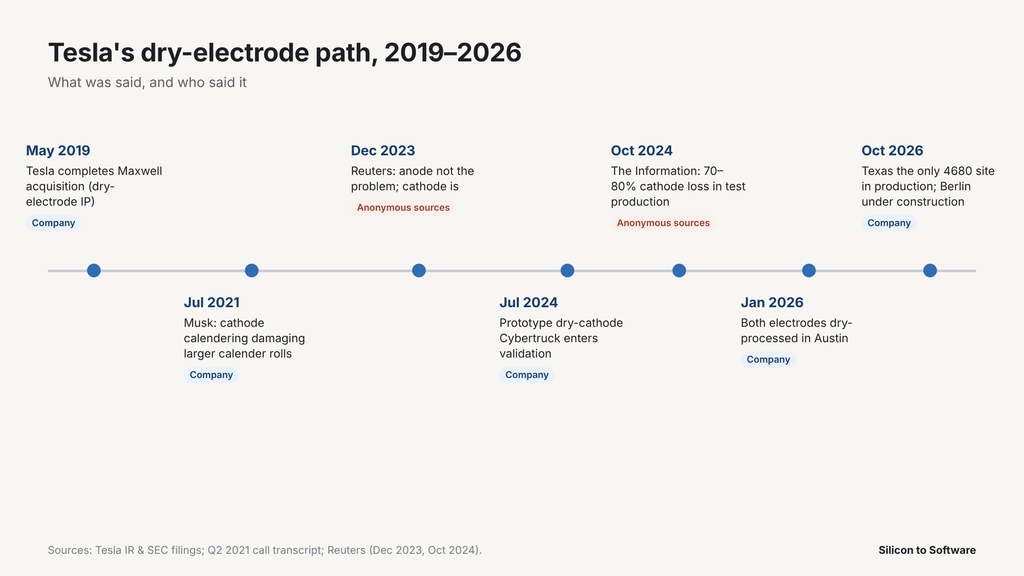
Table of Contents
What the Tesla 4680 Dry Electrode Process Replaces
The conventional wet process
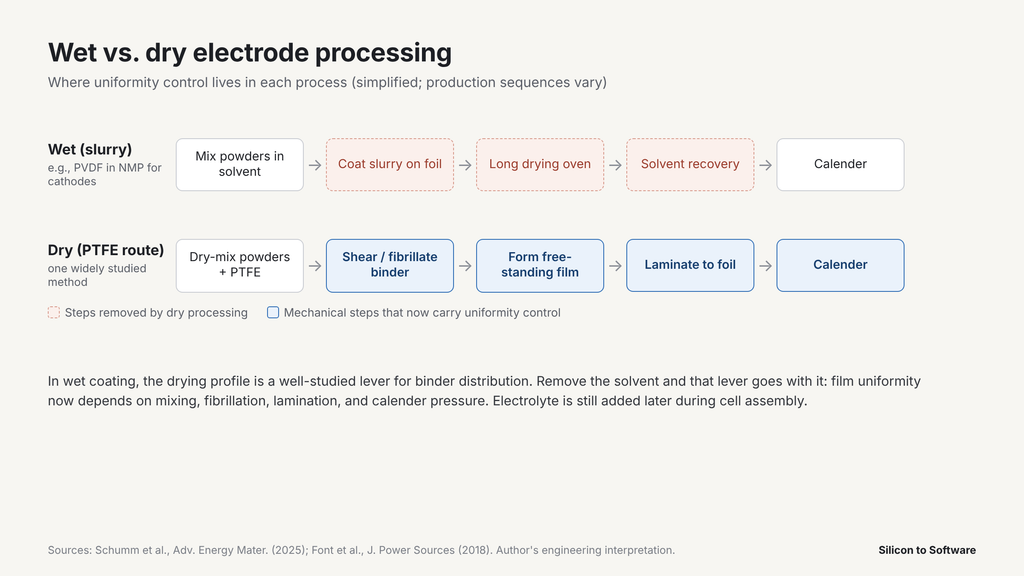
Conventional lithium-ion electrodes are made by slurry coating. Many cathode lines mix active material and a PVDF binder in N-methyl-2-pyrrolidone (NMP), coat the slurry onto aluminum foil, and run it through long, high-temperature dryers with solvent recovery, because NMP is toxic and flammable (Ahmed et al., 2016). Graphite anodes commonly use water-based binder systems such as CMC and SBR instead. Both electrodes still need coating and drying, but the solvent handling differs.
How dry battery electrode (DBE) processing works
Dry-electrode processing eliminates the solvent-based coating and drying stages from electrode fabrication. The cell still receives liquid electrolyte later in assembly. One widely studied route uses PTFE fibrillation: powder mixing, binder fibrillation, and calendering replace the slurry steps. Under shear from jet milling, kneading, or high-shear mixing, PTFE particles slip and stretch into fibers that form a web holding the active particles together. Dry-electrode processes differ in how films are formed, laminated, and bonded to foil, and Tesla has not published its full production sequence.
Tesla’s starting point was acquired. It completed the Maxwell Technologies acquisition in May 2019 to secure dry-electrode IP and process know-how. Maxwell had developed the technology primarily for ultracapacitors, and scaling it to continuous, automotive-volume battery electrode production is where the problems started. Turning it into an EV production process was Tesla’s own work.
The uniformity problem moves upstream.
Wet coating isn’t perfectly uniform either. As the solvent evaporates, binder migrates, and the poorly covered regions it leaves behind are linked to capacity fade and electrode delamination (Font et al., 2018). That failure mode is well studied, though, and there are established mitigation strategies, including optimized and multistage drying profiles designed to keep drying times short while holding binder distribution closer to uniform.
Remove the solvent, and you lose that control knob. Uniformity now depends on mixing, fibrillation, calender pressure, and roll condition, all mechanical variables with far less production history. The process-control burden doesn’t disappear. It moves to the less mature stages of the line. (This section is the author’s engineering interpretation.)
Cohesion isn’t the only requirement. A fibrillated film can hold itself together well and still struggle to stay bonded to the metal foil. The 2026 binder perspective cited below identifies weak adhesion to the current collector as a limitation of PTFE-based films, and describes co-binder chemistry as one possible way to improve it.
Why the 4680 Dry Cathode Was the Bottleneck
Anode less problematic, cathode not
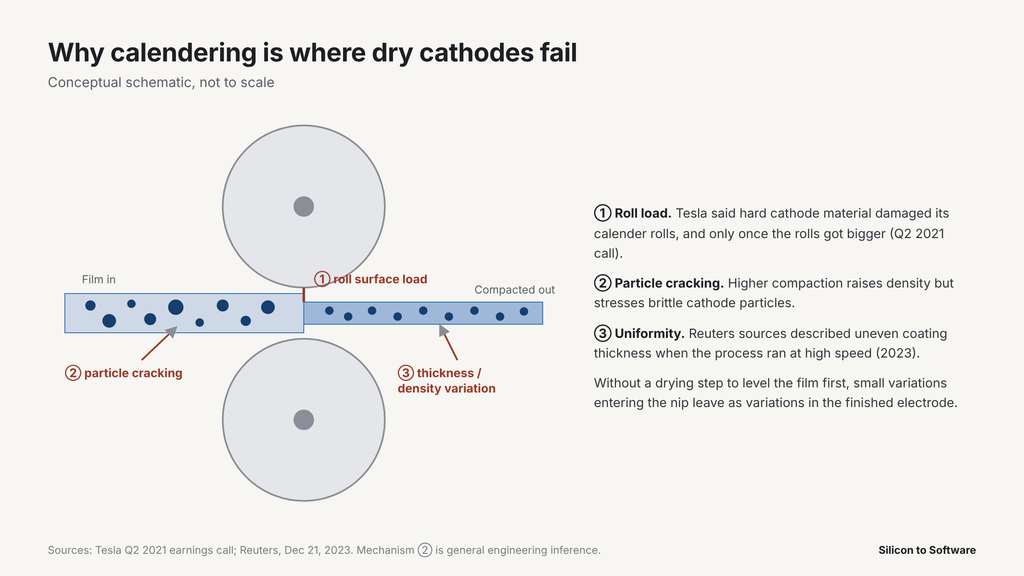
According to Reuters’ December 2023 reporting, based on nine anonymous sources, dry-coating the 4680 anode was not a problem at that time. The cathode, which Reuters described as the most expensive component in a battery, was. At high speed, the cathode process reportedly produced uneven coating thickness, which creates quality and longevity risks.
The reported loss rates (2024)
In October 2024, The Information reported, as summarized by Reuters, that Tesla was losing 70–80% of cathodes in 4680 test production. The same reporting said conventional battery makers lose fewer than 2% of their components to manufacturing defects. Neither figure was independently verified, and the two describe different populations: cathodes in a new process under test versus components on mature lines. If accurate, the figures indicate the severity of the manufacturing problems the sources described. They are not a measured industry yield gap, and they are not current scrap rates.
No throughput gain either
One Reuters source said in 2023 that the dry cathode method was not proving any faster than the wet process, even with scrap down to as low as 10–20%. For a given line, removing the dryer only raises output if the dryer was the constraint. If calendering is the slowest station, eliminating the dryer doesn’t raise throughput, although it can still save floor space, energy, and capital.
The PTFE Binder Trade-Off in Dry Electrodes
PTFE fibrillation provides mechanical cohesion without slurry coating, but it brings formulation trade-offs. The fibrillated PTFE network is electronically and ionically insulating, and recent research has moved toward hybrid binder systems that keep PTFE’s fibrillation while aiming to compensate for its electrochemical and interfacial weaknesses, including adhesion to the foil.
Too little binder and the film doesn’t survive handling and calendering. Too much and you add insulating material and give up energy density. How much any of this matters depends on electrode composition and processing, and Tesla has not disclosed the binder formulation in its production 4680 cells.
The patent record points the same way, though not where the headlines suggest. A U.S. application published in November 2025 describes a composite binder that blends PTFE with PVDF, a PVDF co-polymer, or poly(ethylene oxide). But it belongs to a patent family that traces back to a 2014 Maxwell filing, before Tesla’s acquisition, which already identified increased irreversible capacity loss as a potential drawback of PTFE-binder electrodes. That is one reason binder choice has to be evaluated separately for the anode and cathode environments. The filing shows the binder problem has been known for over a decade. It doesn’t show what Tesla runs on its production lines.
Changing the binder changes how the film behaves in the calender nip, the station where this program kept failing. That makes binder selection a yield decision as much as a chemistry decision.
Latent Defects: The Most Expensive Scrap in Cell Manufacturing
The detail in the 2023 reporting I find most consequential wasn’t a scrap rate. It was timing. One anonymous source said quality problems with the dry cells didn’t show up until months later, so Tesla couldn’t yet tell which cells were good and which had to be scrapped.
The most expensive problem I’ve dealt with in PCB manufacturing wasn’t a board that failed test. It was one that passed, shipped, and failed later, after every downstream dollar had already been spent. A defect caught at the station costs that station. A defect found after formation and aging costs everything that came before it.
The closest PCB equivalent is a reliability escape, such as conductive anodic filament (CAF) failure. (The analogy is about the economics of late detection, not shared failure physics. CAF is a PCB failure mechanism; cell defects have their own mechanisms.) The lesson carries over: some defects only become measurable after formation, aging, or cycling. Screening at those stages catches them, but late. The strongest defense combines a tight upstream process window with validated downstream screening and testing.
What Tesla’s January 2026 Disclosure Establishes
The timeline
Tesla’s Q2 2024 update said it had entered vehicle validation testing on its first prototype Cybertruck built with in-house dry-cathode 4680 cells. Tesla’s Q4 and FY2025 update, published in January 2026, said it now makes dry-electrode 4680 cells with both anode and cathode produced in Austin, and, separately, that it had begun producing battery packs for certain Model Ys with its own 4680 cells.
What is documented, and what isn’t
The disclosure is documented, and it is meaningful progress. But it is company-stated, not independently audited. The update does not say how many of those Model Y packs use fully dry cells, how many were built, or when they reached customers. Tesla has not publicly disclosed the line-level yield data needed for an independent assessment of yield or cost.
The Tesla 4680 Dry Electrode Claims, Classified
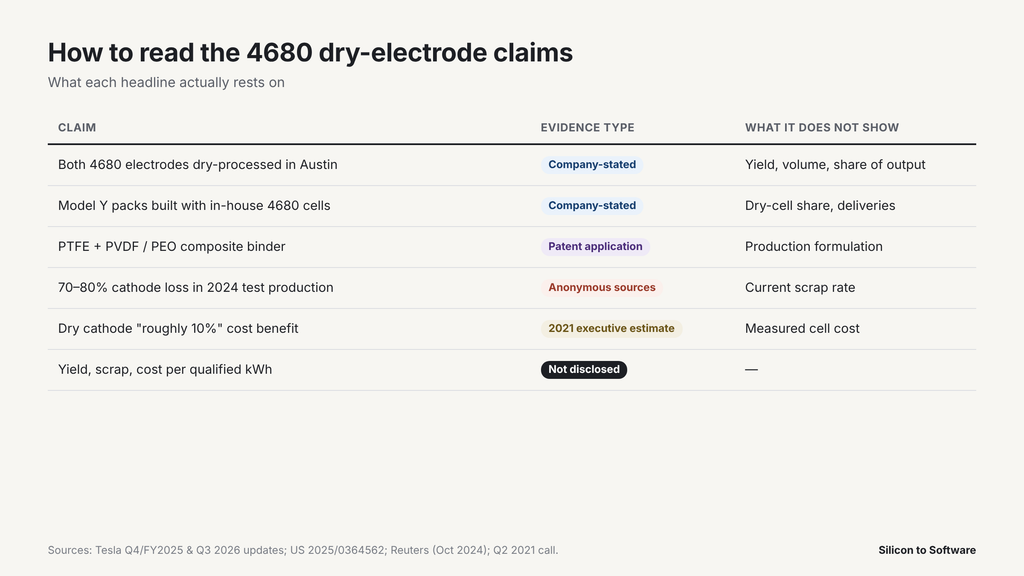
| Claim | Evidence type |
|---|---|
| Both 4680 electrodes dry-processed in Austin | Company-stated (Tesla Q4/FY2025 update) |
| Packs for certain Model Ys using in-house 4680 cells | Company-stated; dry-cell share and delivery volume not disclosed |
| PTFE / PVDF / PEO composite binder | Patent application (family traces to 2014 Maxwell filing); production formulation not disclosed |
| Roughly 10% figure for dry cathode | 2021 executive estimate; scope not defined; not a measured cell-cost reduction |
| Yield, scrap rate, cost per qualified kWh | Not publicly disclosed |
Tesla itself has been more cautious than the headlines. On the 2021 call, Musk told investors not to over-emphasize dry cathode and put its cost benefit at roughly 10%. The remarks moved between dry cathode’s share of the planned cost improvements and a direct dry-versus-wet comparison, so the figure is best read as a loose executive estimate from five years ago, not a measured reduction in cell cost.
Dry Electrode Timelines Across the Battery Industry
In 2024, LG Energy Solution said it aimed to begin commercial production with its dry-electrode process by 2028. In April 2026, an LGES executive described a more specific goal: mass production of dry-process LFP cells from 2029. Whether that’s a delay or a narrower product-specific plan isn’t clear from its public statements. Its CTO also warned in 2024 that dry-processing cathodes with small particles is very challenging.
As of April 2026, according to the Seoul Economic Daily, Samsung SDI and SK On were running pilot lines, CATL was reviewing dry processing for large cells, and Panasonic was running a dry-electrode pilot line for 4680 cells at Wakayama.
Either way, a major cell maker’s public dry-electrode dates are still years out.
Related reading: the same lab-to-factory gap shows up in solid-state batteries and sodium-ion cells.
Repeatability: The Real Test for Tesla’s Dry Electrode
The dry electrode won’t be proven by an announcement. It will be proven by repeatability: the same yield, within defined acceptance limits, on line four as on line one, and at a second site with a different crew. Intel made this discipline famous as “Copy Exactly!” I use it here as an analogy, not as a description of Tesla’s methodology.
I’ve seen the same process, on the same equipment model, yield differently at two sites. Copy-exact sounds simple until you try it.
Reuters reported in 2023 that Tesla was struggling to make its dry-cathode know-how repeatable across production lines. Today, Tesla hasn’t published the line-level yield or cross-site data needed to judge whether its process replicates. It may well be replicating it across lines inside Texas; public disclosures can’t show that either way.
What the disclosures do show is site-level status. Tesla’s January 2026 update named Austin as the dry-electrode site. Its October 2026 update lists Texas as the only 4680 cell site in production in its capacity table, with Berlin’s 4680 cell capacity under construction. If Berlin moves to production and Tesla says it runs the dry process there, that would be public evidence of geographic replication, though still not proof of equal yield.
Tesla also says battery availability is limiting vehicle volume. It does not attribute that constraint to 4680 cells or the dry process, and neither should readers.
What engineers should watch
| Signal | Why it matters | Where it would appear |
|---|---|---|
| Yield-adjusted cost per qualified kWh vs. supplier cells | The real test of the cost thesis, after scrap and utilization | Earnings disclosures |
| Disclosed 4680 output (GWh or cells/week), not installed capacity | Output, not nameplate. Installed Texas capacity is listed at >40 GWh, which says nothing about yield | Tesla update letters |
| Whether Tesla states what share of 4680 output is fully dry | Separates the dry milestone from total 4680 volume | Tesla update letters |
| Berlin 4680 moving from “Construction” to “Production,” and whether Tesla says it runs the dry process there | Potential evidence of geographic replication | Tesla capacity tables |
A manufacturing process isn’t solved when it works. It’s solved when it’s boring: same yield, every line, every site, every shift.
About the Author
Imran Valiani | Sales Director, PCB Electronics Manufacturing
20+ years working with major Bay Area and global tech clients. Founder of Silicon to Software, where I write about the hardware layer — PCB fab, AI gear, autonomous systems, and cyber — the stuff most tech writers have never touched. Literally.
Follow: X @SiToSoftware | LinkedIn
This article was developed with AI assistance and edited, fact-checked, and reviewed by the author. See my full AI disclosure.
Listen to the Silicon to Software podcast on Apple Podcasts, Spotify, or RSS.com — and watch on YouTube.
Sources
Tesla primary documents
Tesla, Inc. — “Tesla, Inc. TSLA Q2 2021 Earnings Call Transcript”
Rev transcript of the July 26, 2021 earnings call.
https://www.rev.com/transcripts/tesla-inc-tsla-q2-2021-earnings-call-transcriptTesla, Inc. — “Second Quarter 2024 Update” (Form 8-K, Exhibit 99.1)
U.S. Securities and Exchange Commission, July 23, 2024.
https://www.sec.gov/Archives/edgar/data/1318605/000162828024032603/exhibit.htmTesla, Inc. — “Q4 and FY 2025 Update”
Tesla Investor Relations, January 28, 2026.
https://assets-ir.tesla.com/tesla-contents/IR/TSLA-Q4-2025-Update.pdfTesla, Inc. — “Q3 2026 Update” (Form 8-K, Exhibit 99.1)
U.S. Securities and Exchange Commission, October 21, 2026.
https://www.sec.gov/Archives/edgar/data/1318605/000162828026066738/exhibit9914.htmTesla, Inc. — “Tesla Completes Acquisition of Maxwell Technologies”
Tesla Investor Relations, May 16, 2019.
https://ir.tesla.com/press-release/tesla-completes-acquisition-maxwell-technologies
Patents
U.S. Patent Application Publication 2025/0364562 — “Dry Energy Storage Device Electrode and Methods of Making the Same”
Google Patents (filed August 4, 2025; published November 27, 2025).
https://patents.google.com/patent/US20250364562A1/enU.S. Patent 10,741,843 — “Dry Energy Storage Device Electrode and Methods of Making the Same”
Google Patents (Maxwell Technologies; later assigned to Tesla).
https://patents.google.com/patent/US10741843U.S. Patent 12,406,995 B2 — “Dry Energy Storage Device Electrode and Methods of Making the Same”
USPTO Official Gazette (assigned to Tesla; claims priority to a 2014 provisional application).
https://patentsgazette.uspto.gov/week35/OG/html/1538-1/US12406995-20250902.html
Peer-reviewed research
“Dry electrode binders: from fluoropolymer fibrillation toward multifunctional architectures for next-generation energy storage”
Energy Materials (OAE Publishing), Perspective, 2026.
https://www.oaepublish.com/articles/energymater.2026.251Schumm, B., et al. — “Dry Battery Electrode Technology: From Early Concepts to Industrial Applications”
Advanced Energy Materials, 15(24), 2406011, 2025.
https://publica.fraunhofer.de/handle/publica/487469Font, F., Protas, B., Richardson, G., Foster, J. M. — “Binder migration during drying of lithium-ion battery electrodes: mod
modelingd comparison to experiment”
Journal of Power Sources, 393, 177–185, 2018. DOI: 10.1016/j.jpowsour.2018.04.097
https://doi.org/10.1016/j.jpowsour.2018.04.097Ahmed, S., Nelson, P. A., Gallagher, K. G., Dees, D. W. — “Energy impact of cathode drying and solvent recovery during lithium-ion battery manufacturing”
Journal of Power Sources, 322, 169–178, 2016. DOI: 10.1016/j.jpowsour.2016.04.102
https://doi.org/10.1016/j.jpowsour.2016.04.102“A Raman spectroscopic method to find binder distribution in electrodes during drying”
University of Minnesota research record (peer-reviewed article on aqueous anode coatings).
https://experts.umn.edu/en/publications/a-raman-spectroscopic-method-to-find-binder-distribution-in-elect/
Credible secondary reporting
Shirouzu, N., Lienert, P. (Reuters) — “Austin, we have a problem! Tesla descends into battery hell”
Reuters, December 21, 2023 (syndicated via Investing.com).
https://investing.com/news/stock-market-news/austin-we-have-a-problem-tesla-descends-into-battery-hell-3261466Reuters — “Tesla plans four new batteries in 2026, including for robotaxi, The Information reports”
Reuters, October 3, 2024.
https://www.reuters.com/technology/tesla-plans-four-new-batteries-2026-including-robotaxi-information-reports-2024-10-03/Bloomberg (via TechXplore) — “LG battery breakthrough eluded Tesla”
TechXplore, July 2024 (interview with LG Energy Solution’s CTO).
https://techxplore.com/news/2024-07-lg-battery-breakthrough-eluded-tesla.pdfSeoul Economic Daily — “LG Energy Solution Targets China’s Battery Dominance with Dry Electrode Process”
Seoul Economic Daily, April 28, 2026.
https://en.sedaily.com/finance/2026/04/28/lg-energy-solution-targets-chinas-battery-dominance-with
Company documentation (non-Tesla)
- LG Energy Solution — “LG Energy Solution Unlocks New Value for Customers with Cutting-Edge Dry Electrode Process”
LG Energy Solution Newsroom, 2024.
https://news.lgensol.com/company-news/supplementary-stories/4168/