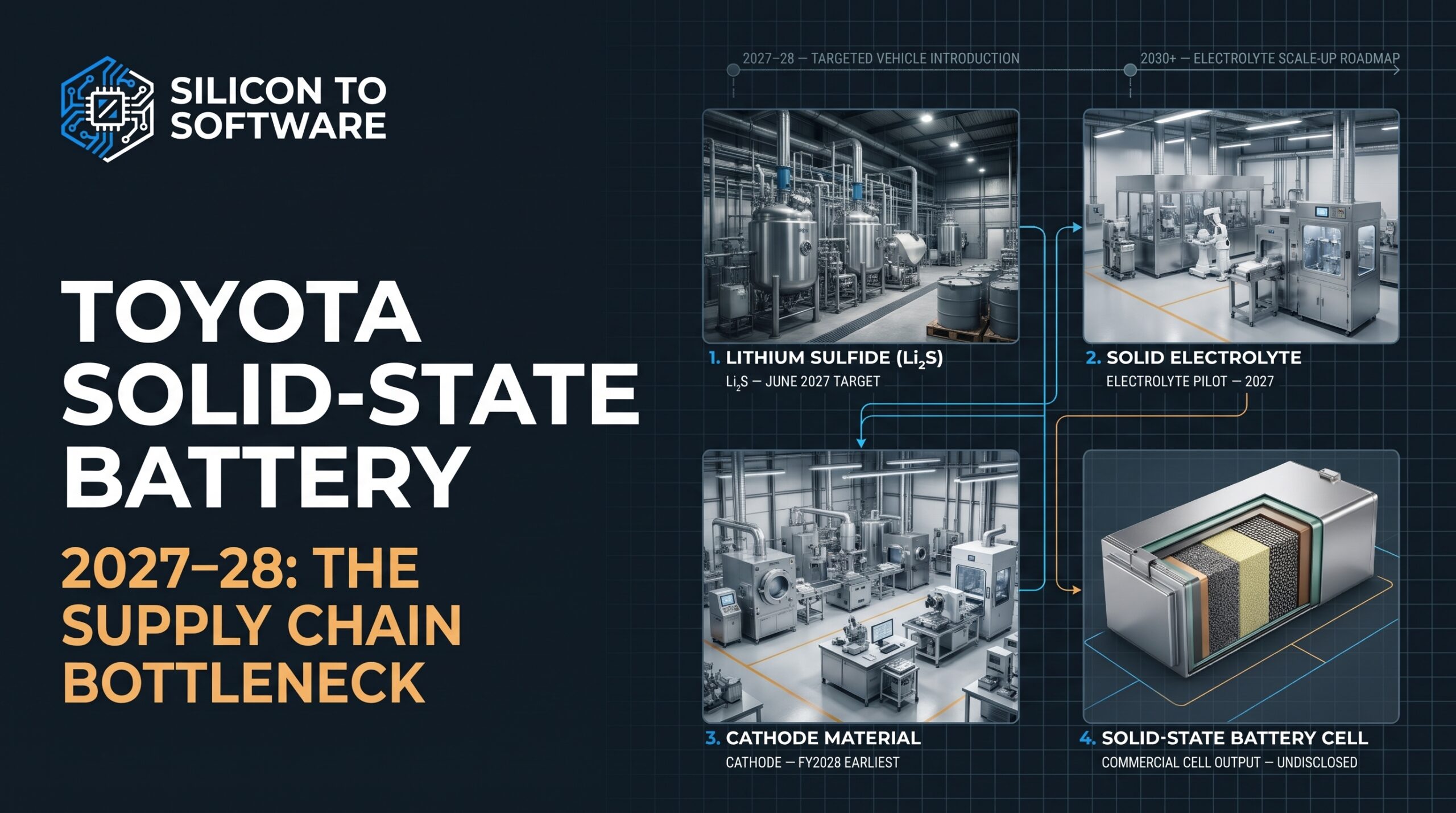
Toyota Solid-State Battery Timeline: Why the 2027–28 Launch Depends on Plants Still Under Construction
A supply-chain reading of the Idemitsu, Sumitomo Metal Mining, Toyota, and METI documents behind Toyota’s all-solid-state battery — and the four manufacturing and supply-chain layers that decide when launch turns into volume.
Last updated: November 13, 2026
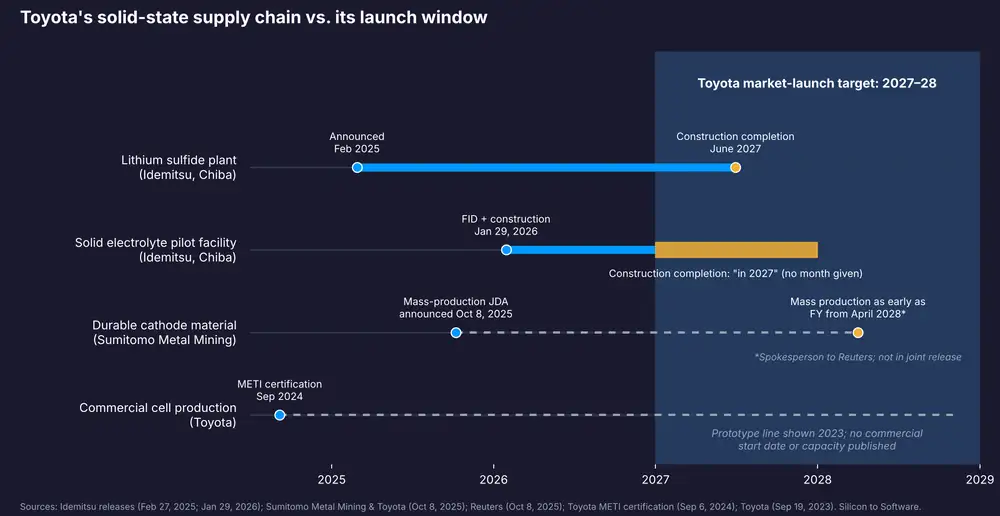
The Toyota solid-state battery has carried the same date for three years. Headlines say 2027. Toyota’s own releases say 2027–28. The more revealing date is in a January 29, 2026 press release from Idemitsu Kosan, the oil refiner supplying one of the battery’s critical materials: construction of the facility that will make that material at larger scale is scheduled to finish in 2027, too.
I found no public revision of the 2027–28 target since Toyota announced it in June 2023. Idemitsu’s January 2026 release restates it, and on November 11, 2026, Toyota described the goal as introducing all-solid-state batteries “in a future model by the end of 2028.”
The target has history, though. In September 2021, Toyota’s CTO confirmed a goal of commercializing solid-state batteries in the first half of the 2020s, with hybrids first; by June 2023, the target had become 2027–28 for battery-electric vehicles. When Toyota and Idemitsu announced their partnership in October 2023, they framed it as commercialization in 2027–28, “followed by full-scale mass production.” Two stages, in the companies’ own words. Many headlines kept the first and dropped the second.
In my world, this happens all the time with high-speed laminates — most recently on AI and data center hardware. A board built on a new low-loss material works through the normal prototype issues and gets them solved. Then the program tries to move to volume, and the schedule stops being ours. It belongs to the laminate supplier and how much capacity they’ve qualified for that material.
The design is done. The supplier’s plant schedule is the real schedule. That’s why I read the supplier dates before I believe any launch date.
This article applies that habit to the Toyota solid-state battery supply chain.
Key takeaways
- Toyota targets a market launch of all-solid-state BEVs in 2027–28 — restated on Nov 11, 2026 as introduction “in a future model by the end of 2028.” Its 2023 partnership with Idemitsu separates that from “full-scale mass production.”
- A 2023 Toyota roadmap put the electrolyte mass-production phase at “2030 and beyond” — several thousand tonnes a year, “several tens of thousands of vehicles.” That’s a material plan, not a confirmed vehicle-production date.
- Idemitsu’s lithium sulfide plant — equivalent to 3 GWh/year of batteries — is due for construction completion in June 2027.
- Idemitsu’s solid electrolyte facility, a pilot rated at “several hundred tons per year,” is due for construction completion in 2027.
- Sumitomo Metal Mining told Reuters its durable cathode material would enter mass production as early as the financial year beginning April 2028 — a date not in the joint release, at the back end of the launch window.
- Toyota’s 2024 METI certification gives no start date or capacity for solid-state cells. The widely quoted “2026, 9 GWh” belongs to a liquid lithium-ion battery.
Table of Contents
Why Toyota uses a sulfide solid electrolyte — and what that means for manufacturing
I covered the cell physics in Solid-State Batteries Explained. For the supply chain, one property matters most.
Sulfide solid electrolytes conduct ions well and are soft enough under pressure to make good contact with electrode particles. They also react with water. Yersak et al. (Frontiers in Energy Research, 2022) found moisture exposure produces H₂S plus solid by-products that raise interfacial impedance.
Sano et al. (Electrochemistry, 2023) reported that sulfide electrolytes can generate H₂S even in dry-room atmospheres — though for the composition they tested, H₂S generation wasn’t the main cause of the conductivity loss, and most of the conductivity recovered after vacuum heating. Both studies used research compositions, not Idemitsu’s proprietary material.
The manufacturing translation: composition-specific humidity limits from powder synthesis to cell assembly, plus worker-safety controls for a toxic gas. That’s a supply chain that has to be built and qualified before it can ship.
Layer 1: Idemitsu’s lithium sulfide plant (construction completion June 2027)
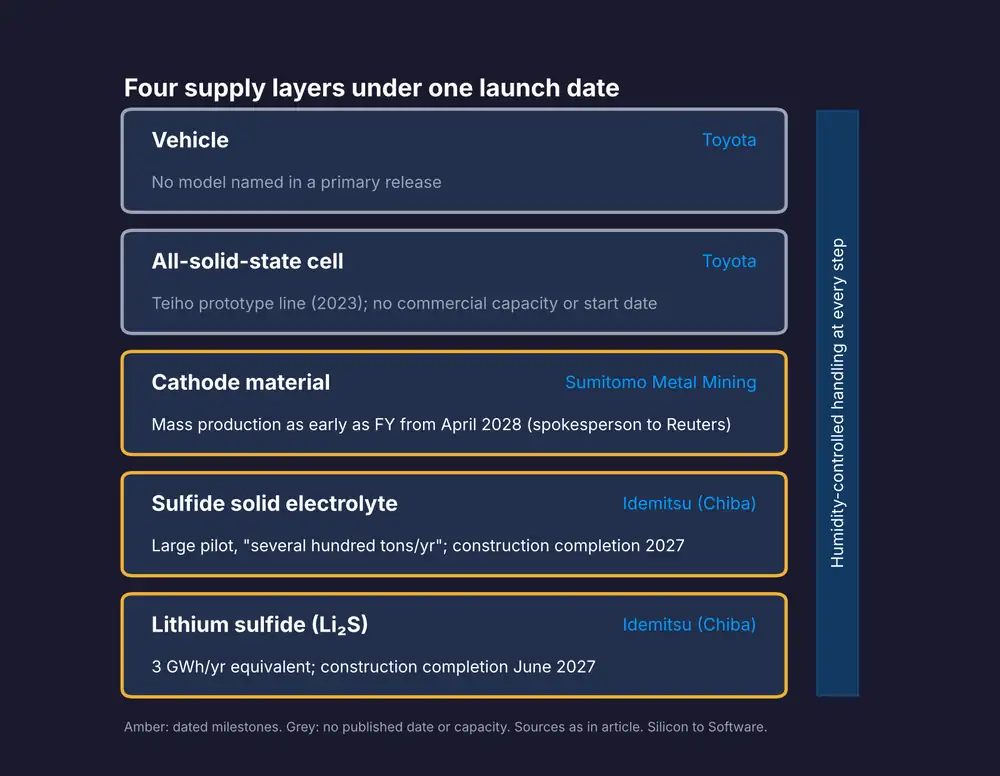
The deepest dependency in Idemitsu’s chain is lithium sulfide (Li₂S), a key intermediate raw material for its electrolyte. In February 2025, Idemitsu announced a large-scale Li₂S facility at its Chiba Complex:
- Investment: approximately ¥21.3 billion total, with up to approximately ¥7.1 billion in grants under METI’s battery supply assurance plan
- Construction completion: June 2027
- Capacity: equivalent to 3 GWh/year of batteries — “world’s top class level,” in Idemitsu’s words
An Idemitsu executive estimated to Reuters that this works out to 1,000 metric tons a year, enough for electrolyte for 50,000–60,000 EVs. In January 2026, the company said construction was “progressing smoothly toward completion in June 2027.”
Idemitsu uses sulfur by-products from petroleum refining as its feedstock, and established its Li₂S mass-production technology in 1994. Lithium has to come from outside; Reuters reported Idemitsu is seeking supply from Australia and other overseas sources.
Engineering trade-off: Making the raw material in-house gives the electrolyte supplier control over its most important input. The cost is timing. A new chemical plant has to start up, reach yield, and qualify inside the same window as the vehicle launch. Construction completion is a facility milestone. Qualified material shipping at rate is a separate one, and Idemitsu hasn’t published a timeline for it.
Cost is the other half of scale. Idemitsu’s own executive called lowering solid electrolyte cost “a major challenge for global adoption,” with the goal of matching liquid lithium-ion.
Layer 2: Idemitsu’s solid electrolyte pilot facility (construction completion 2027)
This is the layer the analysis turns on.
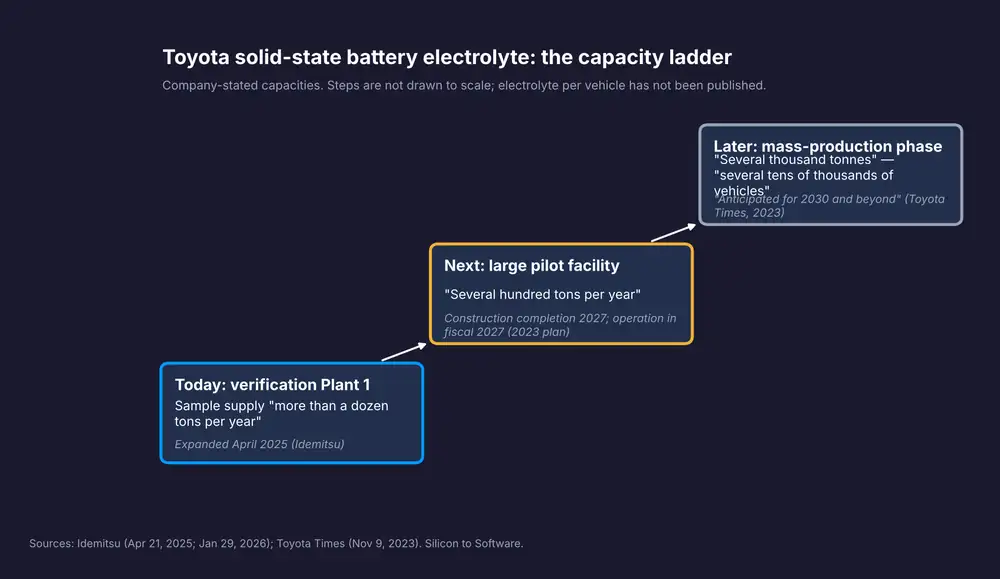
Idemitsu makes electrolyte samples at two small-scale verification facilities. Plant 1 mainly develops electrolytes for Toyota; Plant 2 develops other types. In April 2025, Idemitsu completed a Plant 1 expansion that raised its sample-supply capacity “from several tons per year to more than a dozen tons per year.”
On January 29, 2026, Idemitsu made a final investment decision and began construction of a “large pilot facility” at Chiba, expected to produce “several hundred tons per year” and finish construction in 2027. Chiyoda Corporation is the contractor; NEDO supports the program. Idemitsu calls it “the next phase toward commercialization.”
Toyota’s own publication laid out what that pilot is for. In November 2023, Toyota Times wrote that the pilot would “start operating in fiscal 2027” with several hundred tonnes of annual capacity and “begin sending products out into the market.” The mass-production phase came later: “anticipated for 2030 and beyond,” with capacity growing to “several thousand tonnes (several tens of thousands of vehicles).”
That’s the clearest public picture of the material scale behind “full-scale mass production” — and it isn’t 2027. It is a 2023 electrolyte roadmap, though, not a confirmed date for Toyota’s cell or vehicle volume.
Why the electrolyte stage is one to watch
Put the steps in order: Plant 1’s last disclosed sample-supply capacity of more than a dozen tons a year, several hundred tons from the pilot, several thousand tons in a mass-production phase that Toyota itself places at 2030 or later. Toyota attached a vehicle range only to that last step. I won’t extrapolate one for the pilot, because electrolyte loading per cell hasn’t been published.
The pilot is one of the most important publicly visible milestones. Whether it ends up as the stage that limits output depends on variables nobody has disclosed — qualified yield, Toyota’s share of output, and the readiness of the cathode and cell lines.
Engineering trade-off: Co-development is how this material reached Toyota’s specification. Neither company has disclosed whether Toyota has a separately qualified second source. OEMs sometimes run backup material tracks quietly, but for a co-developed sulfide electrolyte tuned to one cell design, my view is that a mid-stream supplier change could reset much of the qualification work. Toyota hasn’t disclosed its supplier-redundancy strategy. The more the launch leans on one pilot, the more its startup curve matters.
| Facility / phase | Owner | Status | Stated capacity | Timing |
|---|---|---|---|---|
| Verification Plant 1 (Chiba) | Idemitsu | Operating; expansion completed Apr 2025 | Sample supply “more than a dozen tons per year” (from “several tons”) | Operating |
| Li₂S large-scale facility (Chiba) | Idemitsu | Under construction | Equivalent to 3 GWh/yr of batteries | Construction completion June 2027 |
| Solid electrolyte large pilot facility (Chiba) | Idemitsu | Under construction since Jan 29, 2026 | “Several hundred tons per year” | Construction completion 2027; operation fiscal 2027 (Toyota Times) |
| Electrolyte mass-production phase | Idemitsu / Toyota | Planned | “Several thousand tonnes (several tens of thousands of vehicles)” | “2030 and beyond” (Toyota Times, 2023) |
| Durable cathode material | Sumitomo Metal Mining | Joint development agreement for mass production, announced Oct 8, 2025 | Not published | Mass production “as early as the financial year beginning April 2028” (company spokesperson to Reuters) |
Layer 3: Sumitomo Metal Mining’s durable cathode material (mass production from April 2028 at the earliest)
On October 8, 2025, Sumitomo Metal Mining and Toyota announced a joint development agreement for mass production of all-solid-state cathode materials. They have worked together since around 2021 on cathode degradation during repeated charge and discharge cycles, and using Sumitomo Metal Mining’s powder synthesis technology developed what they describe as a “highly durable cathode material.” The joint release covers further work on performance, quality, safety and cost-effective mass production, but gives no start date.
A Sumitomo Metal Mining spokesperson filled that in for Reuters: mass production “as early as the financial year beginning April 2028,” supplying Toyota first.
That makes the cathode the latest-starting layer in the chain. If Toyota launches in 2027, its first vehicles would use cathode material made before that mass-production start.
The failure mechanism: keeping the cathode in contact
In a liquid cell, the electrolyte keeps wetting cathode particles as they change volume during cycling. A sulfide electrolyte is deformable under pressure, but it doesn’t flow back into gaps the way a liquid does.
Toyota named the problem itself in 2021: its CTO said, “longer use will result in creating spaces in the solid electrolyte which leads to deterioration.” Jung et al. (Journal of Materials Chemistry A, 2019) observed physical contact loss between the cathode and a sulfide electrolyte and linked it to chemical reactions at the interface; the same study lists electrochemically driven volume changes of the active material as a separate degradation factor.
Cathode durability in these cells is a coupled problem — interfacial chemistry, volume change, electrode microstructure, and mechanical pressure all interact. Particle engineering like Sumitomo Metal Mining’s is one lever, not the whole solution, and it’s slow work: the same pattern showed up in Tesla’s 4680 dry electrode process, where the cathode took years. Until Sumitomo Metal Mining confirms that date in a formal release and publishes a capacity, the cathode is a separate gate on volume — even if both Idemitsu facilities finish on time.
Layer 4: What Toyota has disclosed about cell production
In September 2024, METI certified Toyota’s battery development and production plan under Japan’s battery supply-assurance framework. The certification table has three rows:
| Row | Item | Applicant | Production start | Production scale |
|---|---|---|---|---|
| 1–2 | Next-generation lithium-ion battery (Performance version) at PPES and PEVE (now Toyota Battery Co.) | PPES / PEVE, Toyota | “Starting from 2026, gradually implemented” | 9 GWh/year |
| 3 | All-solid-state battery | Toyota | Blank | Blank |
The 2026 and 9 GWh belong to the liquid lithium-ion battery. Several outlets merged the rows anyway: InsideEVs reported the plan “states Toyota will begin solid-state battery production in 2026,” and TopSpeed wrote that production “for all of them” would begin in 2026 at up to 9 GWh a year. Trade press (SMM) adds a 10 GWh solid-state factory and an “October 2025 production approval”; neither appears in any Toyota or METI document I could find.
Toyota has shown where it’s developing the process. In September 2023, it opened a prototype all-solid-state battery line at its Teiho Plant, inside a temperature- and humidity-controlled room, and said it had achieved high-speed, high-precision stacking “without damage to the battery materials in anticipation of mass production.” That’s process development, not a commercial line with a published capacity or start date.
Cell assembly is its own scale-up
Even if every material plant hits its construction date, commercial cell output depends on variables Toyota and its suppliers haven’t quantified publicly: electrolyte loading per kWh, material and cell yields, cathode–electrolyte interface durability, stack-pressure requirements, and the throughput of qualified cell-assembly equipment. The disclosed facility capacities mark supply-chain milestones. They don’t establish a vehicle-production rate.
What the supply chain means for the Toyota solid-state battery launch
The strongest objection is fair. Toyota doesn’t need volume in 2027–28. It has promised a market launch, and building the first vehicles from pilot-scale material is one reasonable way to introduce a new cell technology.
I agree with most of that. My point isn’t that Toyota is late. It’s that “solid-state is here” will describe something narrower than most readers expect.
Both Idemitsu and Toyota have published one capacity figure each for 2027-era production, and they measure different things. Idemitsu sizes its lithium sulfide plant as equivalent to 3 GWh/year of batteries — raw material, which it also intends to supply to other customers. Toyota’s certified plan for its liquid lithium-ion Performance battery is 9 GWh/year of cell production. Neither measures Toyota’s solid-state cell output; that number hasn’t been published.
What has been published is the shape of the plan: an electrolyte pilot supplying the market from fiscal 2027 (a 2023 plan), durable-cathode mass production from April 2028 at the earliest, and electrolyte mass production “anticipated for 2030 and beyond.” The supplier roadmap is consistent with a limited initial commercialization phase before full-scale production. Public information doesn’t establish Toyota’s initial volume, or prove which stage will bind.
Toyota’s own leadership has framed it the same way. At the October 2023 press conference launching the Idemitsu partnership, then-president Koji Sato said solid-state volumes would remain small in 2027: “I think the most important thing at the moment is to put out [the solid-state batteries] into the world and we will consider expansion in volume from there,” according to Driving.co.uk. Kyodo reported the same day that Toyota aimed to establish mass-production technology as early as 2030.
Samsung SDI, another major company pursuing sulfide electrolytes, has chosen a different first market. It said in March 2026 it is targeting mass production in the second half of 2027, has since described humanoid robots as the likely first commercial application with EVs to follow, and by October 2026 had reported shipping humanoid-robot samples for customer evaluation.
My reading: robots make a lower-volume first market where a new line can learn its yields; automotive qualification — vibration, crash safety, fast-charge duty — is a separate hurdle that still comes later.
One limit applies to all of this: it covers what’s public. Toyota or Idemitsu may hold capacity or plans they haven’t announced, and the Plant 1 expansion is a reminder that supply can grow between press releases.
Toyota solid-state battery milestones to watch in 2027
- Lithium sulfide: Does Idemitsu confirm construction completion in June 2027 — and then production?
- Electrolyte: Does the pilot facility start operating in fiscal 2027, and does Idemitsu announce the mass-production plant after it?
- Vehicle: Does Toyota name a first all-solid-state model in a primary release?
- Cells: Does Toyota publish a location and capacity for commercial all-solid-state production?
- Cathode: Does Sumitomo Metal Mining confirm its April 2028-or-later mass-production start in a formal release, with a capacity?
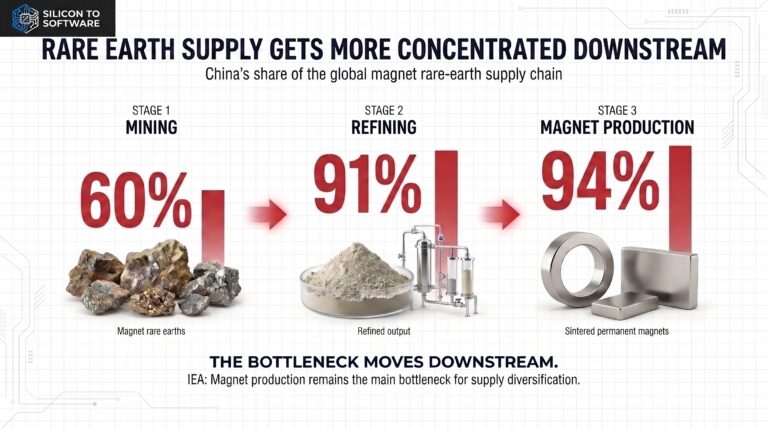
The same pattern — the bottleneck sitting downstream of where the headlines point — shows up in rare earth magnets, where the constraint is refining and magnet manufacturing rather than the mine, and in AI chips, where CoWoS packaging and IC substrates can cap output as tightly as wafer fab capacity.
Toyota and Idemitsu told us in 2023 there would be two stages: commercialization, then full-scale mass production. For the Toyota solid-state battery, the 2027–28 target tells you when the first is supposed to arrive. The plants — once they’re running and qualified — will tell you when the second one starts.
About the Author
Imran Valiani | Sales Director, PCB Electronics Manufacturing
20+ years working with major Bay Area and global tech clients. Founder of Silicon to Software, where I write about the hardware layer — PCB fab, AI gear, autonomous systems, and cyber — the stuff most tech writers have never touched. Literally.
Follow: X @SiToSoftware | LinkedIn
This article was developed with AI assistance and edited, fact-checked, and reviewed by the author. See my full AI disclosure.
Listen to the Silicon to Software podcast on Apple Podcasts, Spotify, or RSS.com — and watch on YouTube.
Sources
Primary company and government documents
- Toyota Motor Corporation — “Media Briefing on Batteries and Carbon Neutrality” (transcript)
Toyota Motor Corporation, 2021.
https://global.toyota/pages/news/images/2021/09/battery/battery_03_en.pdf - Toyota Motor Corporation — “Changing the plant status quo and the future of manufacturing”
Toyota Global Newsroom, 2023.
https://global.toyota/en/newsroom/corporate/39758451.html - Idemitsu Kosan & Toyota Motor Corporation — “Idemitsu and Toyota Announce Beginning of Cooperation toward Mass Production of All-Solid-State Batteries for BEVs”
Idemitsu Kosan, 2023.
https://www.idemitsu.com/en/content/100043691.pdf - Toyota Times — “Idemitsu & Toyota Team Up to Create Global Standard for All-Solid-State Batteries”
Toyota Motor Corporation, 2023.
https://toyotatimes.jp/en/toyota_news/1046_1.html - Toyota Times — Monozukuri Workshop report (Teiho, Motomachi and Myochi plants)
Toyota Motor Corporation, 2023.
https://toyotatimes.jp/en/toyota_news/1041.html - Toyota Motor Corporation — “Toyota’s Next-Generation BEV Battery Development and Production Plan Certified by METI”
Toyota Global Newsroom, 2024.
https://global.toyota/en/newsroom/corporate/41100223.html - Idemitsu Kosan — News release: decision to construct a large-scale lithium sulfide (Li₂S) production facility
Idemitsu Kosan, February 27, 2025.
https://www.idemitsu.com/jp/news/2024/250227_en.pdf - Idemitsu Kosan — “Completed construction to increase capacity of Plant 1, small pilot facilities for mass production of solid electrolytes (all-solid-state battery materials).”
Idemitsu Kosan, 2025.
https://www.idemitsu.com/jp/news/2025/250421_en.pdf - Sumitomo Metal Mining & Toyota Motor Corporation — “Sumitomo Metal Mining and Toyota Collaborate on Mass Production of Cathode Materials for All-Solid-State Batteries”
Toyota Global Newsroom, 2025.
https://global.toyota/en/newsroom/corporate/43380876.html - Idemitsu Kosan — “Final Investment Decision and Construction Start for Large Pilot Facility for Solid Electrolytes (All-Solid-State Battery Material)”
Idemitsu Kosan, 2026.
https://www.idemitsu.com/jp/news/2025/260129_en.pdf - Samsung SDI — “SAMSUNG SDI Unveils All-Solid-State Battery for Physical AI”
Samsung SDI, 2026.
https://news.samsungsdi.com/global/press/view?seq=383 - Toyota Motor North America — “Toyota Powers What’s Next in Mobility and Manufacturing”
Toyota Pressroom, 2026.
https://pressroom.toyota.com/?p=122989
Peer-reviewed research
- Thomas A. Yersak, Yubin Zhang, Fang Hao, Mei Cai — “Moisture Stability of Sulfide Solid-State Electrolytes”
Frontiers in Energy Research, Vol. 10, 2022. DOI: 10.3389/fenrg.2022.882508
https://doi.org/10.3389/fenrg.2022.882508 - Hikaru Sano, Yusuke Morino, Yasuyuki Matsumura, Koji Kawamoto, Hiroyuki Higuchi, Noriyuki Yamamoto, Atsunori Matsuda, Hirofumi Tsukasaki, Shigeo Mori, Atsushi Sakuda, Akitoshi Hayashi — “Surface Degeneration of Li3PS4–LiI Glass-Ceramic Electrolyte by Exposure to Humidity-Controlled Air and Its Recovery by Thermal Treatment”
Electrochemistry, Vol. 91, No. 5, 2023. DOI: 10.5796/electrochemistry.23-00029
https://doi.org/10.5796/electrochemistry.23-00029 - Sung-Kyun Jung, Hyeokjo Gwon, Seok-Soo Lee, Hyunseok Kim, Jae Cheol Lee, Jae Gwan Chung, Seong Yong Park, Yuichi Aihara, Dongmin Im — “Understanding the effects of chemical reactions at the cathode–electrolyte interface in sulfide-based all-solid-state batteries”
Journal of Materials Chemistry A, Vol. 7, No. 40, 2019.
https://pubs.rsc.org/en/Content/ArticleLanding/2019/TA/C9TA08517C
Credible secondary reporting
- Driving.co.uk — “Toyota aims for solid-state battery EVs with up to 750 miles of range by 2027”
Driving.co.uk, 2023.
https://www.driving.co.uk/?p=135923 - Kyodo News — report on the Toyota–Idemitsu all-solid-state battery tie-up press conference
Kyodo News, as published by Khaosod English, 2023.
https://www.khaosodenglish.com/news/business/2023/10/12/toyota-idemitsu-tie-up-in-mass-production-of-advanced-ev-batteries/amp/ - Reuters (Yuka Obayashi, Kaori Kaneko) — “Japan’s Idemitsu to build lithium sulfide plant to help support Toyota’s EV plans”
Reuters, as syndicated by Stockopedia, 2025.
https://www.stockopedia.com/share-prices/idemitsu-kosan-co-TYO:5019/news/japan-apos-s-idemitsu-to-build-lithium-sulphide-plant-to-help-support-toyota-apos-s-ev-plans-updated-019e69ae-e0cb-765e-a976-59c49dda6be6/ - Reuters (Yuka Obayashi) — “Toyota, Sumitomo Metal make advances in cathode materials for solid-state batteries”
Reuters, as syndicated by MarketScreener, 2025.
https://hk.marketscreener.com/news/toyota-sumitomo-metal-make-advances-in-cathode-materials-for-solid-state-batteries-ce7d5bd2df81f32d - MarkLines — “Toyota’s Development and Supply of Batteries: Investing JPY 1.5 trillion by 2030”
MarkLines, 2021.
https://www.marklines.com/en/report/rep2204_202109 - InsideEVs — “Toyota’s Solid-State Battery Production Plans Approved By Japan’s Government”
InsideEVs, 2024.
https://insideevs.com/news/732940/japan-toyota-solid-state-production/ - TopSpeed — “The Current Status Of Toyota’s Solid State Battery Development”
TopSpeed, 2024.
https://www.topspeed.com/toyota-solid-state-battery-development-current-status/ - The Korea Herald — “Samsung SDI eyes capacity expansion as US ESS orders surge; LFP mass production set for October”
The Korea Herald, 2026.
https://biz.heraldcorp.com/article/10825975 - The Korea Times — “Samsung SDI swings to profit in Q3 on ESS battery demand”
The Korea Times, 2026.
https://www.koreatimes.co.kr/path/A2026102910310001302
Industry trade press (cited only as unverified claims)
- SMM (Shanghai Metals Market) — “Toyota’s Solid-State Battery Layout: Mass Production in 2027 to Achieve a 1,000-km Driving Range Revolution”
SMM, 2025.
https://news.metal.com/newscontent/103633667