Most Internet Traffic Runs Through 570 Submarine Cables on the Ocean Floor. That Should Scare You.
Note: The “400 cables” number you see cited all over the web is old — pre-2020. Per TeleGeography’s own February 2025 piece (Lane Burdette, “How Many Submarine Cables Are There, Anyway?”), It’s 570 active in-service systems right now, with 81 more being built. The 2026 TeleGeography map shows 694 total — but that counts planned and historical cables too. 570 is the live count. Also worth knowing: we’re talking about international traffic here. Your Netflix buffering at home runs on land fiber. This is about the cables that cross oceans.
How submarine cables carry over 95% of the world’s cross-border internet — and why one bad week could grind economies, cloud services, and military comms to a halt.
Table of Contents
Let Me Start With the Part That Gets Glossed Over
Before I even tell you what happened in Tonga, let me hit you with the number that stopped me cold when I was pulling this piece together. It’s about submarine cables — the actual physical infrastructure that carries the internet across oceans — and specifically about how few ships exist to fix them when something goes wrong.
Twenty ships.
That’s roughly how many vessels on the whole planet are built to repair the submarine cables that carry over 95% of the world’s cross-border internet traffic (per TeleGeography / ICPC). Twenty. For 1.5 million kilometers of cable, three repairs a week on average, spread across every ocean. I’ve been in the hardware supply chain for two decades, and I’ve seen some tight single-supplier situations — but this one genuinely surprised me. Not great.
Here’s why that number matters more than it looks. A repair isn’t just a ship showing up. It’s mobilization time to get a vessel on-site, time spent locating the actual fault along the route, time spent grappling the cable up from the seafloor, the splice or replacement itself, and then testing before the system goes back into service. Every one of those steps consumes vessel-days. With only twenty repair-capable ships covering every ocean, a handful of simultaneous faults in different regions can back the whole system up. The fleet isn’t just small. It is the capacity constraint that the rest of the repair timeline sits behind.
Okay. Now Tonga.
January 15, 2022.
It was a Saturday when the Hunga Tonga–Hunga Ha’apai volcano blew. The force of a 7.6 quake. Ash 20 kilometers up. Tsunami waves hitting coastlines clear across the Pacific. Three dead. Homes gone. Water supply wrecked.
And then — separately, quietly, in a way most disaster coverage barely touched — a nation went dark.
The Tongan government put out a four-line statement. Last line: “Due to the damage to the international fiber optic cable, the internet is down.”
That was it. 100,000 people, mid-disaster, no way to reach the outside world. No banking. No calls home. No way to tell relief teams where to go. Gone.
Digicel (one of the local carriers) found out what happened. The eruption — which, by the way, hit roughly 10 megatons, so technically a bomb went off under the ocean — didn’t just cut the cable. It shredded 80 kilometers of it into bits (per Tonga Cable CEO James Panuve, AFP/Inquirer, 2022). They were expecting to splice a break. What they found looked like confetti.
The internet came back 38 days later.
I think most people who heard about this filed it under “remote island, extreme event, not relevant to me.” I get that reaction. I’d push back on it, though — and I’ll explain why as we go.
Nobody Talks About Submarine Cables. Nobody.
Ask ten people how the internet works. Right now, in your head, run through what they’d say.
Wi-Fi. Satellites. Cell towers. Maybe someone who’s read a little says “data centers.” What almost no one says — and I mean genuinely almost no one outside of this specific industry — is: cables on the ocean floor.
But that’s the right answer.
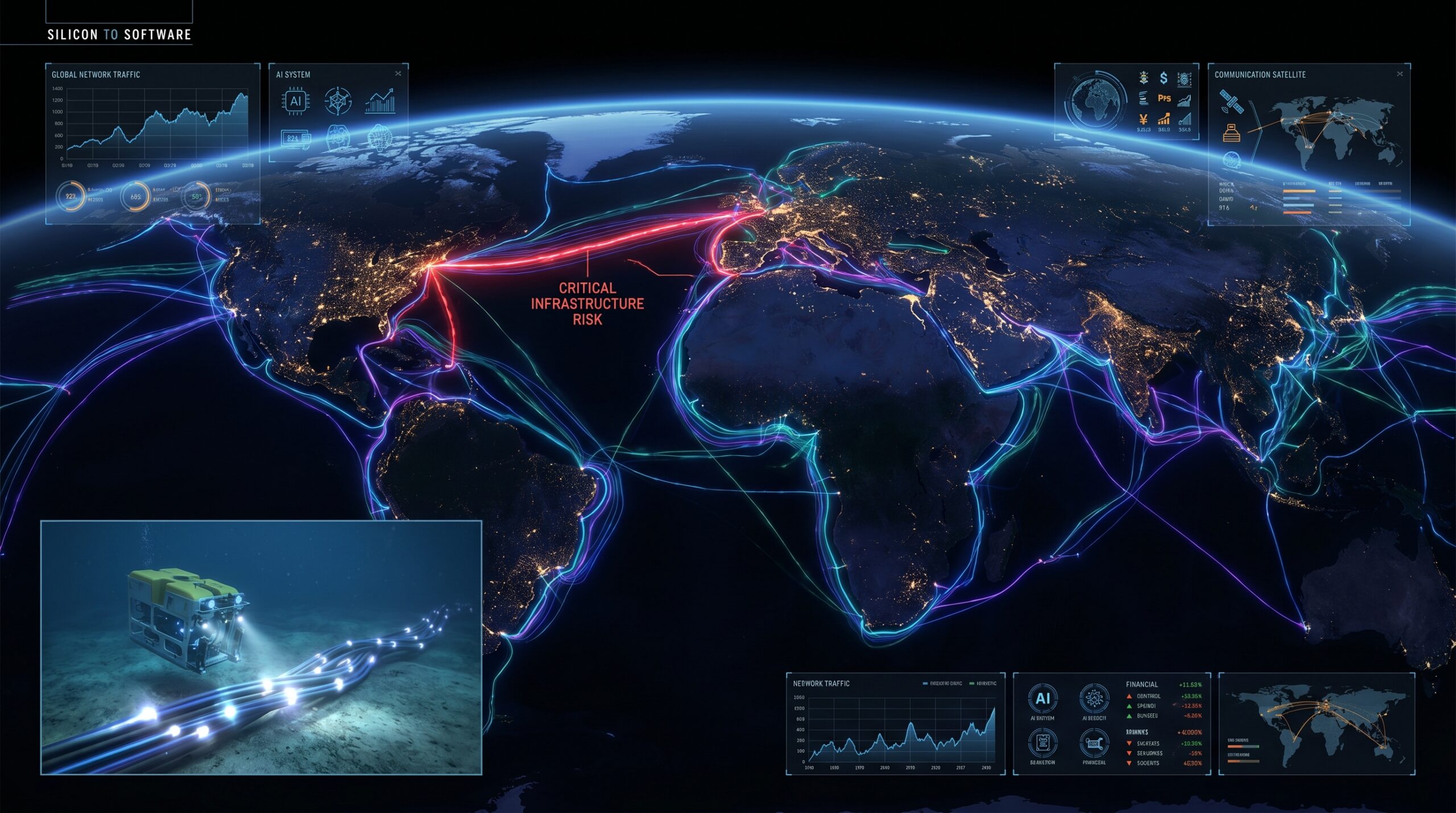
As of 2024, there are around 559 submarine cable systems running approximately 1.5 million kilometers across the seabed (TeleGeography Submarine Cable Map 2024). They connect tiny Pacific islands to the trading floors in New York and the data centers in Singapore. They carry over 95% of all cross-border internet traffic — some analysts put it at 99%, some at 95%; it depends how you count, but the ballpark is not in dispute.
And they move an estimated $10 trillion or more in daily financial transactions (this is a modeled figure, not a metered one — TeleGeography’s Tim Stronge ran it against SWIFT volumes in 2023 and concluded the $10T floor is legit, even if the exact number is fuzzy).
Ten trillion a day. Through a system most people couldn’t describe if you asked them.
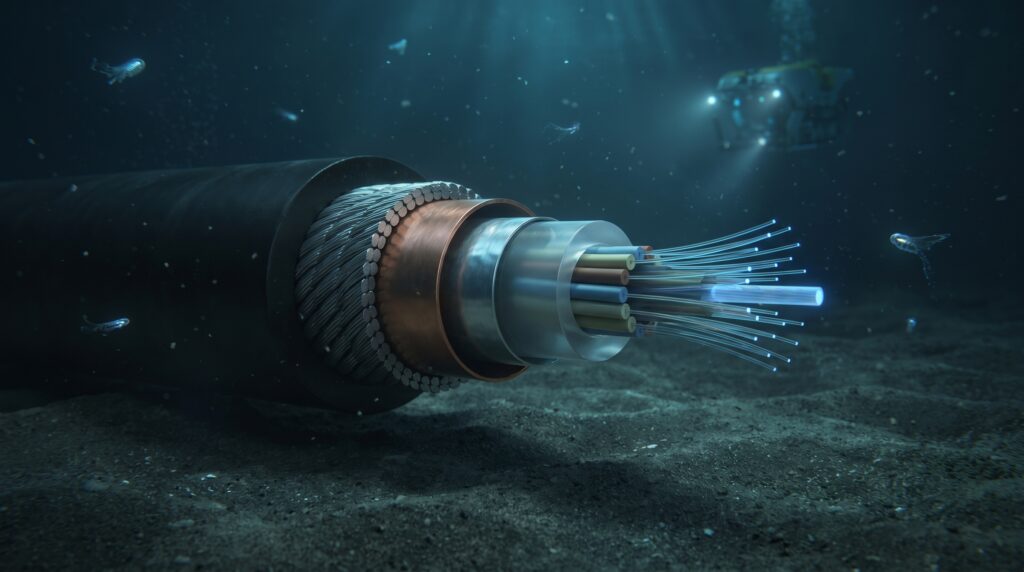
Here’s the physical reality, and I still find this jarring: the cable itself — the thing doing all of this — is, in deep water, roughly the width of a garden hose. Somewhere between 17 and 20mm across for unarmored deep-sea sections (per TeleGeography FAQs). The actual glass fiber inside? Width of a human hair. Near shore it gets wrapped in steel wire and thickens up to 50mm or more, which is good because that’s where fishing trawlers and dragged anchors do most of their damage — but out in deep water? Garden hose.
Now here’s where I think people get it wrong, though. The cable isn’t really the fragile part. The fragile part — the part you actually can’t fix quickly — is the repeater. Every 60 to 100 kilometers along the route, there’s a pressurized steel housing bolted to the cable, packed with electronics running dense wavelength-division multiplexing (DWDM) and erbium-doped fiber amplifiers (EDFAs).
These sit at depths up to 8,000 meters. They’re rated for 25 years with zero maintenance. You cannot get to them. It’s the same underlying problem I wrote about with embedded hardware that can’t be patched once deployed — except here the deployment site is the bottom of the ocean, not a hospital or a car. And when one fails, the parts to fix it come from a list of suppliers so short it’ll make your supply chain team nervous — more on that below.
A garden hose carrying $10 trillion a day, held together by components you can’t touch for a quarter century. That’s the infrastructure the modern world runs on.
How Did We End Up Doing It This Way?
Honestly? Kind of by accident. No master plan here.
The first cable across the Atlantic went in the water in 1858. For telegraph, not internet — but the model of “put fiber in the sea and hope it stays there” has been with us for 150+ years. The modern fiber-optic version ramped up in the 80s and went hard in the 90s as internet demand exploded.
Satellites were going to change all of this. I know what you’re thinking — Starlink, LEO constellations, the whole pitch. Here’s the thing: satellites still carry less than 1% of U.S. international internet traffic, per TeleGeography. The physics don’t work in their favor. Fiber is cheaper per bit, by a lot, and faster in terms of real throughput. That math hasn’t moved.
So the cable count grew. 570 active systems now, 81 more being laid. More than any point in the last 20 years.
On the other hand, maybe I’m wrong to assume this will always hold. If LEO satellite costs keep dropping, the calculus might shift. I just haven’t seen it yet.
Who Owns All of This?
Not who you’d think.
Telecom carriers used to run most of the subsea cable world. That era is over. The dominant players now are hyperscalers — Google, Meta, Amazon, Microsoft. They hold ownership stakes in 59 cable systems, up from 20 in 2017 (TeleGeography / LightReading, December 2024). And that’s the conservative count — it only tracks direct ownership. Through fiber-pair leasing and spectrum deals, they have substantial sway over capacity without even showing up in the ownership numbers.
$11 billion in new cable builds planned for 2024–26. Double the prior three years. The big tech firms are funding most of it.
I’ve noticed that people tend to shrug at this — “okay, so Google owns cables, so what?” But think about it for a second. The pipes that move the world’s data are increasingly run by the same companies whose services flow through those pipes. At the end of the day, that’s a structural question about who controls a piece of critical global infrastructure — and I don’t think it’s one we’ve really reckoned with yet. Maybe it’s fine. I’m genuinely not sure.
The Ways Things Break — There Are More Than Two
The Everyday Kind (Which Happen All The Time)
150 to 200 cable faults a year, says the UN. Fishing gear and anchors cause nearly two-thirds of them (TeleGeography, 2024). In 2023, the ICPC tracked 206 repair jobs across 136 countries. Three a week. Most take weeks to months to fix, depending on what ships are available and whether permits come through.
The record for a single repair? 947 days (ICPC Global Cable Repair Data Analysis 2024). Almost three years. Not because it was technically hard — because permit gridlock and scarce repair ships stacked on top of each other. That’s the outlier, but it shows the ceiling.
The Geopolitical Kind (Where It Gets Murky Fast)
November 2024. Two Baltic cables — BCS East-West Interlink and C-Lion1 — go down within 24 hours of each other. The Chinese cargo ship Yi Peng 3 was tracked right there, right when it happened. Held for inspection. No conclusive attribution. Released (per Reuters; UW Jackson School, 2025).
Christmas Day 2024. The Russia-linked tanker Eagle S — shadow fleet, sanctioned oil, Cook Islands flag — dragged its anchor roughly 90 kilometers across the seabed and damaged cables between Finland and Estonia. Finnish authorities seized the ship, and three crew members were later charged with aggravated criminal mischief and interference with communications. In October 2025, however, the Helsinki District Court dismissed the case after ruling that Finland lacked jurisdiction. The incident remains a useful example of the gap between establishing physical responsibility for infrastructure damage and successfully pursuing criminal liability.
Here’s the part most outlets skipped: across the full run of Baltic cable breaks, multiple European officials told Recorded Future News they believe most of the incidents were probably accidents — not Kremlin ops. A Swedish ship initially held for sabotage was cleared inside a week. Prosecutors: “The investigation now clearly shows that it is not a case of sabotage.” Baltic ship traffic has surged because of Russia’s shadow fleet hauling oil — more ships, more anchor drags, more breaks. Simple math (The Record / Recorded Future News, March 2025).
NATO’s line was carefully vague: “We are deeply concerned by actions, be they negligent or malicious.” Recorded Future’s own analysts said the investigations “highlighted the difficulty of attributing cable cuts to state-sponsored sabotage.”
So where does that leave us? One charged incident. Most others either unattributed or likely accidental. And a context — shadow fleets, hybrid warfare, documented Russian and Chinese infrastructure targeting in other areas — that makes the pattern hard to ignore even when individual events can’t be proven. It’s a toss-up, honestly, whether any given incident is malice or just reckless seamanship. That ambiguity might be the whole point.
It’s worth understanding what cable-monitoring systems can actually tell investigators, and what they can’t. A sudden loss of signal at a given point on the line can establish where the fault occurred, but the location and basic fault signature alone generally do not establish why it happened. Determining cause requires separate evidence: vessel tracking data, physical inspection of the cable ends when recovered, or other corroborating information. That’s a big part of why some incidents remain in “no conclusive attribution” territory — the system that detects and locates a fault isn’t necessarily designed to determine its cause.
Taiwan is a different story. The Matsu Islands — Taiwan territory, 20km from mainland China — have had their cables cut 30 times since 2017, with at least a third traced to Chinese vessels (per IISS). In February 2022, 11,800 people were offline for 50 days. No redundancy. No backup. Just gone.
And then there’s the permit game in the South China Sea, which I think is the most underreported part of this whole situation. Repair permits through Chinese-claimed waters used to take 10 days. Now they take four months (LightReading, December 2024; Stars and Stripes, October 2024). Beijing denies it. Industry sources — executives, regulators, people who deal with this daily — confirm it (Washington Post; Stars and Stripes, 2024).
In the South China Sea, a repair that should take a week now stretches past 40 days (Asia Media Center, February 2026). Is that policy? Leverage? Both? I don’t know. But the effect is the same either way.
The Spots Where One Bad Day Becomes Everyone’s Bad Day
Some parts of the ocean floor matter a lot more than others.
There are places where cables bunch up — same routes, close together, high traffic — and hitting one zone can knock out a disproportionate chunk of global capacity. The big ones (per TeleGeography / Internet Society, 2024):
- The Red Sea / Suez corridor — East-West traffic between Asia and Europe
- Malta and Gibraltar — European and African access point
- The South China Sea — the most contested stretch of cable-dense water on earth
These chokepoints aren’t accidents of geography alone — they’re also the path of least resistance economically. New cables tend to land where landing stations, permitting frameworks, and terrestrial fiber already exist, because building fresh infrastructure at a new site adds cost and years of approval time. Seabed geography narrows the options further; some corridors are simply the shortest, shallowest, or most cable-friendly route between two continents. The result is that operators can face a tradeoff between geographic path diversity and the cost, permitting time, and infrastructure requirements of developing a new route. Resilience favors diversification; deployment economics can favor established corridors.
In 2024, the Red Sea scenario actually happened. Houthi attacks and shipping chaos disrupted cables carrying 25% of Asia-Europe traffic. A land war became a broadband crisis. Took weeks to see the full damage. Months to fix.
Back to the Twenty Ships Problem
I know I led with this, but it deserves more space.
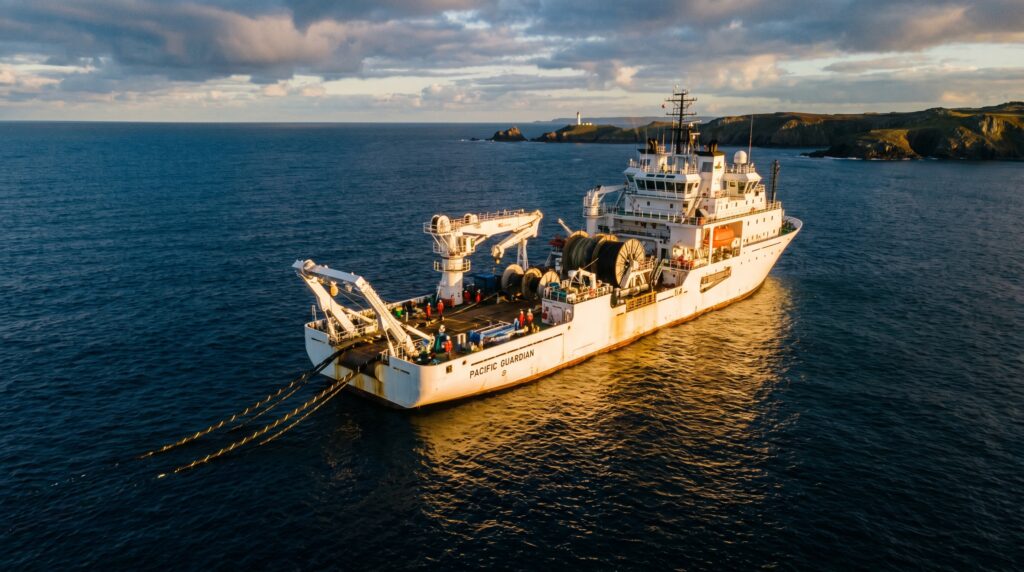
Roughly 80 cable ships in the world. About 20 dedicated repair vessels (TeleGeography / Equinix Blog / ICPC). The rest are for laying new cable, not fixing old ones. And multi-purpose offshore ships aren’t a substitute — they don’t have the cable tanks, the linear engines, the burial gear, or the ROV systems that repair ships need. That’s not my opinion. That’s just what the equipment requires.
TeleGeography’s maintenance report says closing the fleet gap takes $3 billion — 15 replacement ships and 5 new ones — just to hold current service levels.
Congress is moving to authorize two new ships (per Steptoe, 2025).
Two.
Now add the parts problem. When a repeater housing dies at 8,000 meters — that steel unit with the EDFA electronics, rated for 25 years no maintenance — the parts to fix it come from basically one place. The EU’s 2024 submarine cable study (Analysys Mason/Axiom) laid it out: optical pumps in repeaters come exclusively from US manufacturers. Transponder chips are controlled by Taiwanese and South Korean firms. No backup suppliers. Lead times are real (EU Submarine Cable Report, Analysys Mason/Axiom, 2024).
In my experience working hardware supply chains, “one source, no backup” is the kind of thing that gets flagged as critical risk in any serious audit. This is a global-scale version of that.
What This Has To Do With You
I’ll keep this part short because I think you’ve got the picture by now.
Every time you send an email across a border, wire money internationally, open a shared doc on a server in another country, or stream something from a foreign CDN — your data crosses one of these cables. The path runs through fiber thinner than your hair, in a cable roughly the width of your wrist, kept alive by electronics at the bottom of the ocean, with about 20 ships available globally to fix it if something goes wrong.
For businesses: if your DR plan doesn’t account for regional cable outages, it has a gap. In practice, that means looking past which cloud region you’re failing over to, and asking which physical cable systems actually carry that traffic. Two providers can look diverse on paper while both routing through the same handful of cables or the same landing station. Real resilience means diversity at every layer — the cable systems themselves, the carriers or providers using them, and the landing stations where they come ashore — because a single chokepoint at any one of those layers can undermine redundancy you thought you had elsewhere.
Vietnam lost all five of its international cables at once in 2024 — took eight months to restore full service (Washington Post / LightReading). West Africa had its own multi-cable failure the same year. Same calendar year. Two separate crises. Don’t sweat the day-to-day noise, but the multi-cable regional event is not a tail risk anymore. It’s just a thing that happens.
What’s Being Done About It
Slowly. That’s the honest answer.
The Center for Cybersecurity Policy and Law put out a report in 2024 calling for more coordination and better policy frameworks around cable security. Good document. Meaningful recommendations. I’ve noticed that government bodies are very good at producing those.
Google and Meta are routing new cables around high-risk chokepoints (per HEC Paris, 2025). Real money, real diversification. That’s actually encouraging. But private investment optimizes for their uptime, not for collective national security. Not the same thing.
Also worth flagging: the cyber side of this is largely missing from public discourse. Cable landing stations are physical buildings with online management networks — meaning they carry both a physical break-in risk and a network intrusion risk. Craig Terron at Recorded Future’s Insikt Group noted in 2023 that remote management systems for cables “open up avenues to be potentially targeted by cyber threat actors” (Infosecurity Magazine, 2023). It’s the same pattern I’ve seen writing about hardware that gets hacked precisely because nobody expects the physical layer to be the weak point — cables are that problem at oceanic scale. Two related risks sit alongside it: routing-level attacks like the 2023 Rostelecom BGP incident, which redirected major cloud traffic without touching a single cable, and the supply-chain exposure the EU’s 2024 study flagged in repeater components themselves — concentrated among a small number of US and Taiwanese suppliers (Analysys Mason/Axiom, 2024). There’s also a longer horizon risk worth a mention: the encryption protecting this traffic today is the same encryption quantum computing may eventually break — a separate clock running in the background. The physical threat is real. The digital threat is sitting right next to it, quieter.
So What Do We Do With All This?
UC Berkeley Professor Nicole Starosielski studies this stuff full time. Her take: “The internet transforms our experience of space and time. So many people depend on it, and we need to know about how it works.”
She’s right. Most people have no idea.
And here’s the thing — I’m not saying the internet is about to collapse. Frankfurt isn’t Tonga. Major economies have dozens of cables each, BGP rerouting, redundant landing stations. A total blackout isn’t the realistic threat. What is realistic is slow degradation — speeds that crawl, payments that fail, cloud services that drop in and out, military comms rerouted through paths they weren’t designed for. Not silence. Erosion. Harder to blame, harder to fix, more damaging over time than any single outage.
On the other hand, maybe I’m overstating the risk. Maybe the redundancy built into major economies is sufficient, the repair fleet will be funded eventually, and the geopolitical stuff stays below the threshold of real disruption. I’m genuinely open to that. I just haven’t seen the evidence for it.
What I do know is this: a system this important, this invisible, this concentrated, and this under-resourced deserves a lot more public attention than it gets. Right now, the people thinking hard about it are mostly specialists. The rest of the world is barely whispering.
Maybe it’s time to get louder.
About the Author
Imran Valiani | Sales Director, PCB Electronics Manufacturing
20+ years working with major Bay Area and global tech clients. Founder of Silicon to Software, where I write about the hardware layer — PCB fab, AI gear, autonomous systems, and cyber — the stuff most tech writers have never touched. Literally.
Follow: X @SiToSoftware | LinkedIn
This article was developed with AI assistance and edited, fact-checked, and reviewed by the author. See my full AI disclosure.
Sources & References
- TeleGeography — Lane Burdette, “How Many Submarine Cables Are There, Anyway?” February 27, 2025. resources.telegeography.com
- TeleGeography — Tim Stronge, “Do $10 Trillion of Financial Transactions Flow Over Submarine Cables Each Day?” April 2023. resources.telegeography.com
- TeleGeography — “Do Submarine Cables Account For Over 99% of Intercontinental Data Traffic?” Mythbusting Part 3, 2023. blog.telegeography.com
- TeleGeography — Submarine Cable FAQs: Frequently Asked Questions. www2.telegeography.com
- TeleGeography — The Future of Submarine Cable Maintenance (report). TeleGeography Research.
- TeleGeography / LightReading — “2024 In Review: Submarine Cables Become a Battleground.” December 2024. lightreading.com
- International Cable Protection Committee (ICPC) — Global Cable Repair Data Analysis 2024. ICPC Annual Report.
- Al Jazeera — “Tonga Internet Reconnected Five Weeks After Volcanic Eruption.” February 23, 2022. aljazeera.com
- Digital Journal / AFP — “Volcano Damage to Tonga Undersea Cable Worse Than Expected.” February 2022. digitaljournal.com
- CSIS — “Risk Beneath the Waves: Safeguarding Subsea Cables.” 2026. features.csis.org
- EU Submarine Cable Report — Analysis Mason / Axiom Consulting, Submarine Cable Infrastructure Security and Resilience in the EU. European Commission, 2024.
- Recorded Future Insikt Group — Submarine Cable Infrastructure Threat Intelligence Report. 2024–2025. recordedfuture.com
- The Record / Recorded Future News — “European Officials Say Most Baltic Sea Cable Breaks Were Accidental.” March 2025. therecord. media
- Submarine Networks — “Eagle S Cable Incident Update.” August 2025. submarinenetworks.com
- Submarine Networks — “EU Publishes Landmark Report and Funding for Cable Hubs.” 2024. submarinenetworks.com
- Infosecurity Magazine — James Coker, “Submarine Cables at Growing Risk of Cyber-Attacks.” June 27, 2023. infosecurity-magazine.com
- HarfangLab — 2025 Cyber Threatscape Report (BGP hijacking / Rostelecom incident). harfanglab.io
- International Institute for Strategic Studies (IISS) — “Submarine Cables: The Achilles Heel of Cyberspace in the Asia-Pacific.” IISS Cyber Power Matrix.
- Stars and Stripes — “China’s Permit Delays Are Slowing Submarine Cable Repairs.” October 2024.
- Asia Media Center — “South China Sea Cable Repair Delays.” February 2026.
- Washington Post — Reporting on South China Sea cable repair delays and Vietnam cable outages. 2024.
- Bridewell — “Submarine Cable Security Report 2025.” bridewell.com
- HEC Paris — “Submarine Cables: The Hidden Infrastructure of the Digital Economy.” 2025.
- Center for Cybersecurity Policy and Law — “Submarine Cable Security and Resilience: An Action Plan.” 2024. cybersecuritypolicy.org
- Steptoe — Legislative analysis, Strategic Subsea Cables Act / U.S. cable ship procurement effort. 2025. steptoe.com
- University of Washington Jackson School — Analysis of Yi Peng 3 / BCS East-West Interlink and C-Lion1 attribution. 2025.
- UC Berkeley News — “Nicole Starosielski on Submarine Cable Infrastructure.” May 2024. news.berkeley.edu