Humanoid Robots Factory Floor Deployments: 7 Critical Hardware Gaps Nobody’s Talking About
Tesla Optimus, Figure AI, Boston Dynamics — and the Real Bottleneck
Table of Contents
Humanoid robots factory floor deployments are no longer a concept — Tesla, Figure AI, and Boston Dynamics are running real machines in real facilities right now. But every time one of those demo videos goes viral, the same two camps appear in the comments — people who think this is five years away, and people who think it’s already solved.
They’re both wrong.
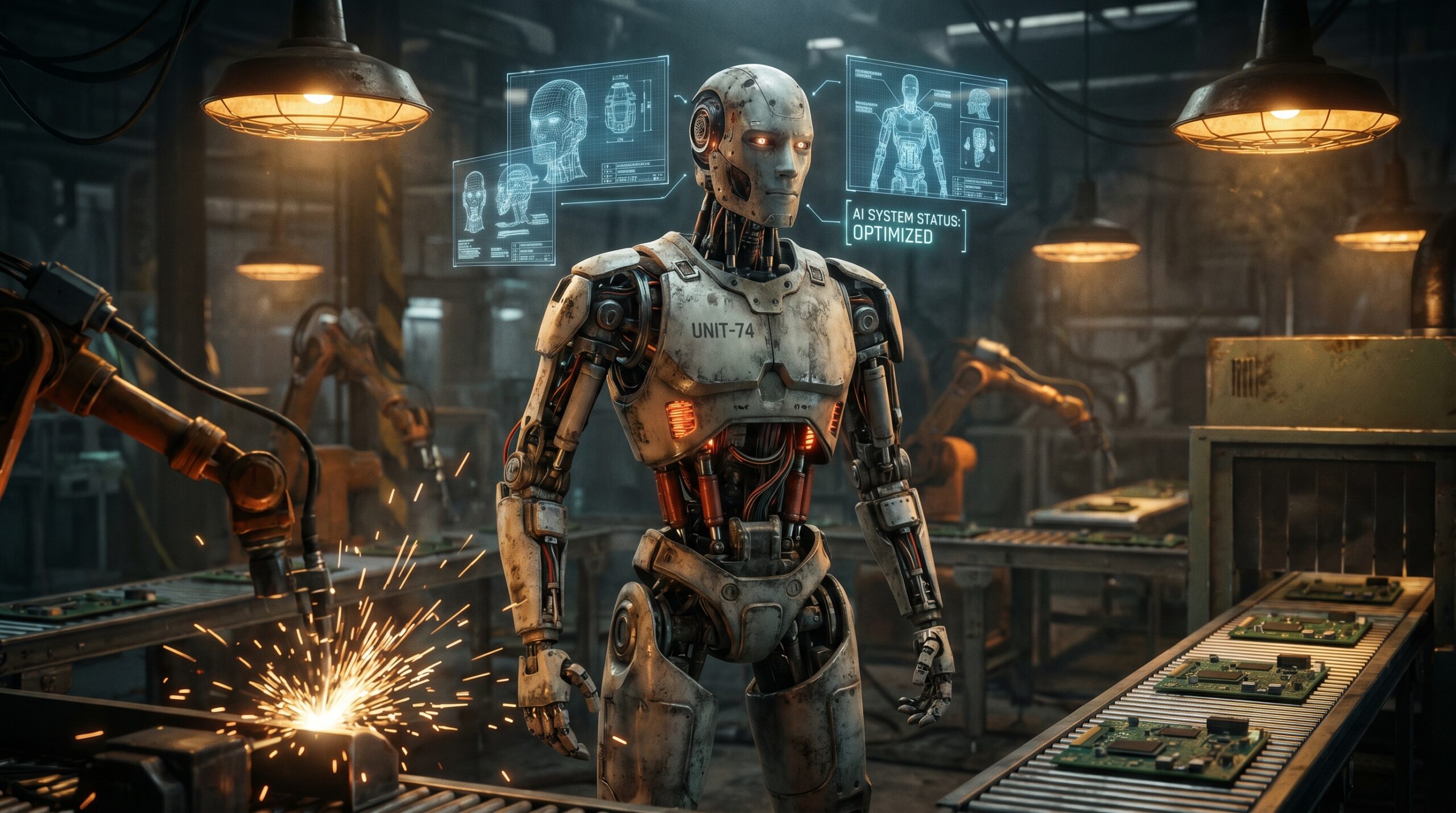
Here’s the thing: those demos are choreographed. Controlled lighting. Flat floors. No forklifts. No coolant mist. No random worker with a pallet jack who doesn’t see the robot until he’s six inches away. The real humanoid robots factory floor environment is a completely different planet — and I’ve yet to see a single promo clip that captures what it actually does to a machine over eighteen months of continuous operation.
That’s the gap nobody’s talking about. Not the AI. The hardware.
Why Humanoid Robots Are Heading to the Factory Floor Now
Fair question. Why build something that looks like a person?
The answer is almost embarrassingly practical. Human workplaces — warehouses, assembly lines, fulfillment centers — were designed for human bodies. Two hands. Two legs. Eyes at a specific height. Stairs, ladders, tools with handles shaped for fingers. If you want a robot that works in those spaces without gutting and rebuilding everything around it, making it roughly human-shaped isn’t a philosophical choice. It’s an engineering shortcut.
BCG’s 2023 report “Amplify Your Warehouse Automation ROI” is pretty blunt about the labor math: aging workforces plus chronic labor shortages in developed economies are driving demand for flexible factory automation at a pace that fixed robotic arms can’t address. A welding robot on an assembly line is great at one thing. A humanoid robot on the factory floor that can sort batteries, hand off parts, and walk to a different station to do quality inspection? That’s the pitch.
Tesla’s stated goal for Optimus (per the 2022 AI Day presentation) is to fix its own Gigafactory labor shortages first, then sell the robots to everyone else. Figure AI closed a $675 million Series B in 2024 and locked in a deployment partnership with BMW at Plant Spartanburg. Boston Dynamics — now part of Hyundai — has been running Atlas in real logistics and automotive test environments, where the PCB engineering and embedded systems demands are already among the most stringent in manufacturing.
The ambition is real. The money is real. The hardware isn’t ready. It’s a pattern we’ve seen before — the metaverse went through the same hardware ceiling just a few years ago, and the lesson still applies.
The Real Bottleneck: It’s Not the Brain
This is the part that surprises people. The AI has actually gotten pretty good. Vision-language models (VLMs — models that process images and text simultaneously) are giving humanoid robots factory floor situational understanding that would’ve sounded like science fiction in 2019. Motion planning. Task reasoning. Whole-body coordination. Genuinely impressive.
But a robot’s brain is useless if its body falls apart.
And factory environments are brutal in ways that are hard to overstate.
What Factory Floors Actually Do to Humanoid Robot Hardware
I’ve found that most people, when they imagine a factory floor, picture something clean and orderly. It isn’t. Constant vibration from conveyors, forklifts, and stamping equipment works metal fatigue into every joint and fastener in ways that only show up after thousands of hours — not in a three-minute demo. Thermal cycling from temperature swings between a cold loading dock, a paint oven, and an open floor stresses seals and electronic components invisibly until they fail. Particulate contamination — metal shavings, lubricants, hydraulic fluid — finds every gap in every enclosure. And then there are the collisions: carts, dropped tooling, other workers who don’t read the robot’s path the way a simulation assumes they will.
Per IEC 60529 — the standard that defines Ingress Protection (IP) ratings — industrial machinery needs IP65 at minimum (fully dust-tight, protected against directed water jets). But that’s not a single number that fits every environment. A food processing facility may require IP69K for high-pressure washdown. A semiconductor cleanroom has an entirely different problem: particulate emission from the robot matters as much as contamination going in. An automotive stamping line brings its own cocktail of coolant, metal dust, and vibration loads.
Here’s what makes this genuinely hard for humanoid robots factory floor deployments specifically. IP ratings have to hold across joints that move through large ranges of motion — continuously, at production speed, for years. Sealing a static enclosure to IP65? Solved. Sealing a shoulder joint that rotates through 180 degrees in three axes, with live wiring routed through it, for 40,000 hours? Not solved. Not even close. For comparison, satellite PCB engineering — arguably the most demanding hardware durability challenge in existence — takes decades of refinement to achieve reliable long-duration performance in extreme environments. Humanoid robots are asking for similar durability, in a fraction of the development time.
Gap 1 — Actuators: The Hardware That Keeps Breaking
Let’s talk actuators — the motors and mechanical drives that move a robot’s limbs. Right now, to be honest, they’re the single biggest hardware pain point for any humanoid robots factory floor program.
Two approaches dominate:
Hydraulic actuators are powerful, with an excellent force-to-weight ratio. Real torque. Good for lifting heavy things repeatedly. The problem is everything else: hydraulic fluid leaks, seals degrade, and the maintenance infrastructure required on a shared factory floor is expensive and messy. Boston Dynamics ran hydraulics in earlier Atlas versions for exactly the power-density reason. But their official April 2024 announcement made the all-electric transition explicit — serviceability, not performance, was the constraint.
Electric actuators are cleaner. More controllable. Easier to service. The two architectures that dominate current research are Series Elastic Actuators (SEAs) — formally introduced by Gill Pratt and Matthew Williamson in their 1995 IEEE/RSJ IROS paper (DOI: 10.1109/IROS.1995.525827) — and Quasi-Direct Drive (QDD) motors, developed through MIT’s Biomimetics Lab under Professor Sangbae Kim in the MIT Cheetah research program. Both are good at force control and safe contact behavior. Neither matches hydraulics for raw power at equivalent weight. Both architectures also share a quieter dependency: their torque density comes almost entirely from high-performance NdFeB permanent magnets, and that magnet supply chain carries its own single point of failure that most robotics roadmaps don’t factor into their timelines. That matters when you’re asking a robot to move a 20 kg payload through a full eight-hour shift.
Tesla’s Optimus runs custom rotary and linear actuators (per the 2023 Investor Day materials). No publicly released MTBF (Mean Time Between Failures) data under real production loads. That one number — MTBF under production conditions — is what every serious procurement officer asks for first. Nobody’s published it yet. And this is before you factor in the onboard edge AI chips running the perception and control stack — adding heat, power draw, and their own reliability variables to the equation.
Gap 2 — Hands: The Hardest Hardware Problem
I’ll be honest: this is the section that genuinely humbles me every time I dig into the literature.
Human hands have 27 bones. Dozens of muscles and tendons. Sensory feedback that registers force, texture, temperature, and vibration simultaneously. Building a robotic hand that can pick up a delicate circuit board without cracking it, grip a wrench with enough force to actually use it, and feel when a part is seated correctly versus slightly misaligned — in the same hand, in the same shift — remains an open hardware problem for humanoid robots factory floor programs.
Figure 02 (unveiled August 2024) features a fourth-generation hand design with 16 degrees of freedom per Figure AI’s published specs. The demonstrations are real. But here’s what the research literature says about durability. The GelSlim tactile sensor paper (Donlon et al., MIT CSAIL, IEEE ICRA 2018) identifies frictional wear as intrinsic to vision-based tactile sensors — contact forces during normal manipulation are significant enough to damage both sensor surface and internal structure over time. A 2021 comparative evaluation in Frontiers in Robotics and AI (Friedl & Roa, DOI: 10.3389/frobt.2021.704416) explicitly names fingertip silicone pad replacement as a design requirement, not an edge case.
And then there’s this: the ORCA hand paper (Christoph et al., ETH Zurich, accepted IEEE/RSJ IROS 2025) reports 10,000 continuous operation cycles — roughly 20 hours — without hardware failure, and describes this as a notable durability result worth publishing.
Twenty hours. As a research milestone.
Tesla’s Optimus Gen 2 (December 2023 demo) has 11 degrees of freedom per hand with tactile sensing on fingertips. Impressive spec sheet. But degrees of freedom don’t tell you anything about how those joints hold up under eight hours of production repetition, five days a week, for two years.
Gap 3 — Battery Life: The Honest Numbers
Every active humanoid robot is simultaneously draining current through its actuators, its compute hardware, and its sensor arrays. All at once. The thermal and power math is non-trivial.
Here’s what’s actually been published. Figure 01 carries a battery rated for approximately 5 hours of runtime (confirmed by IEEE Spectrum’s robot database and Figure AI’s own specs). Figure 02 bumped that to a 2.25 kWh pack — roughly 50% more than Figure 01. Figure 03’s battery blog post on figure.ai documents a 2.3 kWh pack targeting 5 hours at peak performance with 2 kW fast charging.
Tesla’s figure is traceable but soft. At AI Day 2022, the Optimus engineering team presented a 2.3 kWh pack at 52V on stage and described it as “perfect for a full day of work” — with idle draw around 100 watts and brisk walking around 500 watts (per Engadget and Motley Fool’s contemporaneous coverage). Tesla has not published an independently verified spec sheet with duty-cycle-specific runtime figures. “Full day” is Tesla’s characterization. Not a third-party number.
The structural problem is real regardless. A human worker does eight to ten hours. Any humanoid robot on the factory floor doing active manipulation tasks faces a genuine gap between its battery capacity and that shift duration. And unlike a person who can push through tired, a robot on degraded voltage sees actuator torque drop in ways that can produce unsafe motion behavior.
The relevant standards here are IEC 62619 (safety requirements for secondary lithium cells in industrial applications) and UL 1973 (stationary and motive battery applications). Neither was written with a mobile biped generating simultaneous heat from motors, joint actuators, and dense onboard compute in mind. That thermal management problem is still open — and the next generation of battery technology may be part of the long-term answer.
Gap 4 — IP Sealing Across Moving Joints
Already covered in depth above, but worth calling out explicitly as its own gap. The IEC 60529 IP rating challenge for humanoid robots factory floor deployments isn’t about whether a robot can be sealed to IP65 — it’s whether that rating holds across every joint, through every range of motion, for tens of thousands of hours of operation. Nobody has published independent data proving it does.
Gap 5 & 6 — Safety Standards and Compliance
A humanoid robot working next to a human being on an active production floor isn’t just a hardware durability problem. It’s a regulatory problem, a legal problem, and — increasingly — a cybersecurity problem.
ISO 10218-1 and ISO 10218-2 govern industrial robot safety in most jurisdictions. ISO/TS 15066 covers collaborative robot (cobot) operations specifically — Power and Force Limiting (PFL) modes, safety-rated monitored stop, hand-guiding requirements. These aren’t optional. They’re the baseline for CE marking in Europe and the framework OSHA compliance programs reference in the US. No certification here means no humanoid robots factory floor deployment, full stop.
The good news (and it is genuinely new) is that a humanoid-specific standard is now in development. ISO 25785-1 — formally “Safety requirements for dynamically stable industrial mobile robots” — reached working draft (WD) status in 2025, developed through ISO TC 299 with contribution from Boston Dynamics and Agility Robotics. It covers robots whose balance depends on active control systems. Not enforceable yet. But for the first time, a dedicated framework exists — and factory operators need to track it.
Gap 7 — OT Cybersecurity
The cybersecurity layer is the one almost nobody in the robotics press discusses. Humanoid robots are network-connected Linux-based computers controlling physical actuators. They receive OTA firmware updates. They talk to Manufacturing Execution Systems (MES). They live on the same OT (Operational Technology) network infrastructure that has been a chronic security weak point in industrial environments for years. The frameworks that apply — IEC 62443 for OT cybersecurity and NIST SP 800-82 for OT environments — were not written with a mobile bipedal robot in mind. And the cryptographic underpinnings of those frameworks face their own looming quantum threat that embedded hardware designers are only beginning to grapple with.
That gap is already showing up in real disclosures. In May 2026, CISA and Universal Robots disclosed CVE-2026-8153 (CISA advisory ICSA-26-134-17): a critical CVSS 9.8 OS command injection vulnerability in PolyScope 5’s Dashboard Server — allowing an unauthenticated attacker with network access to run arbitrary commands on the robot’s OS. Patched in PolyScope 5.25.1. No known exploitation. Discovered by Vera Mens at Claroty Team82.
The architecture it exposed is the same architecture humanoid robots are being built on. A Linux controller. An Ethernet port. A factory network that was never designed to treat a robot as a potential adversarial entry point. A compromised robot isn’t just broken. On a poorly segmented OT network, it’s a pivot point into everything else on that floor. If you want to understand how this attack pattern plays out in a related vehicle context, the EV cybersecurity hardware vulnerabilities exposed at Pwn2Own every year tell a very similar story.
Where Are Humanoid Robots Actually Deploying in 2026?
Let’s get specific — because the PR often outpaces reality by a considerable margin.
Tesla Optimus is running inside Fremont and Giga Texas on battery cell sorting, parts handling, and quality inspection, per published reports and Tesla’s own statements. Elon Musk projected “several thousand” units in production for internal use in 2025 (X, January 2025). Independent estimates as of early 2026 put active internal-use units in the low hundreds. Tesla has not confirmed deployment figures.
Figure AI is running active tests at BMW’s Plant Spartanburg — BMW’s largest US production facility — with Figure 01 completing full autonomous task trials including parts placement and self-correcting manipulation. Deployment scale hasn’t been publicly detailed.
Boston Dynamics Atlas has deployment testing underway with Hyundai Motor Group following the April 2024 all-electric reveal. No production data published.
None of these companies have released independent third-party MTBF data. For context: Motion Controls Robotics, a certified FANUC integrator, cites operational reliability in the 80,000–100,000 hour range for FANUC’s current fixed industrial arm models under proper load conditions. That comparison isn’t apples-to-apples — fixed arms don’t deal with dynamic balance loads and gait impacts — but the directional gap is real. And enormous. Nobody has published a total cost of ownership model for a humanoid in production conditions. Those numbers would tell you far more than any demo video.
What Humanoid Robots Factory Floor Programs Need to Get Right
Here’s my honest assessment of where things stand:
- Actuator MTBF at production loads needs public documentation and independent verification
- Dexterous hand joint and sensor durability needs validation under real task repetition rates, not 20-hour lab cycles
- IP rating compliance needs confirmation across full joint range of motion per IEC 60529 for each specific environment type
- Battery runtime and thermal management under simultaneous motor, actuator, and compute load needs formal published specs
- ISO 10218 / ISO/TS 15066 compliance pathways need to be defined per platform; ISO 25785-1 needs to reach enforceable status
- OT cybersecurity — IEC 62443 and NIST SP 800-82 need to be applied to robot controllers before fleet-scale deployment
- Total cost of ownership — maintenance intervals, parts availability, downtime cost — needs transparent publication
The AI is improving faster than the hardware. That’s real. But “faster” doesn’t mean “solved.” Edge inference under constrained power budgets, real-time perception in high-particulate environments, long-horizon task planning, safe recovery from unexpected failure states — all still open problems. The hardware is the current bottleneck. The AI will be the next one.
The Bottom Line
Humanoid robots on factory floors aren’t science fiction. They’re real, they’re being tested, and some version of widespread deployment is coming.
But “coming” isn’t “here.” The companies that solve actuator durability, hand longevity, OT security, and regulatory compliance first — not the ones with the most cinematic demo videos — are the ones that will actually change how manufacturing works.
Watch the specs. Not the videos.
Frequently Asked Questions
Are humanoid robots currently working on factory floors? Yes, in limited supervised deployments. Tesla Optimus is running inside its Fremont and Giga Texas facilities on tasks like battery cell sorting and parts handling. Figure AI is testing at BMW’s Plant Spartanburg. None have published independent production uptime data.
Why isn’t humanoid robot hardware ready for full factory deployment? Actuator durability, dexterous hand wear rates, battery runtime gaps, IP-rated joint sealing across full range of motion, and OT cybersecurity compliance are all unresolved engineering problems at production scale. The AI stack has largely been solved — the physical hardware hasn’t.
What safety standards apply to humanoid robots on factory floors? ISO 10218-1/-2 and ISO/TS 15066 govern collaborative robot safety currently. ISO 25785-1 — a dedicated standard for dynamically stable industrial mobile robots — reached working draft status in 2025 through ISO TC 299.
How long do humanoid robot hands last in real use? Published research gives a sobering picture. The ORCA hand paper (ETH Zurich, 2025) reports 10,000 cycles — approximately 20 hours — as a notable durability milestone. Production deployments typically require 40,000+ hours of reliable operation.
What is the battery life of current humanoid robots? Figure 03 targets approximately 5 hours per charge from a 2.3 kWh pack with 2 kW fast charging. Tesla Optimus’s engineering team described their 2.3 kWh pack as “good for a full day of work” at AI Day 2022, but no independently verified production runtime figures have been published.
About the Author
Imran Valiani | Sales Director, PCB Electronics Manufacturing
20+ years working with major Bay Area and global tech clients. Founder of Silicon to Software, where I write about the hardware layer — PCB fab, AI gear, autonomous systems, and cyber — the stuff most tech writers have never touched. Literally.
Follow: X @SiToSoftware | LinkedIn
This article was developed with AI assistance and edited, fact-checked, and reviewed by the author. See my full AI disclosure.
Sources
Every claim in this post is traceable to a primary source, grouped by topic.
Industry Reports & Company Announcements
- BCG — “Amplify Your Warehouse Automation ROI” (March 2023)
- Tesla AI Day 2022 — Optimus battery specs, actuator design, labor rationale
- Tesla Investor Day 2023 — Optimus custom actuator materials
- Figure AI — $675M Series B and BMW Plant Spartanburg partnership (February 2024)
- Figure AI — F.03 Battery Development (2.3 kWh, 5-hour runtime, 2 kW fast charging)
- Boston Dynamics — All-electric Atlas announcement (April 2024)
Engineering & Hardware Standards
- IEC 60529 — Ingress Protection (IP) ratings
- IEC 62619 — Safety requirements for secondary lithium cells in industrial applications
- UL 1973 — Batteries for stationary and motive applications
- Pratt & Williamson — “Series Elastic Actuators”, IEEE/RSJ IROS 1995. DOI: 10.1109/IROS.1995.525827
- MIT Biomimetics Lab (Prof. Sangbae Kim) — QDD motors, MIT Cheetah
Robotics Research Papers
- Donlon et al. — GelSlim, MIT CSAIL / IEEE ICRA 2018
- Friedl & Roa — Tactile sensor evaluation, Frontiers in Robotics and AI, 2021. DOI: 10.3389/frobt. 2021.704416
- Christoph et al. (ETH Zurich) — ORCA Hand, accepted IEEE/RSJ IROS 2025
Safety & Cybersecurity Standards
- ISO 10218-1 and ISO 10218-2 — Industrial robot safety
- ISO/TS 15066 — Collaborative robot safety
- ISO 25785-1 — Safety requirements for dynamically stable industrial mobile robots (WD)
- IEC 62443 — Industrial OT cybersecurity
- NIST SP 800-82 — Guide to OT Security
- CISA ICS Advisory ICSA-26-134-17 — CVE-2026-8153, Universal Robots PolyScope 5
Deployment & Reliability Data
- Motion Controls Robotics — FANUC operational reliability documentation
- IEEE Spectrum Robots Database — Figure 01 specifications
- Elon Musk — Optimus production projection, X (January 2025)
Note: PCB electronics reliability standards (IPC-A-610 Class 3, IPC-6012, JESD22, BGA solder joint fatigue) are directly relevant to humanoid robot durability but fall outside the scope of this post’s beginner audience. That follow-up is now live: Industrial IoT Hardware Reliability: Why Boards That Pass Lab Testing Still Fail on the Factory Floor.