Self-Driving Cars Have a Hardware Security Problem Nobody Wants to Talk About
Table of Contents
Self-driving car hardware security is the gap nobody in the autonomous vehicle industry wants to discuss publicly. I’ve spent a lot of time reading autonomous vehicle whitepapers. Safety reports. Technical disclosures. And I keep noticing the same pattern: everyone talks about software. Rarely the hardware underneath it.
That’s a problem.
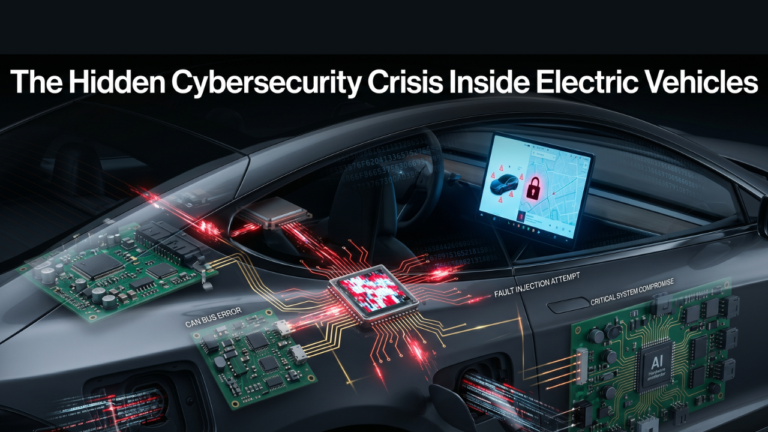
Because here’s the thing — when a self-driving car gets hacked, it probably won’t happen the way Hollywood imagines it. No one’s going to break into the cloud dashboard and steer the car off a cliff. The real attack surface is quieter. It’s physical. It’s embedded in silicon, soldered onto circuit boards, and riding inside the sensors your car trusts with your life.
Let’s talk about what’s actually going on.
Your Car Is a Rolling Data Center — With Legacy Self-Driving Car Hardware Security Gaps Built In

Modern autonomous vehicles aren’t just cars. They are mobile computing platforms. As I covered in How AI Is Transforming Modern Cars, a single Level 4 autonomous vehicle (as defined by SAE International’s J3016 standard) can contain dozens to well over 100 Electronic Control Units (ECUs) — though next-generation software-defined vehicle (SDV) platforms are actively consolidating these into zonal and domain controller architectures, with some OEMs targeting 50%+ ECU count reductions. Each ECU is a small embedded computer. Each one communicates with others, processes sensor data, and executes decisions in real time.
Here’s what surprises most people: many of these ECUs were not designed with cybersecurity in mind. At all.
The automotive supply chain has traditionally prioritized:
- Functional safety (per ISO 26262)
- Reliability (mean time between failures)
- Cost optimization
Security? It’s been bolted on after the fact. According to the UN Economic Commission for Europe’s WP.29 regulation (UN Regulation No. 155), automotive OEMs are now required to implement Cyber Security Management Systems (CSMS) — but enforcement is recent, and legacy ECU designs predate it significantly.
That means millions of vehicles on the road today contain hardware designed before security was treated as a requirement.
The CAN Bus Problem Is Worse Than You Think
Let’s start with the Controller Area Network (CAN bus). This is the primary communication protocol used between ECUs in most vehicles on the road.
Development of CAN began in 1983 at Robert Bosch GmbH, when engineer Uwe Kiencke started work on a new serial bus protocol. Bosch formally introduced it at the SAE Congress in Detroit in 1986. The version vehicles actually run — CAN 2.0 — wasn’t published until 1991, with ISO standardization (ISO 11898) following in 1993. That protocol has been unchanged since. That’s the architecture running in safety-critical systems today.
It was designed for reliability. Not security. Classical CAN has no native authentication mechanism. Any node on the bus can send a message, and every other node accepts it. There is no cryptographic verification. No sender identity. No message integrity check.
To be honest, this is kind of remarkable when you think about it. The protocol that tells your brakes to engage, your steering to respond, and your throttle to accelerate — has no way to verify that the message came from a legitimate source.
Why Self-Driving Car Hardware Security Starts With the CAN Bus
Two independent research lineages proved this out — and neither one is reassuring. In 2010–2011, a team from the University of Washington and UC San Diego (Koscher et al.) demonstrated that injecting messages onto the CAN bus of a test vehicle enabled physical control of brake and throttle functions. Then Charlie Miller and Chris Valasek — working independently, not affiliated with those institutions — published their own research in 2014 and 2015, culminating in the live remote exploitation of an unaltered 2014 Jeep Cherokee, presented at Black Hat USA 2015. The attack path: Uconnect cellular modem → head unit → CAN bus → brake and steering control. The week after publication, Fiat Chrysler recalled 1.4 million vehicles.
Two independent research teams. Same conclusion. Physical or remote access to an internet-connected ECU can allow injection of arbitrary CAN frames — fake brake commands, fake throttle inputs, fake steering. I covered the real-world consequences of these vulnerabilities in detail in Tesla Gets Hacked Every Year at Pwn2Own — the attack surface goes deeper than most EV owners realise.
The automotive industry has known about this for over a decade.
Some OEMs have moved toward CAN FD (CAN with Flexible Data-rate) and automotive Ethernet ecosystems built around IEEE 802.3bw (100BASE-T1) and IEEE 802.3bp (1000BASE-T1) standards, promoted by industry consortia such as OPEN Alliance, with added security layers. But retrofitting the entire installed base? Not happening.
The most significant mitigation in modern platforms is AUTOSAR Secure Onboard Communication (SecOC) — a module within the AUTOSAR Classic and Adaptive platform specifications that adds Message Authentication Code (MAC)-based authentication and freshness values to PDU-level CAN communication. SecOC is a genuine architectural improvement. But it applies selectively: OEMs designate which critical CAN message IDs require SecOC protection. It requires both sender and receiver ECUs to implement the module, which means it’s a new-vehicle, new-ECU feature — not a retrofit. A massive installed base of legacy pre-SecOC vehicles remains on public roads, unaffected. And even in vehicles where SecOC is deployed, LIN clusters — which the AUTOSAR SecOC specification explicitly excludes — retain no native cryptographic authentication. The gap is narrowing on new platforms. The installed base is a different problem entirely.
Here’s what makes this harder: CAN isn’t the only protocol with this problem. Modern vehicles run LIN (Local Interconnect Network) clusters for body electronics — windows, mirrors, seats, lighting, climate actuators — and LIN (standardized as ISO 17987) has no authentication mechanism either. It’s a single-wire master/slave bus with no cryptographic protection at all. Then there’s automotive Ethernet — 100BASE-T1 and 1000BASE-T1 (per IEEE 802.3bw and 802.3bp) — which carries the high-bandwidth sensor data that autonomous vehicles actually depend on: camera feeds, LiDAR point clouds, radar returns. Each protocol. Different attack surface. All in the same vehicle.
Sensor Spoofing: The Attack You Can Do With $50 of Hardware
Self-driving car hardware security doesn’t stop at the ECU. The sensor layer is its own attack surface entirely. Autonomous vehicles rely on a sensor fusion stack. Typically:
- LiDAR (Light Detection and Ranging)
- RADAR (Radio Detection and Ranging)
- Cameras (computer vision)
- Ultrasonic sensors
- GNSS (Global Navigation Satellite System, i.e., GPS)
Each of these can be attacked physically. This isn’t theoretical.
LiDAR spoofing: Research has demonstrated that laser diodes operating at wavelengths matching common automotive LiDAR emitters (typically 905nm) can inject false point cloud returns — phantom obstacles, or removal of real ones — into a vehicle’s perception stack. These are line-of-sight attacks; they require optical access to the sensor. Laboratory demonstrations have shown effective spoofing at distances of tens of meters in controlled conditions. What remains an open research problem, per work presented at NDSS 2025 and IEEE publications through 2025, is reliable execution against moving vehicles in realistic autonomous driving scenarios. That gap matters. The threat is real and demonstrated. The operationalized, field-deployable version at speed and distance is still an active research frontier — which is not the same thing as “not a problem.” It means we may not know the full attack envelope before someone does.
GPS/GNSS spoofing: Civilian GPS signals are unencrypted. Counterfeit signals can be broadcast to override a vehicle’s position data. The DHS Science and Technology Directorate has documented real-world GNSS spoofing incidents affecting maritime and aviation sectors — automotive is not immune, and the maritime side of that problem is now showing up in hardware-hardening requirements like IACS UR E26/E27 that automotive is only starting to catch up to.
Camera adversarial inputs: In February 2020, McAfee Advanced Threat Research (researchers Steve Povolny and Shivangee Trivedi) demonstrated that placing a two-inch strip of black electrical tape over the “3” on a 35 mph speed limit sign caused the Mobileye EyeQ3 camera system — deployed in 2016 Tesla Model S and Model X vehicles using Hardware Pack 1 — to misread the sign as 85 mph. The vehicle’s Traffic-Aware Cruise Control (TACC) began accelerating accordingly. Important context: Mobileye noted the EyeQ3 was designed to assist human drivers, not support autonomous driving. Tesla had already stopped using Mobileye systems in 2016. But the EyeQ3 remains in a significant installed base of older vehicles — and the underlying point stands. CNN-based perception systems that read road signs can be manipulated by low-cost physical modifications. The attack vector doesn’t require hacking anything. It’s a piece of tape.
So. Your car’s “eyes” can be fooled. By a piece of tape.
The ECU Supply Chain Is an Unsecured Trust Chain
Here’s where self-driving car hardware security gets complicated — and where my background in PCB manufacturing makes this personal.
An autonomous vehicle contains hardware from dozens of suppliers. Tier 1 suppliers (like Bosch, Continental, Aptiv, Denso) provide major systems. Tier 2 and Tier 3 suppliers provide components within those systems. The OEM assembles everything.
At each link in that chain, there’s a question: is this hardware what it says it is?
Counterfeit electronic components are a documented problem across industries. The Defense Logistics Agency (DLA) and the Government Accountability Office (GAO) have published reports on counterfeit semiconductors entering defense supply chains. Automotive isn’t immune — and the consequences of a counterfeit ECU or a malicious hardware implant in a safety-critical system are obvious.
The automotive-specific standard for hardware security requirements is SAE J3101 (Hardware Protected Security for Ground Vehicles), which defines requirements for hardware roots of trust (HRoT), key protection, secure execution environments, and interface control across more than 150 individual hardware security requirements. It is the primary standard linking hardware security requirements to automotive use cases including authenticated boot, secure messaging, and secure diagnostics. But compliance is not universal across the supply chain, particularly among lower-tier component suppliers.
I’ve found that most people outside the industry don’t realize: there is no equivalent of a software code signature for hardware components at scale. You can cryptographically sign a firmware image. Verifying the physical authenticity of a silicon die at incoming inspection? That’s a much harder problem — and it’s one I’ve seen play out across the PCB supply chain firsthand.
Hardware Trojans — malicious modifications to integrated circuits inserted during fabrication — are a documented concern with a serious research history in defense contexts. DARPA’s TRUST (Trust in Integrated Circuits) program, a multi-phase initiative active in the late 2000s, developed metrics-based approaches for detecting unauthorized IC modifications in defense supply chains. There is limited public evidence of large-scale deployment of Hardware Trojan detection methods in commercial automotive manufacturing specifically — but the structural conditions that make defense supply chains vulnerable (globally distributed fabrication, limited post-manufacture silicon inspection capability) apply equally to automotive. Detection methods developed in defense research environments exist; production-scale deployment in commercial automotive contexts remains limited.
The Automotive AI Accelerator Problem
Self-driving car hardware security extends beyond the CAN bus and sensor stack. Modern autonomous vehicles run deep neural network inference on dedicated AI accelerator chips. NVIDIA’s DRIVE AGX Orin SoC, for example, is specified at up to 254 TOPS (Tera Operations Per Second) and is deployed in vehicles from multiple OEMs.
These chips are complex. They contain multiple processing domains — CPU, GPU, deep learning accelerator, and safety monitoring cores — connected via high-bandwidth interconnects. The security posture of these multi-domain SoCs matters enormously.
Specifically:
- Side-channel attacks: Power analysis and electromagnetic emanation analysis can potentially extract cryptographic keys or model weights from hardware accelerators running inference workloads. Research in this area (published at venues including CHES — Cryptographic Hardware and Embedded Systems conference) demonstrates that even hardware-protected secure enclaves can leak information through physical side channels.
- Rowhammer-class attacks: DRAM-based fault injection attacks (Rowhammer, documented extensively since 2014 by Google Project Zero) can flip bits in memory, potentially corrupting neural network weights or control logic. Not all automotive compute implementations use server-grade ECC memory protections uniformly across all processing domains and cost tiers — making the attack surface architecture-dependent.
- PCIe attack surfaces: High-bandwidth sensor data interfaces may use PCIe Gen 4 or PCIe Gen 5 connections internally. DMA (Direct Memory Access) vulnerabilities via PCIe — documented extensively in research on Thunderclap and similar attack frameworks — apply to automotive compute platforms if IOMMU (Input-Output Memory Management Unit) protections are not correctly configured.
These attack classes are well-established in adjacent embedded and enterprise compute environments. Public evidence of reliable exploitation against deployed autonomous vehicle stacks specifically remains limited — but the structural conditions that make them possible (shared DRAM, PCIe interconnects, complex multi-domain SoCs) are present in production AV compute platforms. The research matters because understanding the attack surface is how you engineer against it before an incident, not after.
Why Nobody Talks About This (Honestly)
A few reasons.
Liability exposure. If an OEM publicly acknowledges that their CAN bus architecture has no authentication, they’ve created a document that plaintiff attorneys will use in every future lawsuit. This is a core reason self-driving car hardware security discussions stay behind closed doors. Legal has strong opinions about this.
Competitive sensitivity. Security architecture is proprietary. Nobody wants to publish their ECU network topology.
Regulatory lag. ISO/SAE 21434 (Road vehicles — Cybersecurity engineering) was published in August 2021. It establishes a cybersecurity engineering framework for the full vehicle lifecycle. But the standard itself acknowledges it addresses processes and management systems — hardware-level security requirements at the component level remain fragmented across different standards bodies.
The “it hasn’t happened yet” problem. As of this writing, no confirmed large-scale cyberattack on autonomous vehicle hardware in consumer deployments has been publicly documented. That absence creates a false comfort. The automotive threat intelligence community — including researchers at institutions like SANS, Argus Cyber Security, and Upstream Security — tracks this space actively, and the absence of a confirmed public incident is not the same as a clean bill of health. Sophisticated adversaries don’t announce reconnaissance.
What Responsible Engineering Looks Like
To be clear: progress is happening. Significant progress. The industry is not standing still.
The Progress That’s Actually Happening
- AUTOSAR Secure Onboard Communication (SecOC) adds MAC-based message authentication and freshness values to CAN communication on new-generation ECUs. It is the most important in-vehicle bus security development of the past decade — a real architectural improvement on new platforms, even if it leaves the pre-SecOC installed base unchanged.
- Zonal and domain controller architectures are consolidating distributed ECU networks into isolated compute domains with firewall-enforced boundaries. Volkswagen’s SSP platform, GM’s Ultifi, and Mercedes-Benz MB.OS all represent this shift — reducing ECU count, network attack surface, and lateral movement risk simultaneously.
- Hardware Security Modules (HSMs) embedded in ECUs provide cryptographic key storage and authentication. EVITA (E-safety Vehicle Intrusion Protected Applications) project specifications define HSM requirements for automotive use. Several Tier 1 suppliers now include EVITA-Medium and EVITA-Full compliant HSMs in production ECUs.
- Phones have shipped a version of this for years: every iPhone SoC carries a unique key fused at manufacturing, and each Touch ID sensor is paired to its Secure Enclave with a factory-provisioned key.
- Secure Boot chains verify firmware integrity from power-on using cryptographic signatures. This prevents unauthorized firmware from executing on ECUs — though it doesn’t solve supply chain hardware authenticity.
- Vehicle intrusion detection systems (VIDS) monitor in-vehicle network traffic for anomalous patterns. Companies like Upstream Security, Argus Cyber Security (acquired by Continental), and C2A Security offer automotive-specific solutions.
- Zero Trust architecture principles, while originally defined in NIST SP 800-207 for enterprise IT, are being adapted for automotive Ethernet networks — requiring authentication even for inter-ECU communication. The quantum computing threat adds another layer of urgency here: as I covered in The Quantum Computer Is Coming and Your Embedded Hardware Has a Quantum Problem, the cryptographic foundations of today’s HSMs and Secure Boot implementations may need replacement before the decade is out.
These are real improvements. They’re moving faster than the article’s critics may admit. But they’re still being deployed on new platforms while the installed base of legacy-architecture vehicles — where self-driving car hardware security gaps remain unaddressed — grows every year those new platforms aren’t yet on the road.
What You Should Actually Take Away From This
Self-driving cars are impressive technology. Genuinely. The engineering involved is extraordinary.
But impressive technology with an evolving — and in many legacy systems, still incomplete — security architecture shouldn’t reach mass public deployment faster than the security architecture matures.
The hardware layer — ECUs, sensor systems, AI accelerators, supply chains — deserves the same level of public scrutiny and regulatory attention as software. Self-driving car hardware security is harder to patch than software. Harder to audit. And harder to explain in a press release before a large-scale public incident forces faster regulatory action.
The conversation is starting. ISO/SAE 21434, UN R155, NIST’s automotive cybersecurity guidance, and ENISA’s reports on connected vehicle security are all steps in the right direction.
But the gap between “steps in the right direction” and genuinely solved self-driving car hardware security at scale on public roads is still significant.
Worth talking about. Openly. Before we have to.
About the Author
Imran Valiani | Sales Director, PCB Electronics Manufacturing
20+ years working with major Bay Area and global tech clients. Founder of Silicon to Software, where I write about the hardware layer — PCB fab, AI gear, autonomous systems, and cyber — the stuff most tech writers have never touched. Literally.
Follow: X @SiToSoftware | LinkedIn
This article was developed with AI assistance and edited, fact-checked, and reviewed by the author. See my full AI disclosure.
Sources
- SAE J3016 Level 4 definition: SAE International Standard J3016
- ISO 26262 functional safety: ISO 26262:2018 (Road vehicles — Functional safety)
- UN Regulation No. 155 (CSMS requirement): UNECE WP.29, UN R155
- CAN bus development history: CAN in Automation (CiA) historical record; Robert Bosch GmbH
- ISO 11898 CAN standard: ISO 11898; Bosch CAN 2.0 specification
- UC San Diego / UW CAN bus research 2010–2011: Koscher et al., “Experimental Security Analysis of a Modern Automobile.”
- Miller & Valasek Jeep Cherokee remote exploit: Miller & Valasek, Black Hat USA 2015; NHTSA Enforcement Action NHTSA 38-15; NHTSA Recall Technical Document RCRIT-15V461
- LIN bus standard: ISO 17987; CSS Electronics LIN bus documentation
- Automotive Ethernet standards: IEEE 802.3bw (100BASE-T1); IEEE 802.3bp (1000BASE-T1); OPEN Alliance (industry consortium)
- LiDAR spoofing research: IEEE publications; NDSS 2025: “On the Realism of LiDAR Spoofing Attacks against Autonomous Driving Vehicle at High Speed and Long Distance.”
- GPS/GNSS spoofing: DHS Science and Technology Directorate
- McAfee EyeQ3 / Tesla speed sign attack: McAfee Advanced Threat Research (Povolny & Trivedi), February 2020
- Counterfeit components — defense supply chain: GAO reports; Defense Logistics Agency (DLA)
- SAE J3101 automotive hardware security: SAE J3101: Hardware Protected Security for Ground Vehicles (2020, updated 2024)
- DARPA TRUST program: DARPA Microsystems Technology Office; DARPA.mil program page
- NVIDIA DRIVE AGX Orin (254 TOPS): NVIDIA DRIVE AGX Orin product specification
- Rowhammer: Google Project Zero, 2014
- Thunderclap / PCIe DMA attacks: Thunderclap research (NDSS 2019)
- ISO/SAE 21434: ISO/SAE 21434:2021
- EVITA HSM specifications: EVITA project (E-safety Vehicle Intrusion Protected Applications)
- NIST Zero Trust: NIST SP 800-207
- AUTOSAR SecOC specification: AUTOSAR FO PRS SecOC Protocol R24-11; AUTOSAR SWS Secure Onboard Communication
- Zonal architecture ECU consolidation: VW SSP platform; GM Ultifi; Mercedes-Benz MB.OS
- ENISA connected vehicle security: ENISA (European Union Agency for Cybersecurity)